
BRICS Nations Agree on New Delhi Declaration: How India Engineered It & What it Means for the World
The breakthrough is being widely viewed in diplomatic circles as a major win for India's chairship of BRICS in 2026, themed "Building for Resilience, Innovation, Cooperation and Sustainability."
- India News
- 6 min read

;'%3e%3cpath%20d='m8,15.99c4.41,0,7.99-3.58,7.99-7.99S12.41,0,8,0,0,3.59,0,8s3.58,7.99,7.99,7.99Z'%20style='stroke:%23fff;%20stroke-miterlimit:10;%20stroke-width:.02px;'/%3e%3cpath%20d='m3.08,3.37l3.82,5.11-3.84,4.15h.87l3.37-3.64,2.72,3.64h2.94l-4.04-5.39,3.58-3.87h-.86l-3.1,3.35-2.5-3.35h-2.94Zm1.27.64h1.35l5.97,7.99h-1.35l-5.97-7.99Z'%20style='fill:%23fff;'/%3e%3c/g%3e%3c/svg%3e)


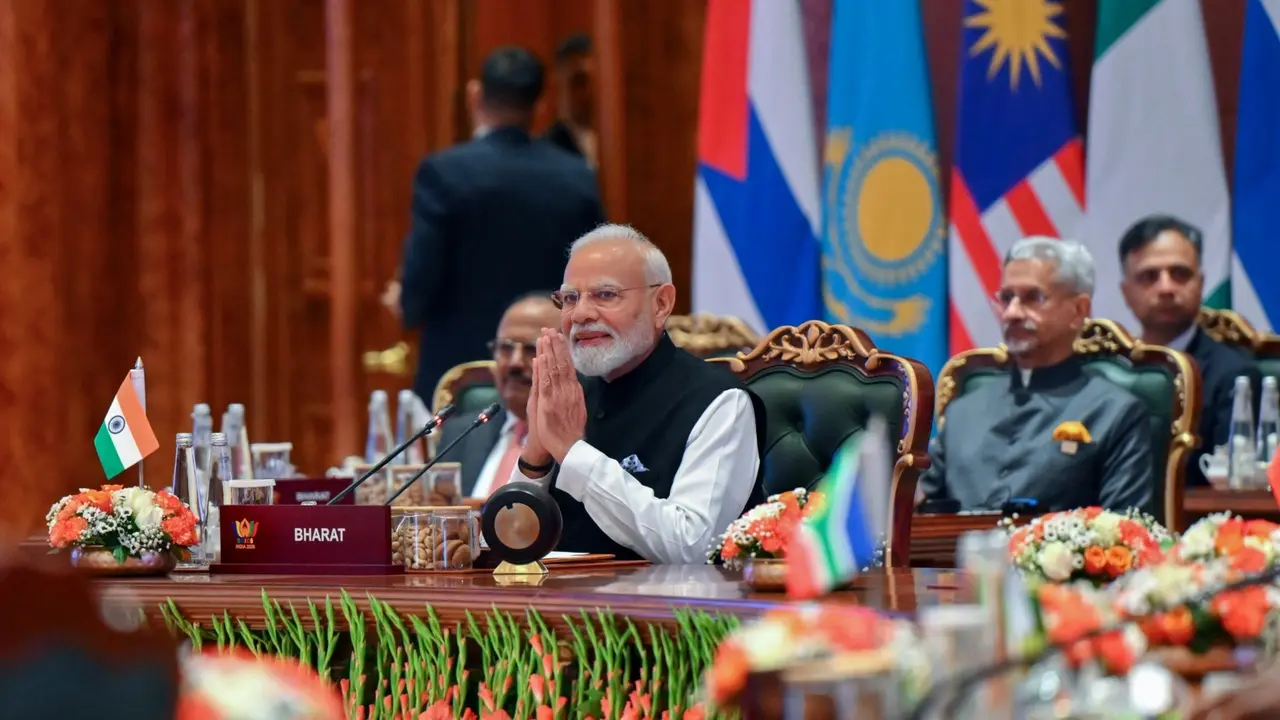
New Delhi: In a major diplomatic achievement, India has successfully steered all 11 members of the BRICS grouping to a consensus on a Joint Declaration at the 18th BRICS Summit, overcoming sharp divisions among member nations to ensure the bloc could once again speak in one voice. The agreement, now being called the New Delhi Declaration, was reportedly finalised after negotiators worked through the night -- from Friday evening until nearly 4 am on Saturday -- just hours before world leaders assembled at Bharat Mandapam for the summit's opening session.
The breakthrough is being widely viewed in diplomatic circles as a major win for India's chairship of BRICS in 2026, themed "Building for Resilience, Innovation, Cooperation and Sustainability."
What the Joint Declaration Means for the World
The consensus carries outsized significance because it was reached within an increasingly complex and expanded bloc. Since last year, BRICS has grown from its founding five members -- Brazil, Russia, India, China and South Africa -- to an 11-nation grouping that also includes Egypt, Ethiopia, Indonesia, Iran, Saudi Arabia and the United Arab Emirates. Together, these nations now account for more than 40 percent of the world's population and nearly a quarter of the global economy, giving the bloc unprecedented heft -- but also making unanimous agreement on contentious geopolitical questions far more difficult.
That difficulty was on full display in the run-up to this summit. A meeting of BRICS deputy foreign ministers on West Asia in April this year failed to produce a joint statement, and a foreign ministers' meeting in New Delhi in May had to settle for a mere Chair's Statement instead of a full communique -- the first such failure in the bloc's history. Against this backdrop, the New Delhi Declaration represents a genuine turnaround.
Advertisement
At the heart of the difficulty this time was the deep rift between Iran on one side and Saudi Arabia and the UAE on the other, amid the ongoing regional conflict in West Asia. The UAE had suspended trade and financial dealings with Iran in August after Iranian missile strikes, making it evident how far apart the two sides had drifted even while sharing a table within BRICS.
To bridge this divide, the declaration reportedly steers clear of naming any single country while condemning unilateral aggression and unprovoked war, instead anchoring its language in broader principles -- sovereignty, the UN Charter, and the primacy of dialogue and diplomacy in resolving conflicts. This carefully calibrated formulation allowed both Tehran and Abu Dhabi, along with the rest of the bloc, to sign off on common text.
Advertisement
For the world, the declaration's broader implications are twofold. First, it shows that a rapidly expanding, ideologically diverse BRICS can still function as a coherent voice for the Global South on matters of multilateral reform, trade and development, rather than fracturing under the weight of its own growth. Second, by avoiding country-specific condemnation while still asserting principles against unilateral aggression, the bloc signals its preference for a rules-based, dialogue-driven approach to resolving conflicts, positioning itself as a platform for consensus-building rather than confrontation among competing global power blocs.
How India Engineered the Consensus
According to reports, it was India's sustained, round-the-clock diplomatic push that ultimately held the bloc together. Indian negotiators led intensive consultations through the night, reconciling starkly divergent positions, most critically between Iran and the UAE, without letting the impasse derail the declaration altogether.
Rather than pushing for language that named any party to the West Asia conflict, Indian diplomats reportedly built the text around principles that every member could accept -- sovereignty, adherence to the UN Charter, and a shared rejection of unilateral aggression, paired with an emphasis on diplomacy over confrontation. This approach, seeking the broadest possible common ground rather than the most specific language, has been central to India's diplomatic playbook as BRICS chair through 2026, and it proved decisive in a summit that many feared might collapse into discord, as had nearly happened at the foreign ministers' level in April and May.
The outcome is being read in New Delhi as a vindication of India's approach to managing an increasingly fractious and expanded membership -- one that includes countries currently locked in direct hostilities with each other.
Key Takeaways and Tangible Outcomes
- Consensus restored after back-to-back failures: The declaration reverses a string of setbacks, including the failed April meeting on West Asia and the unprecedented failure to issue a joint communique in May, restoring BRICS's credibility as a bloc capable of unified positions.
- Balanced language on West Asia: The declaration avoids naming any country while condemning unilateral aggression, a diplomatic middle path that satisfied both Iran and the Gulf states without compromising the substance of the bloc's position on sovereignty and dialogue.
- Reaffirmation of multilateral reform priorities: In keeping with previous BRICS declarations, the New Delhi outcome document is expected to continue pushing for reform of institutions such as the IMF, World Bank and UN Sanctions Committee, alongside deliverables tied to India's chairship themes of resilience, innovation, cooperation and sustainability.
- Institutional continuity: The declaration builds on the bloc's established cooperation architecture, including the New Development Bank and the Contingent Reserve Arrangement, while advancing India's chairship agenda across economic, technological and people-to-people tracks.
- Symbolic diplomatic signals: The UAE's decision to send its crown prince rather than a minister to New Delhi was widely read as a marker of how cautiously Gulf states are navigating a bloc that now also seats Iran, emphasising just how delicate India's balancing act was.
A Second Landmark Consensus for India, After the G20 in 2023
The New Delhi Declaration adds to a growing list of diplomatic milestones for India on the global stage. It comes almost exactly three years after India's most celebrated feat of consensus-building -- the 100 percent agreement among G20 members on the New Delhi Leaders' Declaration at the G20 Summit in September 2023, achieved despite sharp divisions over the Russia-Ukraine conflict, and which also saw the African Union inducted as a permanent G20 member during India's presidency.
Pulling off a similar feat within BRICS, a bloc that, unlike the G20, includes countries in active, ongoing conflict with one another, arguably presented an even steeper diplomatic challenge. Successfully bridging the Iran-Saudi-UAE divide, so soon after the G20 triumph, demonstrates India's ability to convene sharply divided nations around common ground, without diluting the substance of the outcome.
Taken together, these back-to-back consensus-building successes are likely to further cement India's positioning as a credible bridge-builder between the Global South and major global institutions -- a country capable of hosting and steering complex multilateral platforms toward unified outcomes even amid deep geopolitical fault lines. For India, this reinforces its aspiration to be seen not just as a participant in global governance forums, but as an indispensable convenor capable of holding together coalitions that other platforms have struggled to sustain.
Get Current Updates on India News, Entertainment News, Cricket News along with Latest News and Web Stories from India and around the world.