
BRICS Summit: New Delhi Declaration Adopted Unanimously As PM Modi Pushes For New Global Order
PM Modi announces unanimous adoption of the New Delhi Declaration 2026 at the BRICS Summit as India builds consensus on global governance, trade and diplomacy.
- India News
- 4 min read

;'%3e%3cpath%20d='m8,15.99c4.41,0,7.99-3.58,7.99-7.99S12.41,0,8,0,0,3.59,0,8s3.58,7.99,7.99,7.99Z'%20style='stroke:%23fff;%20stroke-miterlimit:10;%20stroke-width:.02px;'/%3e%3cpath%20d='m3.08,3.37l3.82,5.11-3.84,4.15h.87l3.37-3.64,2.72,3.64h2.94l-4.04-5.39,3.58-3.87h-.86l-3.1,3.35-2.5-3.35h-2.94Zm1.27.64h1.35l5.97,7.99h-1.35l-5.97-7.99Z'%20style='fill:%23fff;'/%3e%3c/g%3e%3c/svg%3e)


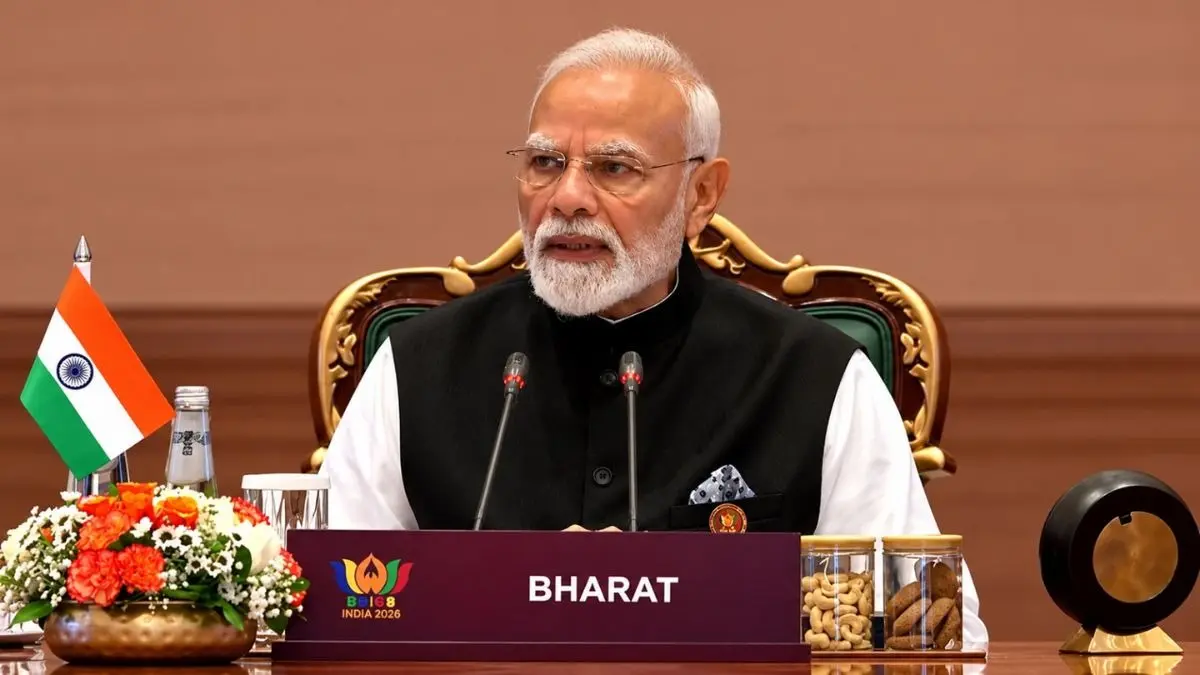
New Delhi: Prime Minister Narendra Modi on Saturday announced the unanimous adoption of the New Delhi Declaration 2026 at the 18th BRICS Summit in New Delhi, marking a key diplomatic outcome for India’s BRICS chairship after negotiations continued into the early hours of the morning.
“No member has raised any objection. The New Delhi Declaration 2026 is adopted unanimously,” PM Modi said at the Summit.
4 AM Negotiations End In Consensus: How India Bridged Differences
The adoption came after intense deliberations among BRICS members that lasted until 4 AM on Saturday, with countries bargaining over various difficult issues before reaching a consensus position.
According to Reuters, the declaration emphasized the significance of averting conflicts, particularly addressing their root causes. BRICS members also reiterated their commitment to resolving international disputes through conversation, consultation, and diplomacy, as well as a multilateral strategy that considers different country perspectives on significant global issues.
Advertisement
The statement also voiced severe worry about the increased use of unilateral tariff and non-tariff measures, claiming that they distort trade and violate World Trade Organization norms.
The consensus is especially important because the BRICS grouping includes Iran, Saudi Arabia, and the UAE, all of whom hold opposing views on a variety of regional and geopolitical issues. With hostilities and tensions raging in West Asia, bringing such countries together on a similar platform proved impossible diplomatically.
Advertisement
India engaged in extensive negotiations with member countries to narrow divisions and prevent issues from derailing the final declaration. The resulting accord was regarded as a significant diplomatic outcome of India's chairship.
From ‘Pyramid Of Privilege’ To ‘Platform Of Partnership’: Modi’s Reform Push
The declaration came as India hosted the 18th BRICS Summit in New Delhi on September 12-13 under the theme “Building for Resilience, Innovation, Cooperation and Sustainability”, with development, sustainability and innovation among the key areas of focus.
Earlier at the Summit session on Inclusive Global Governance and Strengthening, PM Modi called for BRICS countries to jointly prepare 10 proposals for global governance reform, with the aim of developing them into a BRICS Reform Roadmap by the next Summit.
“The Global South is today in the front row when it comes to facing global crises, but in the back row when it comes to decision-making. We must transform this ‘pyramid of privilege’ into a ‘platform of partnership,’ where every country has a voice, every member has a stake, and human development remains at the heart of every effort,” PM Modi said.
“With this objective, I propose that we jointly prepare ten proposals for global governance reform, which we can seek to develop into a BRICS Reform Roadmap by the next Summit,” he said.
Modi said the roadmap should be built around three broad priorities: Representation, Responsiveness and Rule-making.
On representation, he said reform of the United Nations Security Council could no longer be postponed and called for text-based negotiations to be tied to a fixed timeline and clearly defined outcomes.
He also argued that voting rights, leadership roles and policy priorities in international financial institutions should better reflect the economic realities of today.
“Countries that drive global economic growth should also have an appropriate role in shaping global economic governance,” PM Modi said.
What Are PM Modi’s 10 Proposals Trying To Change?
The Prime Minister’s second focus was responsiveness, particularly the speed, scale and last-mile impact of international responses to global challenges. Highlighting the role of seafarers in keeping global trade moving, Modi proposed exploring a Seafarers Emergency Support Network. The proposed mechanism could link maritime authorities and diplomatic missions of relevant countries to help with distress alerts, medical assistance, communication with families and evacuation support.
The third pillar was rule-making. Modi stressed that countries of the Global South should have a greater role in framing the rules governing emerging technologies and future areas of global competition.
“AI, cyberspace, outer space, biotechnology, and critical technologies are not only creating future opportunities but are also shaping the rules of the future,” he said.
“We must make efforts to transform the Global South from a rule-taker into a rule-shaper,” PM Modi said, adding that BRICS could help young diplomats and policymakers from Global South countries develop negotiation skills, practical training and legal expertise.
Modi also pointed out that September 12 is the United Nations Day for South-South Cooperation, arguing that advancing such an initiative on a day dedicated to the Global South would have special significance.
“India is ready to take the lead on this issue,” he said. The BRICS grouping has increasingly become a platform for major emerging economies to coordinate on issues ranging from development and finance to technology, trade and people-to-people exchanges, while pushing for greater representation of the Global South in international institutions.
The grouping currently has 11 members- Brazil, China, Egypt, Ethiopia, India, Indonesia, Iran, Russia, Saudi Arabia, South Africa and the UAE.
Get Current Updates on India News, Entertainment News, Cricket News along with Latest News and Web Stories from India and around the world.