
'British Baked The Cake Of Pakistan, Not Jinnah': Ideas Flow At Sr Adv Rakesh Dwivedi's Book Launch
Senior Supreme Court Advocate Rakesh Dwivedi's new book reveals that Pakistan's creation was a deliberate British strategy, not Jinnah's doing, citing transfer of power documents and electoral realities of 1946.
- India News
- 4 min read

;'%3e%3cpath%20d='m8,15.99c4.41,0,7.99-3.58,7.99-7.99S12.41,0,8,0,0,3.59,0,8s3.58,7.99,7.99,7.99Z'%20style='stroke:%23fff;%20stroke-miterlimit:10;%20stroke-width:.02px;'/%3e%3cpath%20d='m3.08,3.37l3.82,5.11-3.84,4.15h.87l3.37-3.64,2.72,3.64h2.94l-4.04-5.39,3.58-3.87h-.86l-3.1,3.35-2.5-3.35h-2.94Zm1.27.64h1.35l5.97,7.99h-1.35l-5.97-7.99Z'%20style='fill:%23fff;'/%3e%3c/g%3e%3c/svg%3e)


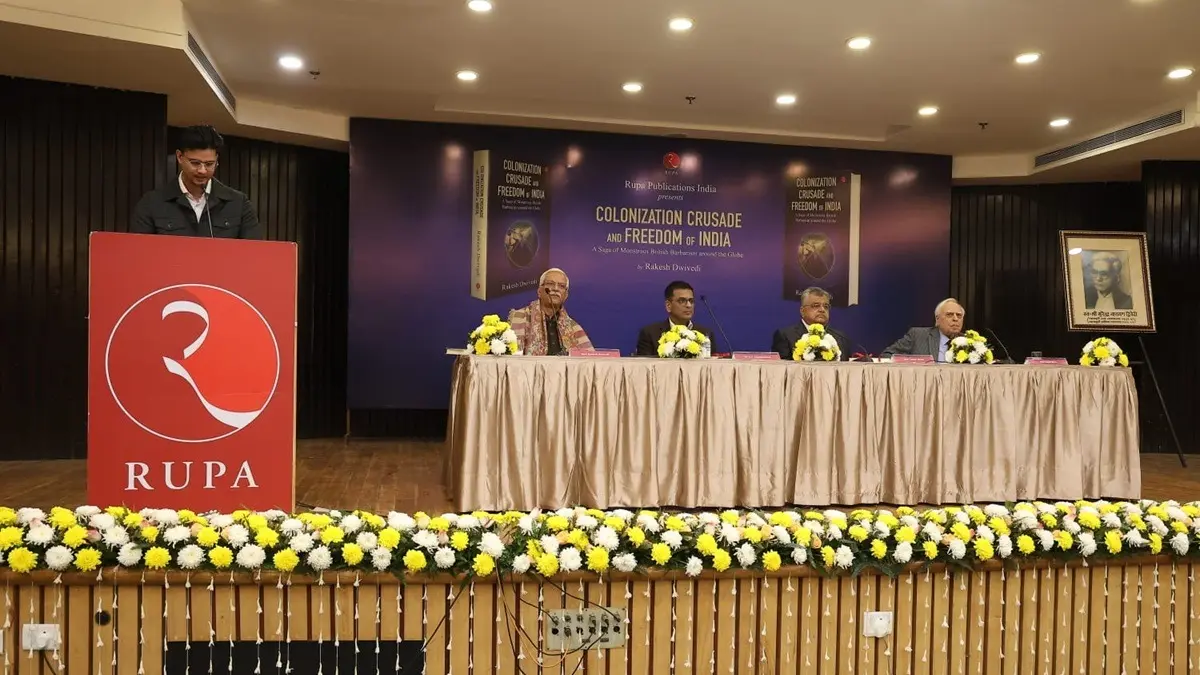
New Delhi: Senior Supreme Court Advocate Rakesh Dwivedi has challenged the conventional narrative surrounding Pakistan's creation, asserting that it was not the brainchild of Mohammed Ali Jinnah, but rather a deliberate geopolitical strategy orchestrated by the British government during the twilight of colonial rule in India. Senior Advocate Dwivedi's submissions are based on his detailed study of transfer of power documents, which led him to conclude that Jinnah lacked the authority and public backing to single-handedly create a new nation, Pakistan.
Speaking at the launch of his book ‘Colonization Crusade and Freedom of India: A Saga of Monstrous British Barbarism around the Globe’, Dwivedi stated, "I found so many documents of what was happening behind the scenes. Politicians say one thing, outside. What is happening inside is quite different. I believe, after reading all this in the transfer of paper documents, that Jinnah is not the Quaid-e-Azam. He did not build Pakistan."
According to Rakesh Dwivedi, the 1946 elections, which saw the Congress governments formed in multiple provinces, proved that Jinnah's Muslim League did not hold decisive authority across the subcontinent. "In the 1946 elections, after the World War was over, everybody was released from Congress, and elections took place. Eight provinces, Congress government. Two provinces in the northwest, Punjab, coalition government, which is non-Muslim. In the northwest Punjab province also it was Congress government. How could Jinnah build Pakistan? There was no question. He had no authority, no power. The people were not behind him. So it is the British who prepared the dough and baked the cake of Pakistan," he remarked.
Drawing parallels between the devastation caused by European colonial expansion and the atrocities committed by 20th-century dictators. "The kind of devastation which happened, the genocide which happened in American soil..... What Hitler did is nothing….At least 100 Hitlers are required to understand what devastation was done by these Europeans on the American soil. But what they did there was repeated with much worse intensity in Africa, and equally in India."
Advertisement
What Prominent Attendees Said:
The book launch event in New Delhi was attended by several prominent figures, including Solicitor General of India, Tushar Mehta, Senior Advocate Kapil Sibal and former Chief Justice of India (CJI) DY Chandrachud.
Solicitor General Mehta described the book as an important contribution to understanding the colonial past, stating, “A good human being, a good historian, but also as a good poet, I thank the Dwivedi family that I'm honoured. By inviting me and being part of this very august and pious gathering. It's really an honour to be a part of this function and I wish the book the best and I wish that it is sold, not in terms of the commercial sale, but it reaches every reader where it must reach and we should ensure that it reaches that way.”
Advertisement
He designated the book as dismantling the “comforting fiction of empire”, outlining how colonial rule was projected as progress, while concealing violence and exploitation. He added that the book presents the partition not as an inevitable communal event, but as the result of calculated imperial decisions taken to serve British geopolitical interests.
Former CJI Chandrachud praised the book for critically examining how colonial powers justified their rule by presenting themselves as forces of order, civilisation, and governance. "Certain formulations encountered repeatedly across very different works remain curiously stable. In 1883, John Seely observed in the expansion of London, two courses of lectures, that India can hardly be said to have been conquered at all by foreigners. She has rather conquered herself," he noted.
Kapil Sibal asserted that the book treats history as a process of understanding deeper causes and methods, rather than a mere list of events. He stressed that India had a rich history and culture, describing the country's immense contribution to global GDP in the 1700s. "India had such a rich history, such a rich culture. Imagine this, that by the 1700s, India's GDP was 25% of global GDP. And I'm talking about, I'm talking about when the Mughals were here. The decline of the Mughals came about only in the 1700s. So that means even under the Mughals, our GDP was 25% of the global GDP. We were the exporters to the world."
Senior Advocate Rakesh Dwivedi's book launch event saw a sense of introspection, with attendees reflecting on the impact of colonialism on India's history and culture.
Get Current Updates on India News, Entertainment News, Cricket News along with Latest News and Web Stories from India and around the world.