
Cabinet Approves Key Railway Expansion and Rs 3,030 Cr Chemicals Scheme
Union Minister Ashwini Vaishnaw announced the approval for the construction of third and fourth railway lines on a vital economic corridor linking Andhra Pradesh and Karnataka. The Cabinet also cleared a new Rs 3,030 crore scheme for the development of India’s chemicals sector.
- India News
- 5 min read

;'%3e%3cpath%20d='m8,15.99c4.41,0,7.99-3.58,7.99-7.99S12.41,0,8,0,0,3.59,0,8s3.58,7.99,7.99,7.99Z'%20style='stroke:%23fff;%20stroke-miterlimit:10;%20stroke-width:.02px;'/%3e%3cpath%20d='m3.08,3.37l3.82,5.11-3.84,4.15h.87l3.37-3.64,2.72,3.64h2.94l-4.04-5.39,3.58-3.87h-.86l-3.1,3.35-2.5-3.35h-2.94Zm1.27.64h1.35l5.97,7.99h-1.35l-5.97-7.99Z'%20style='fill:%23fff;'/%3e%3c/g%3e%3c/svg%3e)


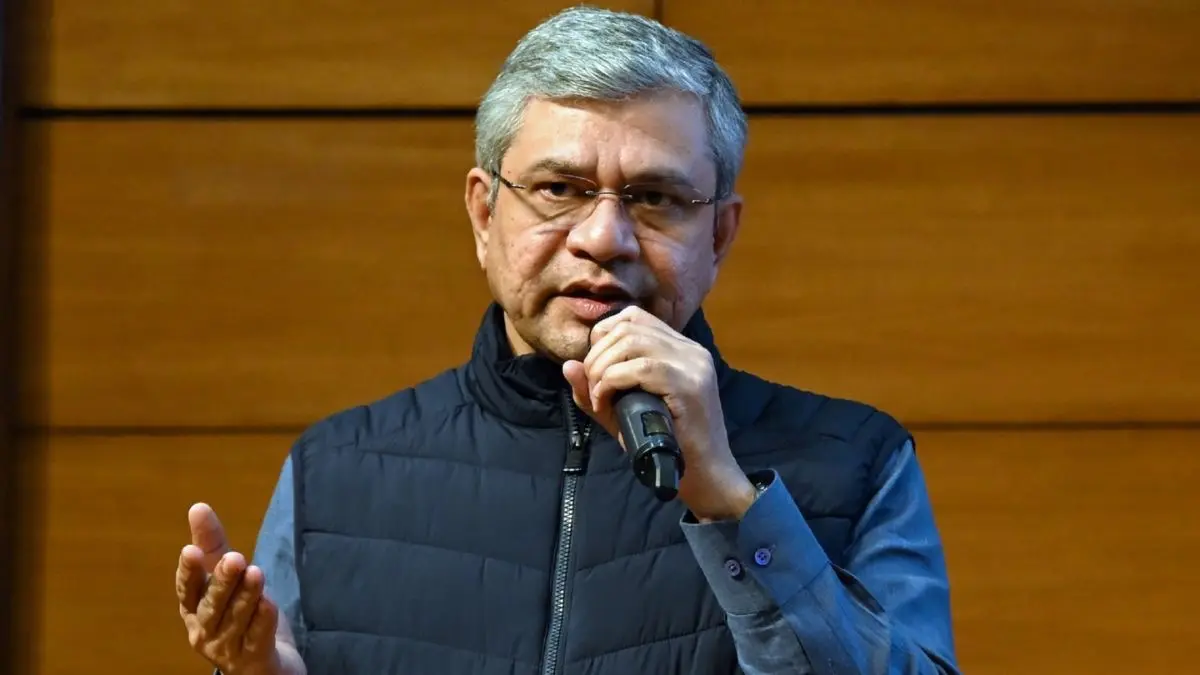
New Delhi: The Union Cabinet, chaired by Prime Minister Narendra Modi, on Friday approved two significant initiatives aimed at boosting infrastructure and industrial growth in the country.
Union Minister Ashwini Vaishnaw, briefing the media after the meeting, announced the approval for the construction of third and fourth railway lines on a vital economic corridor linking Andhra Pradesh and Karnataka. The Cabinet also cleared a new Rs 3,030 crore scheme for the development of India’s chemicals sector.
Railway Project to Strengthen Economic Corridor
Vaishnaw highlighted the strategic importance of the railway project, which covers a high-economic-activity route passing through Guntakal (Andhra Pradesh), Ballari, Hosapete, Hubballi, and extending to Ankola in Karnataka.
The Cabinet specifically approved the doubling of lines (third and fourth tracks) between Guntakal and Ballari, spanning 46 kilometres at an estimated cost of Rs 1,264 crore. The project includes the construction of a major bridge over the Vedavathi River, seven additional major bridges, and 52 minor bridges. It is expected to be completed within three years.
Advertisement
This decision builds on a previous approval for similar lines between Ballari and Hosapete. The Detailed Project Report (DPR) for the Hosapete–Hubballi section is already under preparation. Once completed, along with the new Hubballi–Ankola line, these projects will establish a fully developed economic corridor across North Karnataka, significantly enhancing rail connectivity between the two states.
“The project approved today is a major one,” Vaishnaw said, underscoring its role in supporting regional economic activity.
Advertisement
Union Minister Ashwini Vaishnaw further said, "As you know, transporting cargo by rail results in 89 per cent lower CO₂ emissions compared with highway or road transport. In other words, it is 89 per cent less polluting than road transportation. Secondly, rail transport is significantly more cost-effective than road transport. It is cheaper and also less polluting. That is why many countries around the world have prioritised railways. Since Prime Minister Narendra Modi assumed office in 2014, he has been consistently working to overhaul and transform the entire railway sector."
"As you know, the Indian Railways network is now 99.6 per cent electrified, making it the world's largest electrified railway network. In percentage terms, India ranks second globally after Switzerland. Switzerland has achieved 100 per cent electrification, while India has reached 99.6 per cent," he added.
Fresh Push for Chemicals Sector
In the second major decision, the Cabinet approved a new Rs 3,030 crore scheme for the chemicals industry. Describing chemicals as a foundational sector for the economy -- comparable to semiconductors -- the Minister emphasised the need for a completely fresh approach to its development.
Vaishnaw noted that the scheme aims to transform the sector through modern strategies tailored to current and future economic requirements.
These decisions reflect the government’s continued focus on infrastructure-led growth and strengthening key industrial pillars to support India’s long-term economic ambitions.
Strong Performance of Hydrogen-powered Train
India's maiden hydrogen-powered train has achieved a significant early milestone, completing 1,000 kilometres of trouble-free operation since its inauguration by Prime Minister Narendra Modi on July 17.
Union Minister for Railways, Ashwini Vaishnaw, shared the update during a Cabinet briefing, highlighting the project's strong performance in its initial commercial phase.
"The hydrogen train has performed very well," Vaishnaw said.
"As of this morning, it has successfully completed 1,000 kilometres of flawless operation without any issues," he said.
The minister emphasised that authorities are maintaining rigorous oversight during the critical early stage of operations.
"We are closely monitoring every aspect of its performance and continuously tracking around 130 parameters to assess its behaviour and overall performance," he added.
Beyond operational reliability, the project is poised to deliver substantial economic and environmental benefits. According to Vaishnaw, the new railway line is expected to facilitate the transportation of an additional 16 million tonnes of cargo. This shift is projected to significantly lower carbon emissions, an impact equivalent to the carbon sequestration achieved by planting 27 lakh trees.
The initiative is also anticipated to generate 31 lakh human-days of employment while contributing to cost efficiencies in the sector. It is expected to reduce the country's logistics costs by Rs 149 crore.
The hydrogen train represents a key step in India's push toward greener transportation solutions, aligning with broader goals of sustainable development and reduced dependence on conventional fuels. Officials continue to gather data from the ongoing operations to inform potential expansions and improvements in the technology. This development comes as part of larger efforts to modernise India's railway network with indigenous, environment-friendly innovations.
The minister did not say anything on the anti-paper leak law that has been assured by the Centre amid the ongoing jantar mantar protests.
"No paper leak is happening today," he said when asked whether the Union Cabinet had approved a draft Bill providing for stricter punishments in paper leak cases.
Get Current Updates on India News, Entertainment News, Cricket News along with Latest News and Web Stories from India and around the world.