
Constitution Amendment Bill For Women Reservation Fails 2/3rd Majority Test In Lok Sabha
The bill failed to secure the mandatory two-thirds majority required for a constitutional amendment. Out of 489 members present and voting, 278 voted in favour (ayes) while 211 opposed it (noes), with zero abstentions. This fell well short of the roughly 326 votes needed.
- India News
- 4 min read

;'%3e%3cpath%20d='m8,15.99c4.41,0,7.99-3.58,7.99-7.99S12.41,0,8,0,0,3.59,0,8s3.58,7.99,7.99,7.99Z'%20style='stroke:%23fff;%20stroke-miterlimit:10;%20stroke-width:.02px;'/%3e%3cpath%20d='m3.08,3.37l3.82,5.11-3.84,4.15h.87l3.37-3.64,2.72,3.64h2.94l-4.04-5.39,3.58-3.87h-.86l-3.1,3.35-2.5-3.35h-2.94Zm1.27.64h1.35l5.97,7.99h-1.35l-5.97-7.99Z'%20style='fill:%23fff;'/%3e%3c/g%3e%3c/svg%3e)


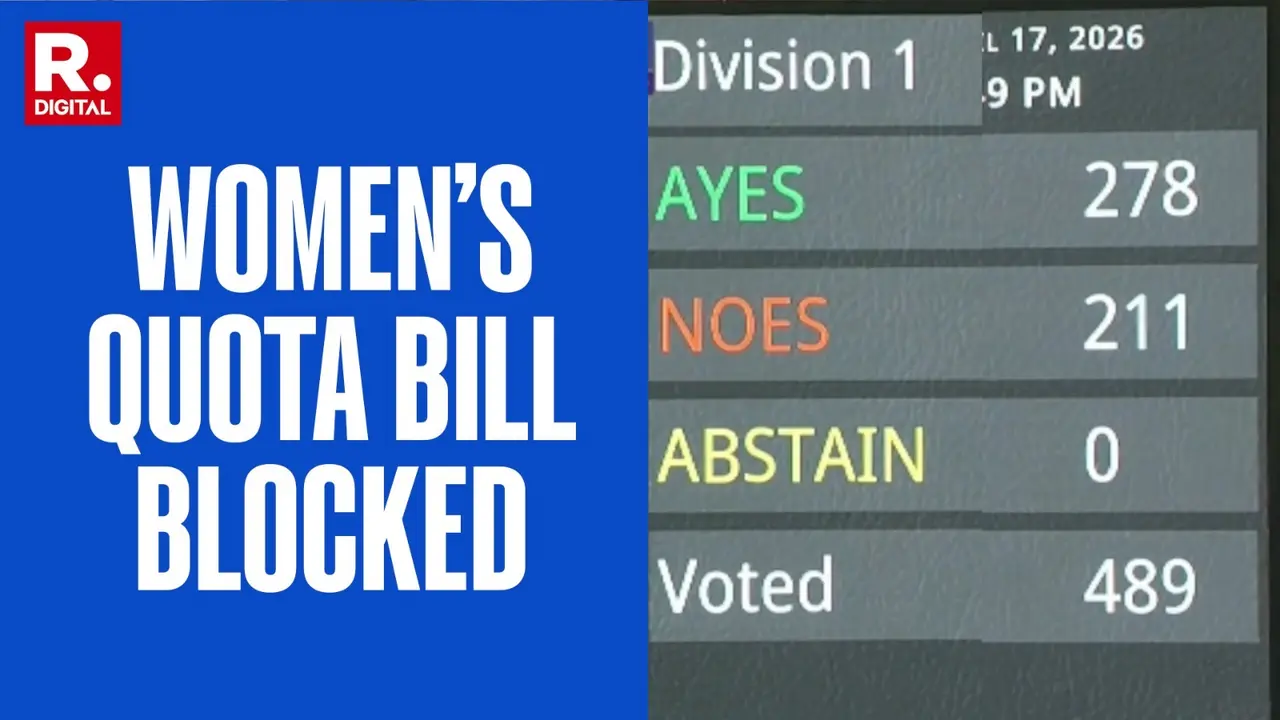
New Delhi: In a major setback for the government, the Lok Sabha on Friday rejected the Constitution (One Hundred and Thirty-First Amendment) Bill, 2026, along with the accompanying Delimitation Bill, 2026, during a high-stakes vote in the ongoing special three-day Parliament session. The proposed legislation aimed to amend the 2023 Women's Reservation Act (Nari Shakti Vandan Adhiniyam) by delinking its implementation from a future census and enabling immediate delimitation to reserve 33% seats for women in the Lok Sabha and state assemblies, potentially ahead of the 2029 general elections.
The bill failed to secure the mandatory two-thirds majority required for a constitutional amendment. Out of 489 members present and voting, 278 voted in favour (ayes) while 211 opposed it (noes), with zero abstentions. This fell well short of the roughly 326 votes needed. The outcome came after a marathon debate spanning Thursday and Friday, during which the House witnessed sharp exchanges over women's empowerment, federalism, and the politics of delimitation.
Heated Debate: Empowerment vs Electoral Map Redrawing
The special session (April 16-18) was convened specifically to debate and pass the three-bill package, which included amendments to the Women's Reservation Act, a fresh Delimitation Bill, and related Union Territory provisions. The government argued that the move would fast-track 33% women's reservation, originally passed unanimously in 2023 but stalled due to its linkage to the next census and delimitation, while expanding the Lok Sabha's strength (proposals ranged from increasing seats by 50% to around 816 or even 850 total) to avoid reducing any state's representation. Union Home Minister Amit Shah assured the House that southern states' seat share would remain protected (rising from 129 to 195 seats in five states, maintaining their percentage). He accused the opposition of opposing the bill "with ifs and buts," slammed "appeasement politics," and highlighted that 56 of the 123 speakers in the debate were women--a record. Shah also defended the absence of religion-based quotas, stating no such provision exists in the Constitution.
Prime Minister Narendra Modi, addressing the Lok Sabha, called it a "defining moment" in parliamentary history and urged parties not to politicise the issue. "Trust the sisters of the country and their intelligence. Let 33% of them come here and then decide which sections within them will get it," he said, adding that he did not seek credit and was ready to give it to everyone if the bill passed. Modi emphasised that no state, north or south, would be discriminated against in delimitation and backed implementation by 2029.
Advertisement
Opposition leaders, however, fiercely contested the linkage to delimitation, calling it a "backdoor" attempt to redraw the electoral map ahead of elections in states like Tamil Nadu and West Bengal. Leader of Opposition Rahul Gandhi injected humour by noting, "PM Modi and I don't have 'wife issue'," while crediting women in public life, but sharply criticised the bill as "not a women's bill" but an "anti-national act" to alter the country's electoral landscape "hiding behind India's women." He vowed the entire opposition would defeat it.
Congress MP Gaurav Gogoi and others, including Karti Chidambaram, demanded immediate rollout on the existing 543 seats without expansion or delimitation, warning that a larger House would dilute debate quality and unfairly penalise southern states based on population. Samajwadi Party's Dimple Yadav pushed for sub-quotas for OBC and Muslim women. AIMIM leaders and DMK allies echoed concerns over federal imbalance and the timing, viewing it as politically motivated.
Advertisement
BJP MP Kangana Ranaut backed the government, hailing it as a step towards women-led development, while other opposition voices like Shashi Tharoor called for decoupling the issues to pass the core reservation without delay.
Background & What Lies Ahead
The 2023 Act, which reserves one-third seats for women (including sub-quotas for SC/ST), technically came into force on April 16, 2026, via notification. However, without delimitation based on fresh population data, it remains unimplemented--effectively keeping women's representation at the current -15% level in the Lok Sabha. The government's 2026 package sought to accelerate this but required cross-party support for the constitutional change.
With the bill defeated, the original 2023 law stays on the books but tied to the next census and delimitation exercise. Analysts note this could delay meaningful change beyond 2029, even as both sides claim commitment to women's empowerment. The Rajya Sabha is yet to take up the matter, but the Lok Sabha rejection effectively stalls it for now.
The session saw record participation from women MPs and underscored deep divides: one side framing it as historic empowerment, the other as a veiled power shift. As Parliament's special sitting concludes on Saturday, the focus shifts to whether further negotiations or a fresh approach can break the impasse on one of India's longest-pending gender reforms.
Get Current Updates on India News, Entertainment News, Cricket News along with Latest News and Web Stories from India and around the world.