
Delhi Biker Death: How Municipal Lapses Led To Safety Failures At Janakpuri Dig Site in Delhi
Kamal Dhyani's death in Janakpuri highlights serious municipal compliance issues, revealing a gap between safety regulations and their implementation for excavation work.
- India News
- 3 min read

;'%3e%3cpath%20d='m8,15.99c4.41,0,7.99-3.58,7.99-7.99S12.41,0,8,0,0,3.59,0,8s3.58,7.99,7.99,7.99Z'%20style='stroke:%23fff;%20stroke-miterlimit:10;%20stroke-width:.02px;'/%3e%3cpath%20d='m3.08,3.37l3.82,5.11-3.84,4.15h.87l3.37-3.64,2.72,3.64h2.94l-4.04-5.39,3.58-3.87h-.86l-3.1,3.35-2.5-3.35h-2.94Zm1.27.64h1.35l5.97,7.99h-1.35l-5.97-7.99Z'%20style='fill:%23fff;'/%3e%3c/g%3e%3c/svg%3e)


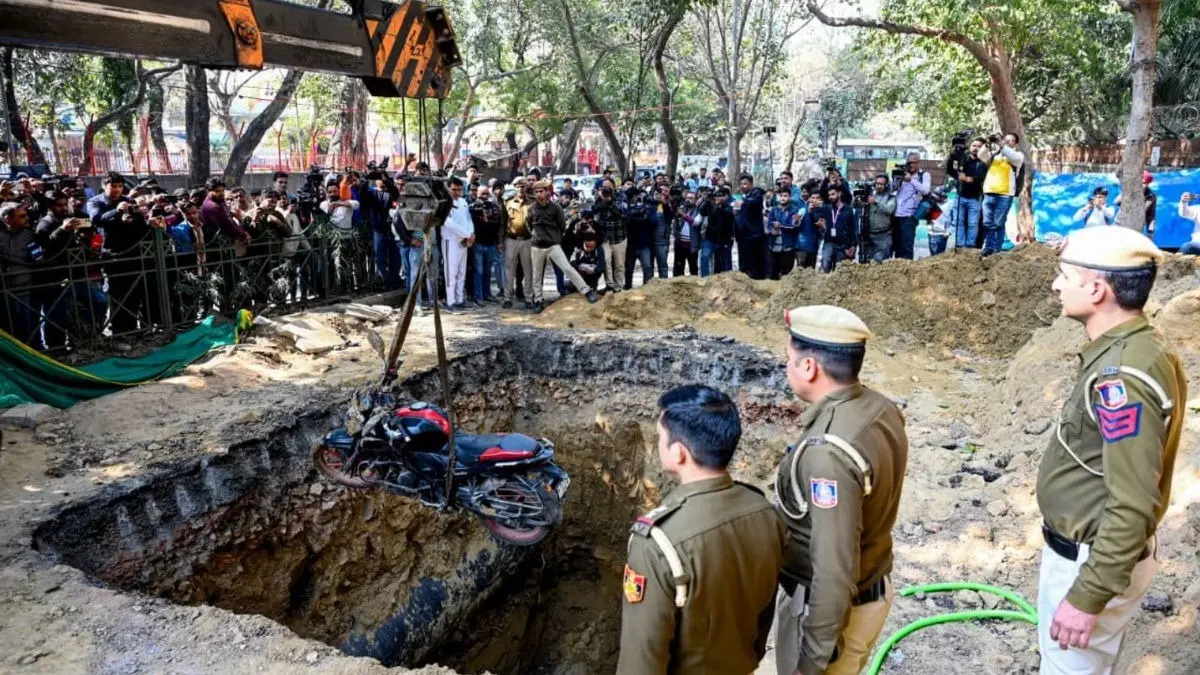
New Delhi: The death of Kamal Dhyani in Delhi’s Janakpuri has once again brought municipal compliance under scrutiny, highlighting gaps between prescribed safety norms for excavation work and their on-ground implementation. While multiple government agencies operate under a detailed framework for road digging and repair work, several mandated safety measures were found missing at the site where the incident occurred.
Following a recent fatal accident involving a biker in the national capital, Delhi Chief Minister Rekha Gupta issued an eight-point safety framework, directing all civic and infrastructure departments to strictly adhere to standard operating procedures during excavation and repair works. These guidelines apply to agencies including the Municipal Corporation of Delhi (MCD), Public Works Department (PWD), Delhi Jal Board (DJB), discoms, DSIIDC, DDA, and the Irrigation and Flood Control Department (I&FC), lays down non-negotiable safeguards aimed at preventing accidents at road-digging sites.
While the framework outlines what must be ensured before and during excavation work, in the Janakpuri case involving Kamal Dhyani, several of these mandatory measures were not observed at the site.
Prescribed Measures That Were Not Followed
Proper warning signage: Guidelines mandate clear and adequate warning boards to alert motorists and pedestrians well in advance of an excavation site. At the Janakpuri location, no prominent warning signage was visible to caution road users approaching the dug-up stretch.
Advertisement
Reflector lights, blinkers or luminous tapes: Excavation zones are required to be clearly visible during low-light and night-time conditions using reflector lights or luminous tapes. Reports indicate that the site lacked sufficient reflective markers, reducing visibility on the road.
Strong and continuous barricading: The safety framework requires sturdy, uninterrupted barricades around excavation pits to prevent accidental entry. In this case, barricading was either inadequate or discontinuous, leaving the site exposed.
Advertisement
Safe handling of excavated material: Rules specify that excavated debris must not be left in a manner that obstructs traffic or creates hazards. At the Janakpuri site, loose material around the excavation reportedly posed an additional risk to commuters.
Visibility and dust control at the site: Authorities are required to ensure that digging work does not compromise visibility or cause excessive dust pollution. The site did not have visible measures to address these concerns.
Safe pedestrian pathways and traffic diversions: The framework mandates proper pedestrian movement arrangements and traffic diversions wherever necessary. No clearly demarcated pedestrian path or diversion plan was evident at the location.
Clear fixation of responsibility: Guidelines stress that responsibility for safety compliance must be clearly assigned to designated officers. However, accountability at the site remains unclear following the incident.
Regular inspections: Departments are required to conduct routine inspections of excavation sites to ensure compliance. The lapses observed suggest inadequate monitoring prior to the accident.
As per the framework, all departments were also instructed to submit details of excavation and digging sites under their jurisdiction within three days. The directions reiterated that accountability for safety compliance must be clearly fixed and that lapses would invite strict action against responsible officials.
Despite existing manuals and departmental guidelines issued by agencies such as the PWD and MCD, enforcement has remained inconsistent. Officials have repeatedly stressed that the rules are clear, but implementation often varies across sites.
As investigations continue into the circumstances surrounding Kamal Dhyani’s death, the Janakpuri case underscores how failure to implement established safety norms on the ground continues to pose risks to public safety.
Get Current Updates on India News, Entertainment News, Cricket News along with Latest News and Web Stories from India and around the world.