
Delhi HC Rejects Umar Khalid, Sharjeel Imam Bail Pleas In 2020 Riots Case; Cites SC Order
Delhi HC rejects Umar Khalid and Sharjeel Imam’s bail pleas in the 2020 Delhi riots case, citing Supreme Court directions and judicial discipline.
- India News
- 4 min read

;'%3e%3cpath%20d='m8,15.99c4.41,0,7.99-3.58,7.99-7.99S12.41,0,8,0,0,3.59,0,8s3.58,7.99,7.99,7.99Z'%20style='stroke:%23fff;%20stroke-miterlimit:10;%20stroke-width:.02px;'/%3e%3cpath%20d='m3.08,3.37l3.82,5.11-3.84,4.15h.87l3.37-3.64,2.72,3.64h2.94l-4.04-5.39,3.58-3.87h-.86l-3.1,3.35-2.5-3.35h-2.94Zm1.27.64h1.35l5.97,7.99h-1.35l-5.97-7.99Z'%20style='fill:%23fff;'/%3e%3c/g%3e%3c/svg%3e)


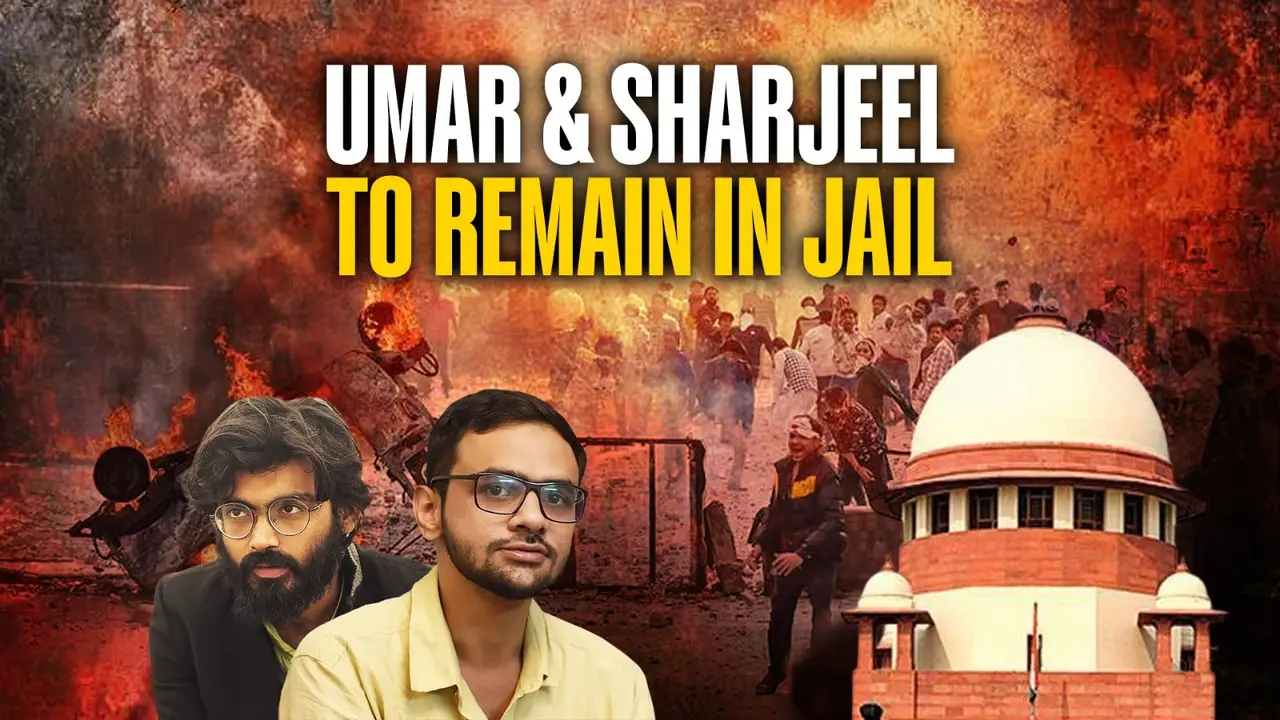
New Delhi: The Delhi High Court on Wednesday rejected the bail pleas of former JNU scholar Umar Khalid and Sharjeel Imam in the case concerning the alleged larger conspiracy behind the February 2020 North-East Delhi riots. The case is being investigated under the Unlawful Activities (Prevention) Act (UAPA) and other penal provisions.
A division bench of Justice Prathiba M Singh and Justice Dinesh Bhatt said it was bound by the Supreme Court's earlier directions concerning the two accused and could not alter the conditions laid down by the apex court. The pleas challenged the trial court's July 4 decision refusing them bail.
Why Did The High Court Reject Their Fresh Bail Pleas?
In his representation of Umar Khalid, Senior Advocate Trideep Pais cited three modifications to the prior proceedings. He maintained that prosecution witnesses had not yet been questioned since charges had not yet been formulated.
Additionally, Pais stated that an SLP was pending at the Supreme Court and cited a Supreme Court ruling. The trial court had stated that it would await the ruling of the Supreme Court.
Advertisement
However, in the Gulfisha Fatima case, the High Court ruled on January 5, 2026, that it could not change the terms set by the Supreme Court.
“This court is bound by judicial discipline,” the bench said. The court also observed that the Supreme Court had treated Khalid and Imam differently from some of the other accused and had imposed specific conditions governing when they could renew their bail pleas.
Advertisement
Court Rejects Parity Argument With Other Accused
Additionally, as a change in circumstances, Khalid and Imam had relied on the bail granted to co-accused Tasleem Ahmed and Khalid Saifi. The High Court dismissed the claim, stating that Saifi and Ahmed's duties differed from Khalid and Imam's. Because the other defendants had been granted interim bail by the Supreme Court, the court ruled that the two could not claim parity with them.
The court also pointed out that the Supreme Court had previously referred to Khalid and Imam as the purported ideological forces behind the conspiracy and identified them as holding a distinct perspective from the other co-accused.
The bench said that, given the specific conditions imposed by the Supreme Court, it could not find fault with the trial court's decision. It consequently dismissed both appeals.
What The Supreme Court Had Said Earlier
The Supreme Court denied Khalid and Imam bail on January 5, but granted it to Gulfisha Fatima, Meeran Haider, Shifa Ur Rehman, Mohammad Saleem Khan, and Shadab Ahmad.
The Supreme Court had stated that Khalid and Imam might reapply their request for release once the examination of protected witnesses was concluded or after one year from the date of the order, whichever came first.
The Delhi Police has opposed their most recent applications, claiming that they violated the orders. The police also stated that Khalid and Imam could not seek parity with the other accused, referring to them as the "masterminds" of the riots.
On July 4, the two faced a bail denial from the trial court. Imam was taken into custody on August 25, 2020, and Khalid on September 13, 2020. In January 2026, the Supreme Court affirmed the Delhi High Court's September 2025 denial of them bail.
Trial Delay And UAPA Bail Question
The case also brought up broader legal concerns about the extended detention of undertrials facing UAPA accusations while their trials are pending. On May 22, the Supreme Court granted co-accused Abdul Khalid Saifi and Tasleem Ahmad six months' interim bail, deferring to a larger court the issue of protracted incarceration in UAPA cases and the strict bail conditions.
The question stems from the Supreme Court's earlier decision in Union of India v. K.A. Najeeb, which recognized extended trial delays as a consideration to consider while determining bail under the UAPA.
A subsequent Supreme Court bench later expressed concerns regarding the interpretation of the January 5 decision in the Gulfisha Fatima case and its relevance to the K.A. Najeeb precedent. A division bench observed a possible disagreement between the judgments in May, therefore the case was referred to a larger bench.
FIR 59 of 2020, registered by the Delhi Police Special Cell, addresses the suspected bigger conspiracy linked to the February 2020 North-East Delhi riots. The case involves provisions of laws from the Indian Penal Code, 1860, and the Uniform Administrative Procedure Act, 1967. Charges have not yet been filed, and the prosecution witnesses have not to be examined.
The accused in the case include Tahir Hussain, Umar Khalid, Khalid Saifi, Isharat Jahan, Meeran Haider, Gulfisha Fatima, Shifa-Ur-Rehman, Asif Iqbal Tanha, Shadab Ahmed, Tasleem Ahmed, Saleem Malik, Mohd. Saleem Khan, Athar Khan, Safoora Zargar, Sharjeel Imam, Faizan Khan and Natasha Narwal.
Get Current Updates on India News, Entertainment News, Cricket News along with Latest News and Web Stories from India and around the world.