
Delhi Riots Case 2020: What Supreme Court Said While Denying Bail To Sharjeel Imam and Umar Khalid
The Supreme Court rejected bail pleas of Delhi riots accused Umar Khalid and Sharjeel Imam today. Read below to know what the top court said during the hearing.
- India News
- 4 min read

;'%3e%3cpath%20d='m8,15.99c4.41,0,7.99-3.58,7.99-7.99S12.41,0,8,0,0,3.59,0,8s3.58,7.99,7.99,7.99Z'%20style='stroke:%23fff;%20stroke-miterlimit:10;%20stroke-width:.02px;'/%3e%3cpath%20d='m3.08,3.37l3.82,5.11-3.84,4.15h.87l3.37-3.64,2.72,3.64h2.94l-4.04-5.39,3.58-3.87h-.86l-3.1,3.35-2.5-3.35h-2.94Zm1.27.64h1.35l5.97,7.99h-1.35l-5.97-7.99Z'%20style='fill:%23fff;'/%3e%3c/g%3e%3c/svg%3e)


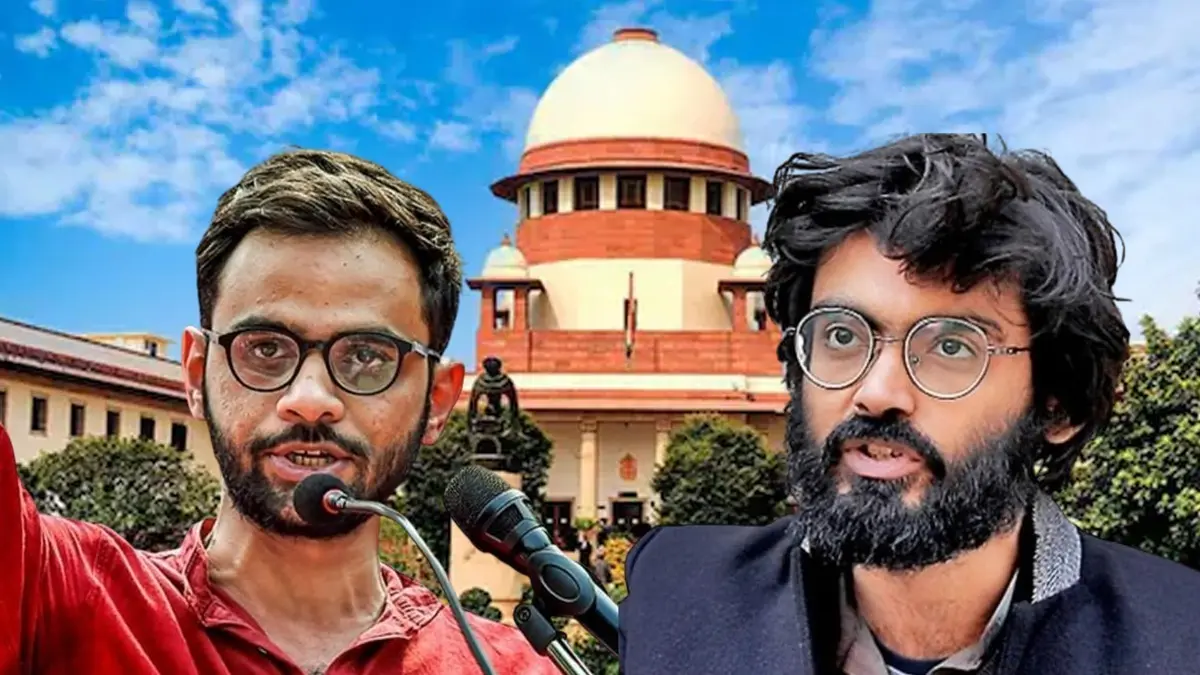
New Delhi: Holding that their role was “central to the conspiracy", the Supreme Court on Monday (January 5, 2026) denied bail to activists Umar Khalid and Sharjeel Imam in the larger conspiracy case linked to the 2020 north-east Delhi riots.
At the same time, the top court granted bail to some of the other accused in the case - Gulfisha Fatima, Meera Haider, Shifa Ur Rehman, Mohd. Saleem Khan and Shadab Ahmed.
The SC bench of Justices Aravind Kumar and NV Anjaria delivered the judgment on the bail pleas.
The accused had challenged a Delhi High Court order refusing them bail in a case under the Unlawful Activities (Prevention) Act (UAPA) linked to the alleged larger conspiracy behind the 2020 2020 north-east Delhi riots.
Advertisement
What Supreme Court said
- The Supreme Court noted that all the accused in the Delhi riots case do not stand on the same footing, as the roles attributed to them are different. Treating all accused identically would risk pretrial detention. Umar Khalid and Sharjeel Imam stand on a qualitatively different footing when compared to the other accused, noted the court.
- The court also noted that their (Khalid and Imam) roles were 'central' to the alleged offences.
- The bench noted that although their incarceration has been long and continuous, it does not violate constitutional guarantees nor override the statutory bar on bail under the applicable law.
- The court observed that the prosecution materials prima facie disclosed "a central and formative role" against Khalid and Imam. In the alleged conspiracy, the material suggests “involvement in the level of planning, mobilisation and strategic direction extending beyond episodic and localised acts.”
- The court further said there are reasonable grounds for believing that the conduct of the accused persons is prima facie a terrorist act as defined under the Act (Unlawful Activities Prevention Act).
- The court avoiding a collective approach said it has independently analysed the role of each accused.
- The court, talking about the appellants who have been granted bail, said twelve bail conditions have been imposed on them and the misuse of which would attract the cancellation of the liberty.
- Justice Kumar, pronouncing the judgment, stated that in prosecutions under the UAPA, delay in trial does not operate as a "trump card" which automatically displaces statutory safeguards.
- At the same time, the court observed that Section 43D(5) of the UAPA does not totally bar judicial scrutiny to assess if there was a "prima facie" case. The judicial enquiry is "accused-specific". Also, at the bail stage, the defence arguments are not to be examined.
- The judgment further held that Section 15 of the UAPA, which deals with the offence of terrorist acts, cannot be interpreted narrowly to include only acts of blatant violence. Apart from death or destruction, the provision encompasses acts that disrupt services and threaten the economy.
- The liberty enshrined in Article 21 of the Constitution is of foundational importance and no constitutional court can be unmindful of the gravity of restraining liberty before guilt is adjudicated.
- At the same time, the Constitution does not concede liberty in isolation, the security of the community, the integrity of the trial process, it was noted.
Meanwhile, while granting bail to 5 other accused, the court in regard to Khalid and Imam said that they can renew their bail applications after the examination of protected witnesses or after one year from today.
Background of the Case
Umar Khalid has been in custody since September 13, 2020, while Imam has been prisoned since January 28, 2020, weeks before the Delhi riots broke out.
Advertisement
The 2020 riots took place in February in parts of Northeast Delhi, following weeks of tension around protests against the Citizenship (Amendment) Act (CAA). The violence, which lasted several days, led to the several deaths, along with large-scale damage to homes, shops, and places of worship.
Investigating the violence, the Delhi police described it as a "conspiracy" linked to protests against the CAA. Several activists, including Sharjeel Imam, a former JNU student, and Umar Khalid, a student activist associated with earlier campus movements, students, and intellectuals were arrested under stringent laws such as the Unlawful Activities (Prevention) Act (UAPA).
The police alleged that their speeches and activities contributed to the planning and escalation of violence, claims that both have strongly denied.
Get Current Updates on India News, Entertainment News, Cricket News along with Latest News and Web Stories from India and around the world.