
2020 Delhi Riots Case: SC Denies Bail To Umar Khalid, Sharjeel Imam, Says Evidence Shows Criminal Conspiracy, Calls Their Role Severe
The Supreme Court denied bail to Delhi riots accused Sharjeel Imam and Umar Khalid today. During the hearing, the Court rejected a uniform approach to bail, asserting that all appellants do not stand on equal footing regarding culpability. It further clarified that a 'terrorist act' under the UAPA is not limited to physical violence. However, the Bench granted bail to five other co-accused in the same case.
- India News
- 11 min read

;'%3e%3cpath%20d='m8,15.99c4.41,0,7.99-3.58,7.99-7.99S12.41,0,8,0,0,3.59,0,8s3.58,7.99,7.99,7.99Z'%20style='stroke:%23fff;%20stroke-miterlimit:10;%20stroke-width:.02px;'/%3e%3cpath%20d='m3.08,3.37l3.82,5.11-3.84,4.15h.87l3.37-3.64,2.72,3.64h2.94l-4.04-5.39,3.58-3.87h-.86l-3.1,3.35-2.5-3.35h-2.94Zm1.27.64h1.35l5.97,7.99h-1.35l-5.97-7.99Z'%20style='fill:%23fff;'/%3e%3c/g%3e%3c/svg%3e)


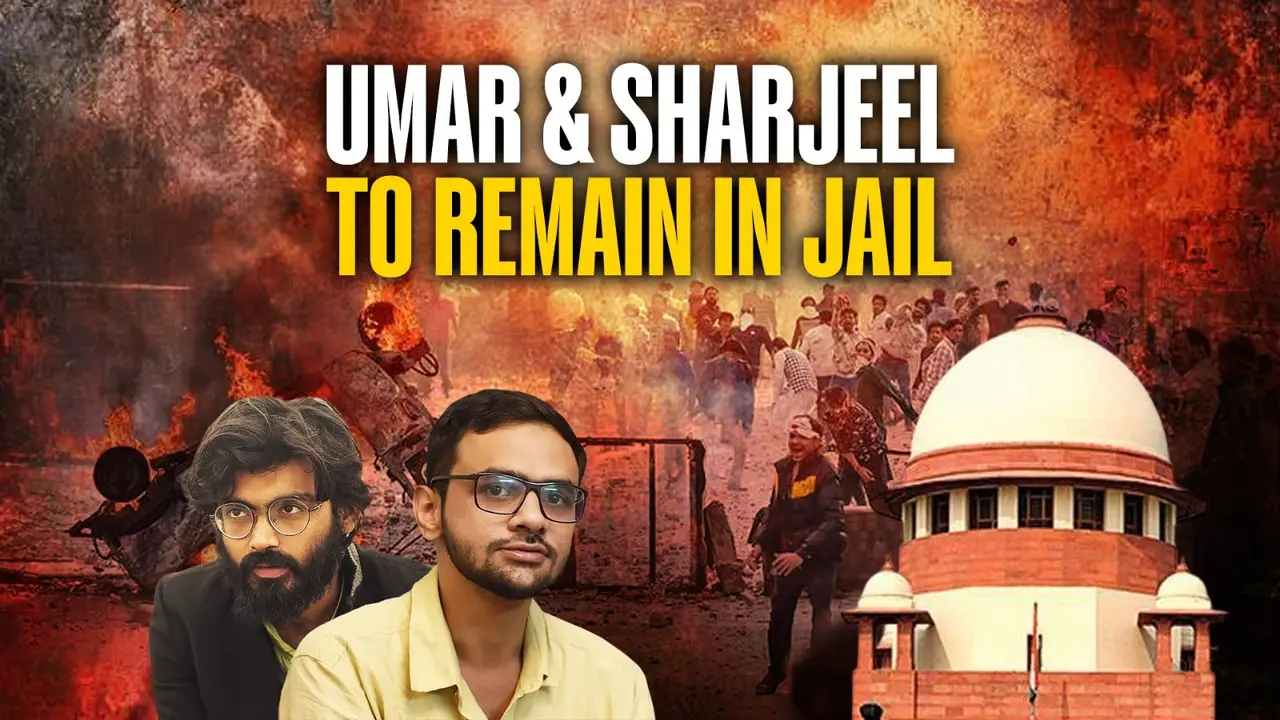
New Delhi: The Supreme Court on Monday (January 5, 2026) rejected bail pleas of Sharjeel Imam, Umar Khalid in a case pertaining to an alleged larger conspiracy behind the 2020 north-east Delhi riots.
The bench clarified that they can approach the court again for bail either after one year or upon the completion of examination of protected witnesses, whichever occurs earlier. Any future application will be considered independently, unaffected by today’s order.
The Supreme Court, however, has granted bail to the remaining five accused, Gulfisha Fatima, Meeran Haider, Shifa Ur Rehman, Mohd. Saleem Khan, and Shadab Ahmad, in the 2020 Delhi riots UAPA case. The bench observed that continued pre-trial incarceration was not shown to be necessary for them. Their release comes with standard conditions, while Umar Khalid and Sharjeel Imam remain in custody.
The Court noted that Umar Khalid and Sharjeel Imam stand on a "qualitatively different footing" both in terms of prosecution and evidence.
Advertisement
It noted that their roles were "central" to the alleged offences.
As regards these two, though the period of incarceration is continued and long it does not violate the Constitutional mandate or override the statutory embargo under the laws.
Advertisement
The SC bench of Justices Aravind Kumar and NV Anjaria delivered the judgment on the bail pleas filed by Gulfisha Fatima, Meeran Haider, Shifa Ur Rehman, Mohd Saleem Khan and Shadab Ahmed.
What was discussed during the hearing?
The Supreme Court during the hearing said that it stresses on right to speedy trial, deprivation of liberty will not be arbitary. It said these appeals arise out of common judgement by the High Court denying bail. Submissions were advanced on prolonged incarceration and liberty under article 21 of the constitution.
SC argued that 43D(5) of UAPA departs from general provisions for grant of bail. It does not exclude judicial scrutiny or mandate denial of bail in default.
Adding further, it highlights Article 21 occupies a central space in the constitutional scheme. Pre-trial incarceration cannot be assumed to have the character of punishment. The UAPA as a special statute represents a legislative judgement as to the conditions on which bail may be granted in pre trial stage.
In a significant clarification of the Unlawful Activities (Prevention) Act (UAPA), the Supreme Court emphasised that the foundation for any prosecution lies in the statutory interplay between Section 50 and Section 45, which defines the legal parameters of a "terrorist act."
The Bench noted that Parliament designed the UAPA to address societal threats that may persist even without immediate physical violence. Consequently, at the bail stage, the judicial inquiry must focus on whether the prosecution’s evidence, taken at face value, establishes a prima facie case against the accused, either as a direct perpetrator or a conspirator.
Crucially, the Court rejected a uniform approach to bail, asserting that all appellants do not stand on equal footing regarding culpability. The Bench highlighted that the roles of some accused may be merely facilitative, requiring a granular assessment of each individual’s participation in the alleged conspiracy.
Regarding the 2020 Delhi riots conspiracy, the Supreme Court clarified that it has decided each bail plea distinctively based on the specific allegations of participation. While the Court was careful to avoid a final adjudication of guilt, it stated that the prosecution’s material prima facie discloses the significant involvement of Umar Khalid and Sharjeel Imam. The Bench noted that evidence pointing toward their roles in planning and organizing the conspiracy serves as a primary factor in the denial of their bail, reaffirming that the Constitution does not view personal liberty in isolation from the gravity of such allegations.
The Supreme Court clarified that, under the UAPA, a “terrorist act” is not limited to acts of physical violence. It also encompasses activities that disrupt essential services or threaten public order. This broad interpretation informs the assessment of whether the accused’s alleged conduct, including planning or instigating protests, falls within the statutory definition of terrorism for the purpose of bail consideration.
What was argued in previous bail pleas ?
During the hearing of their pleas seeking bail in the past, the advocates who appeared for them mostly argued on the delay and the unlikelihood of the commencement of the trial. It was also stated to the court that they have been under custody for over five years in a case in which they are facing serious allegations of committing offences under the UAPA.
The contentions were also made that there is no proof of violence that they instigated the riots, even after five years have passed.
On the other hand, Delhi Police objected to the bail pleas, saying the alleged offences involved a deliberate attempt to destabilise the state. It argued that these were not spontaneous protests but a well-orchestrated "pan-India" conspiracy aiming at "regime change" and "economic strangulation".
The Delhi Police further submitted that the conspiracy was allegedly planned to coincide with the official visit of the then US President to India, with the intention of drawing international media attention and globalising the issue of the Citizenship Amendment Act (CAA).
The issue of CAA was carefully chosen to serve as a "radicalising catalyst" camouflaged in the name of "peaceful protest", it had said.
The prosecution further stated that the "deep-rooted, premeditated and pre-planned conspiracy" hatched by the petitioners resulted in the death of 53 persons, large-scale damage to public property, leading to registration of 753 FIRS in Delhi alone.
Evidence on record suggests that the instant conspiracy was sought to be replicated and executed PAN India, the Delhi police said.
It referred to the various WhatsApp groups, Delhi Protest Support Group (DPSG), and Jamia Awareness Campaign Team. It was also argued that the delays are attributed to the petitioners themselves, and if they cooperate, the trial will be concluded within two years.
Bail Denied Earlier
The Delhi High Court on September 2 denied bail to Imam, Khalid and seven others - Mohd Saleem Khan, Shifa Ur Rehman, Athar Khan, Meeran Haider, Shadab Ahmed, Abdul Khalid Saifi and Gulfisha Fatima. On September 2, the bail plea of another accused, Tasleem Ahmed, was rejected by a different High Court bench.
The High Court had observed that, prima facie, the role of Imam and Khalid in the entire conspiracy was "grave", having delivered inflammatory speeches on communal lines to “instigate mass mobilisation of members of the Muslim community.”
They sought bail from the apex court in the larger conspiracy case under the stringent provisions of the Unlawful Activities (Prevention) Act (UAPA) in the Delhi riots case in February 2020.
2020 Delhi riots case
In 2020, the Delhi police arrested Imam under the UAPA and named him as the main conspirator behind the Delhi riots case.
The violence had erupted during the protests against the then-proposed Citizenship Amendment Act (CAA) and National Register of Citizens (NRC) and had left 53 people dead and over 700 injured.
The Umar Khalid-Sharjeel Imam case so far
Umar Khalid has been in custody since September 13, 2020, while Imam has been prisoned since January 28, 2020, weeks before the Delhi riots broke out.
The 2020 riots took place in February in parts of Northeast Delhi, following weeks of tension around protests against the Citizenship (Amendment) Act (CAA). The violence, which lasted several days, led to the several deaths, along with large-scale damage to homes, shops, and places of worship.
Investigating the violence, the Delhi police described it as a "conspiracy" linked to protests against the CAA. Several activists, including Sharjeel Imam, a former JNU student, and Umar Khalid, a student activist associated with earlier campus movements, students, and intellectuals were arrested under stringent laws such as the Unlawful Activities (Prevention) Act (UAPA).
The police alleged that their speeches and activities contributed to the planning and escalation of violence, claims that both have strongly denied.
One video of Sharjeel Imam where he is seen speaking about blocking the “chicken neck” corridor and separating Assam from the rest of India surfaced, which is cited as a crucial piece of evidence in court hearings. Another video in which Sharjeel Imam allegedly laid out a plan to “paralyse Delhi” through a “chakka jam”, cutting off essential supplies, such as milk and vegetables had also been cited by Delhi police.
The Supreme Court on December 10 repeatedly questioned the Delhi Police on the applicability of Section 15 of the UAPA, which defines a “terrorist act”, to speeches and protest-related activities relied upon by the prosecution.
Additional solicitor general (ASG) SV Raju in previous hearings on Umar Khalid’s role referred to what he described as Khalid’s antecedents, including a controversial 2016 JNU protest, alleging that Khalid had raised the slogan “Bharat tere tukde tukde honge”. Raju said this FIR had been relied upon in the supplementary charge sheet filed in November 2020.
The bail pleas before the Supreme Court stem from from a September 2, 2025, order of the Delhi high court, which had refused bail to nine accused, including Khalid and Imam. A bench of justices Navin Chawla and Shalinder Kaur (since retired) held that the material collected by investigators prima facie pointed to a coordinated conspiracy, describing Khalid and Imam as the “intellectual architects” of the violence.
8 US Lawmakers Lecture Indian Judiciary
Earlier, in an open attempt to interfere in the Indian judiciary system, eight US lawmakers have written to India’s Ambassador in Washington, urging that jailed activist Umar Khalid be granted bail and a fair, timely trial.
Led by US Representatives Jim McGovern and Jamie Raskin, the letter meddling in India's judicial affairs, not only urges Indian authorities to grant bail to ‘Tukde Tukde’ activist Khalid, but also ensure that his trial begins without further delay. Other signatories of the letter include Chris Van Hollen, Peter Welch, Pramila Jayapal, Jan Schakowsky, Rashida Tlaib and Lloyd Doggett.
The lawmakers also lectured Indian judiciary on how judicial proceedings have not yet begun more than five years after the activist's arrest and also pressed New Delhi to ensure that Khalid is afforded due process and that his case is heard in a fair and timely manner.
Mamdani Bats For Riot Accused Umar Khalid
New York City’s Indian-origin mayor, Zohran Mamdani, who became the city’s first Asian American and Muslim mayor last year, also expressed solidarity with jailed activist and former JNU student Umar Khalid and wrote a letter to him .
Khalid's friend Banojyotsna Lahiri shared a photograph of the note 34-year-old Mamdani wrote to Khalid on social media platform X which read, “Dear Umar, I think of your words on bitterness often, and the importance of not letting it consume one’s self. It was a pleasure to meet your parents. We are all thinking of you."
Get Current Updates on India News, Entertainment News, Cricket News along with Latest News and Web Stories from India and around the world.