
Education Minister Dharmendra Pradhan Resigns Amid NEET Paper Leak Protests
Union Education Minister Dharmendra Pradhan resigns following the NEET-UG 2026 paper leak controversy. PM Modi accepts his resignation as the government orders a CBI probe, cancels the exam, announces a re-test, and confirms CBT mode from next year.
- India News
- 3 min read

;'%3e%3cpath%20d='m8,15.99c4.41,0,7.99-3.58,7.99-7.99S12.41,0,8,0,0,3.59,0,8s3.58,7.99,7.99,7.99Z'%20style='stroke:%23fff;%20stroke-miterlimit:10;%20stroke-width:.02px;'/%3e%3cpath%20d='m3.08,3.37l3.82,5.11-3.84,4.15h.87l3.37-3.64,2.72,3.64h2.94l-4.04-5.39,3.58-3.87h-.86l-3.1,3.35-2.5-3.35h-2.94Zm1.27.64h1.35l5.97,7.99h-1.35l-5.97-7.99Z'%20style='fill:%23fff;'/%3e%3c/g%3e%3c/svg%3e)


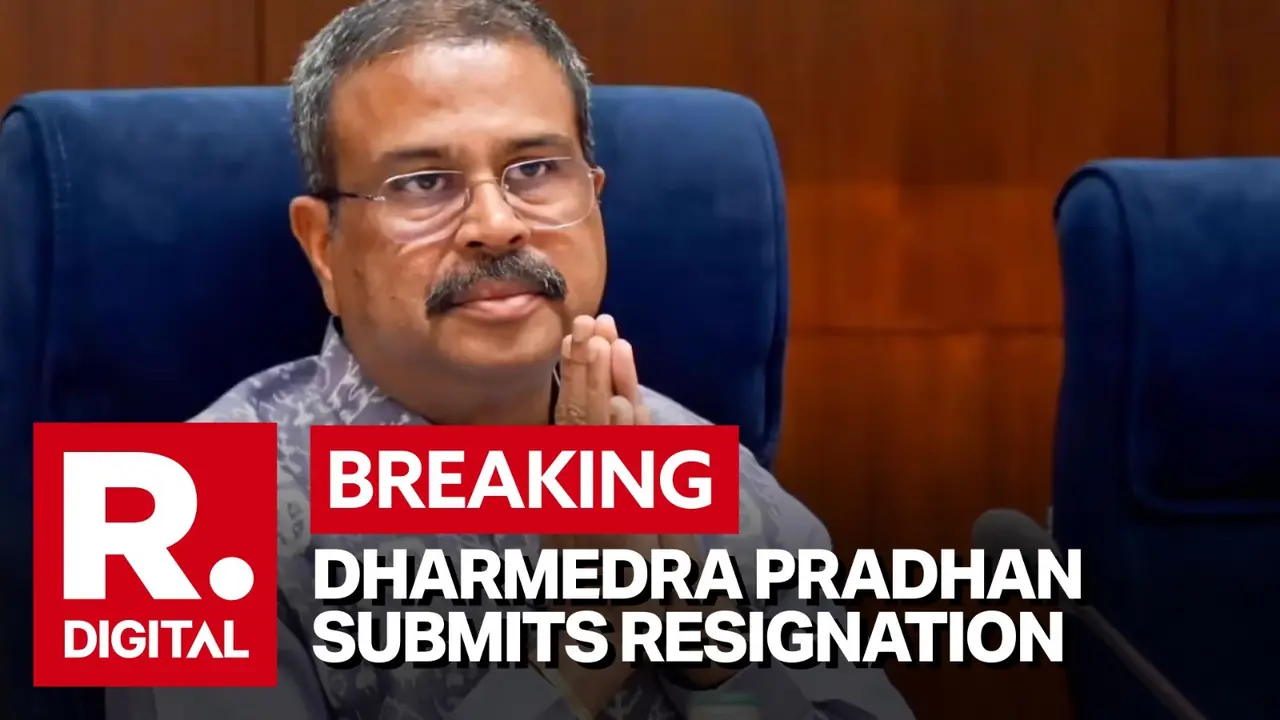
Union Education Minister Dharmendra Pradhan has resigned from the Council of Ministers, submitting his resignation to Prime Minister Narendra Modi on Saturday. The move comes after weeks of intensifying nationwide protests over irregularities in the NEET-UG 2026 medical entrance examination, marking one of the most significant political developments to emerge from the controversy so far.
A decision framed around students' interests
In his resignation letter, Pradhan said his decision was driven by concern for students rather than personal considerations. He stated that he did not want India's youth to get caught up in what he called a "web of confusion" stemming from the ongoing unrest, and expressed hope that the situation would not be used by elements he described as working against the national interest. He was careful to frame the resignation as a matter of principle, saying repeatedly that it was not about his own standing or reputation.
Reflecting on his tenure
Pradhan used the letter to look back on more than 40 years connected to education, teaching, and reform efforts, describing a strong and inclusive education system as essential to a strong nation. He also expressed gratitude to Prime Minister Modi for the opportunity to serve, and thanked his Cabinet colleagues along with officials and staff of the Ministry of Education for their support during his time in office.
How the NEET-UG crisis unfolded
The controversy traces back to irregularities detected in the NEET-UG exam conducted on May 3, 2026. According to Pradhan's account, the government moved quickly once the issues surfaced — referring the case to the CBI for investigation, cancelling the compromised exam, and scheduling a fresh sitting. Officials also announced that from the following year, NEET would transition to a Computer-Based Test format, a shift intended to reduce the risk of future leaks.
Advertisement
The re-examination, which involved more than two million candidates, was held on June 21 with coordination between central and state authorities. Pradhan said this was treated as a top priority throughout, and that he had personally taken responsibility for the situation from the outset rather than stepping back from it. When results were declared on July 16, he described the outcome as satisfactory, noting that many students from economically weaker backgrounds had performed well.
Even so, Pradhan said that during this period certain individuals in positions of responsibility had attempted to mislead students and create obstacles — a development he said left him deeply troubled.
Advertisement
Backdrop of sustained protest
The resignation follows sustained pressure from student groups, opposition parties, and activists, including a 26-day hunger strike by Sonam Wangchuk at Jantar Mantar in Delhi, which became a rallying point for demonstrators demanding accountability over the exam system.
What's next
Alongside this development, the central government is reportedly preparing stronger anti-paper-leak legislation, expected to include Special Fast-Track Courts and a dedicated Special Task Force aimed at curbing examination fraud nationwide. No successor for the education portfolio has been announced yet.
Get Current Updates on India News, Entertainment News, Cricket News along with Latest News and Web Stories from India and around the world.