
Former Delhi Minister Satyendar Jain Taken to Rouse Avenue Court Following Arrest
The ACB arrested six persons in connection with an FIR registered on May 11, 2024, under the provisions of the Prevention of Corruption Act, 1988, as amended in 2018, along with relevant sections of the Indian Penal Code related to cheating, criminal breach of trust and criminal conspiracy.
- India News
- 4 min read

;'%3e%3cpath%20d='m8,15.99c4.41,0,7.99-3.58,7.99-7.99S12.41,0,8,0,0,3.59,0,8s3.58,7.99,7.99,7.99Z'%20style='stroke:%23fff;%20stroke-miterlimit:10;%20stroke-width:.02px;'/%3e%3cpath%20d='m3.08,3.37l3.82,5.11-3.84,4.15h.87l3.37-3.64,2.72,3.64h2.94l-4.04-5.39,3.58-3.87h-.86l-3.1,3.35-2.5-3.35h-2.94Zm1.27.64h1.35l5.97,7.99h-1.35l-5.97-7.99Z'%20style='fill:%23fff;'/%3e%3c/g%3e%3c/svg%3e)


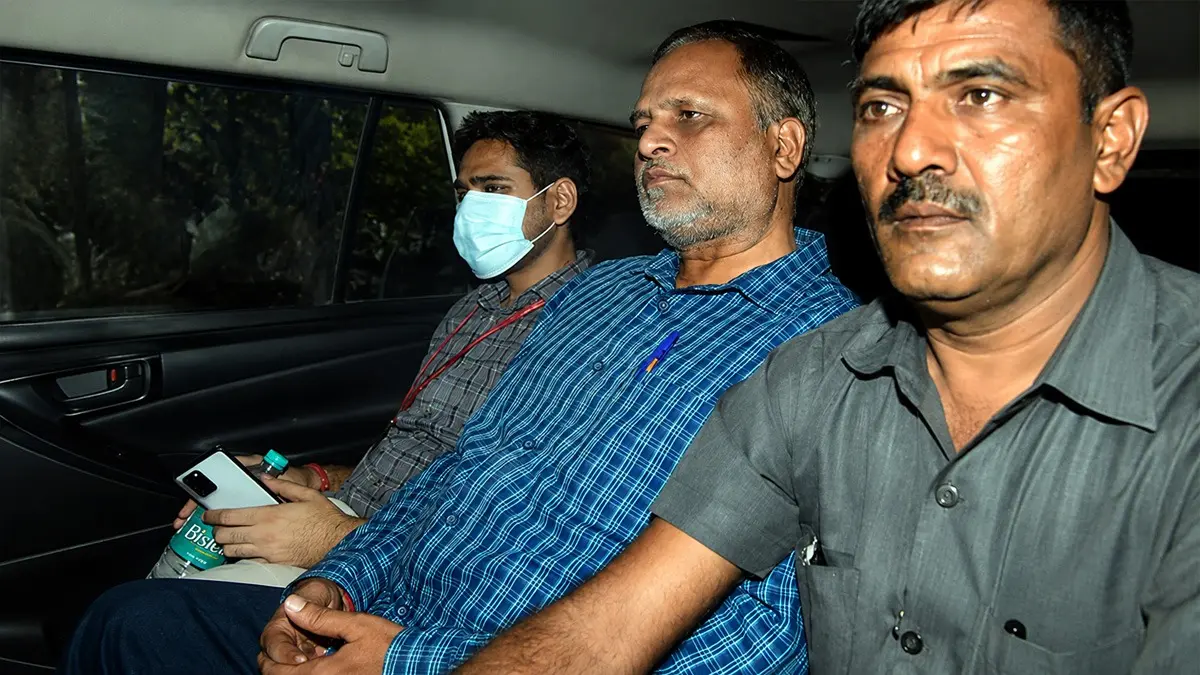
New Delhi: Former Delhi Minister Satyendar Jain was taken to Rouse Avenue Court on Wednesday, a day after he was arrested by the Anti-Corruption Branch (ACB).
He was arrested for alleged large-scale irregularities, manipulation of tender conditions, and criminal conspiracy in the tendering process relating to augmentation/upgradation of Sewage Treatment Plants (STPs) of the Delhi Jal Board (DJB).
The ACB arrested six persons in connection with an FIR registered on May 11, 2024, under provisions of the Prevention of Corruption Act, 1988, as amended in 2018, along with relevant sections of the Indian Penal Code related to cheating, criminal breach of trust and criminal conspiracy.
The accused arrested in the case include Satyendar Kumar Jain, former CEO of the Delhi Jal Board; Udit Prakash Rai (IAS), former contractual consultant of DJB; Ankit Srivastava; Nagendra Yadav, proprietor of M/s AN Enterprises; Raja Kumar Kurra, owner of M/s Euroteck Environment Pvt. Ltd.; and Pankaj Verma, proprietor of M/s Srijanhar.
Advertisement
According to the ACB, the case was initiated following a complaint by the Directorate of Vigilance, Government of National Capital Territory of Delhi (GNCTD), which flagged alleged irregularities in the DJB tender process for augmenting and upgrading STPs.
The agency alleged that the tender process was manipulated to favour a particular private technology firm, M/s Euroteck Environment Pvt. Ltd, through restrictive technical specifications that allegedly prevented participation by other bidders.
Advertisement
The ACB claimed that its investigation found that a proposed pilot study was not conducted, technical specifications were modified during the tender process, and corrigenda were issued in a manner that allegedly benefited the private firm.
The agency further alleged that electronic evidence indicated that tender documents and certain conditions were exchanged among the accused before being incorporated into the official tender notice issued by the DJB.
The agency also claimed that communications between officials and private entities indicated a coordinated effort to influence the procurement process.
The ACB said all six accused were questioned before being arrested on August 18. The agency added that the investigation into the alleged money trail and proceeds of crime is continuing.
Meanwhile, Aam Aadmi Party (AAP) national convenor Arvind Kejriwal on Wednesday questioned Union Home Minister Amit Shah over the arrest of former Delhi Minister Satyendar Jain by the Anti-Corruption Branch (ACB), alleging that the agency was pressured to make the arrest.
In a post on X, Kejriwal said, “Amit Shah ji should explain why he got Satyendra Jain arrested by pressuring the investigation agency.” In another post, Kejriwal claimed that an ACB official had revealed that there was no plan to arrest Jain until Wednesday morning, alleging that the decision was taken after a call from Shah.
“An Anti-Corruption Branch (ACB) official revealed - There was no plan for ACB to arrest Satyendra Jain until morning. Then in the afternoon, a direct call came from Amit Shah ji saying, 'Arrest him.' That's when the arrest was made.” Kejriwal further alleged that arrests were no longer being made on the basis of whether a person had committed a crime.
“Clearly, now arrests don't happen based on whether someone has committed a crime or not, but rather on whom those two want to arrest.” Earlier, BJP MP and former AAP leader Swati Maliwal on Wednesday levelled serious allegations against AAP national convenor Arvind Kejriwal, alleging that he ran a "shop of corruption" in Delhi for a decade and has now shifted his operations to Punjab.
Speaking to reporters, Maliwal alleged that Kejriwal deliberately avoided holding any ministry during his tenure as Delhi Chief Minister so that he could shift blame onto his ministers whenever a scam surfaced. "In the last 10 years in Delhi, Arvind Kejriwal was running a shop of corruption. Whether it was the school classroom construction scam, the liquor scam, or countless other scams that these people orchestrated. And if we observe closely, Arvind Kejriwal operated very shrewdly," Maliwal said.
"During the 10 years he remained the Chief Minister of Delhi, he did not hold charge of a single ministry. His modus operandi is very clear: he orchestrated corruption through his ministers, and the moment a minister was exposed, he would shift the entire blame onto that minister," she said.
Get Current Updates on India News, Entertainment News, Cricket News along with Latest News and Web Stories from India and around the world.