
From 2014 Red Bandhej to 2026 Red Tie-Dye: PM Modi’s Independence Day Turban Tradition
Prime Minister Narendra Modi celebrated the 80th Independence Day in a traditional red tie-and-dye turban, marking his 13th address from the Red Fort. He paired this with a white kurta-pyjama and a chocolate-brown vest, complemented by Tricolour pocket squares. Modi’s choice of distinct regional headgear has become a hallmark of his annual appearances since 2014.
- India News
- 3 min read

;'%3e%3cpath%20d='m8,15.99c4.41,0,7.99-3.58,7.99-7.99S12.41,0,8,0,0,3.59,0,8s3.58,7.99,7.99,7.99Z'%20style='stroke:%23fff;%20stroke-miterlimit:10;%20stroke-width:.02px;'/%3e%3cpath%20d='m3.08,3.37l3.82,5.11-3.84,4.15h.87l3.37-3.64,2.72,3.64h2.94l-4.04-5.39,3.58-3.87h-.86l-3.1,3.35-2.5-3.35h-2.94Zm1.27.64h1.35l5.97,7.99h-1.35l-5.97-7.99Z'%20style='fill:%23fff;'/%3e%3c/g%3e%3c/svg%3e)


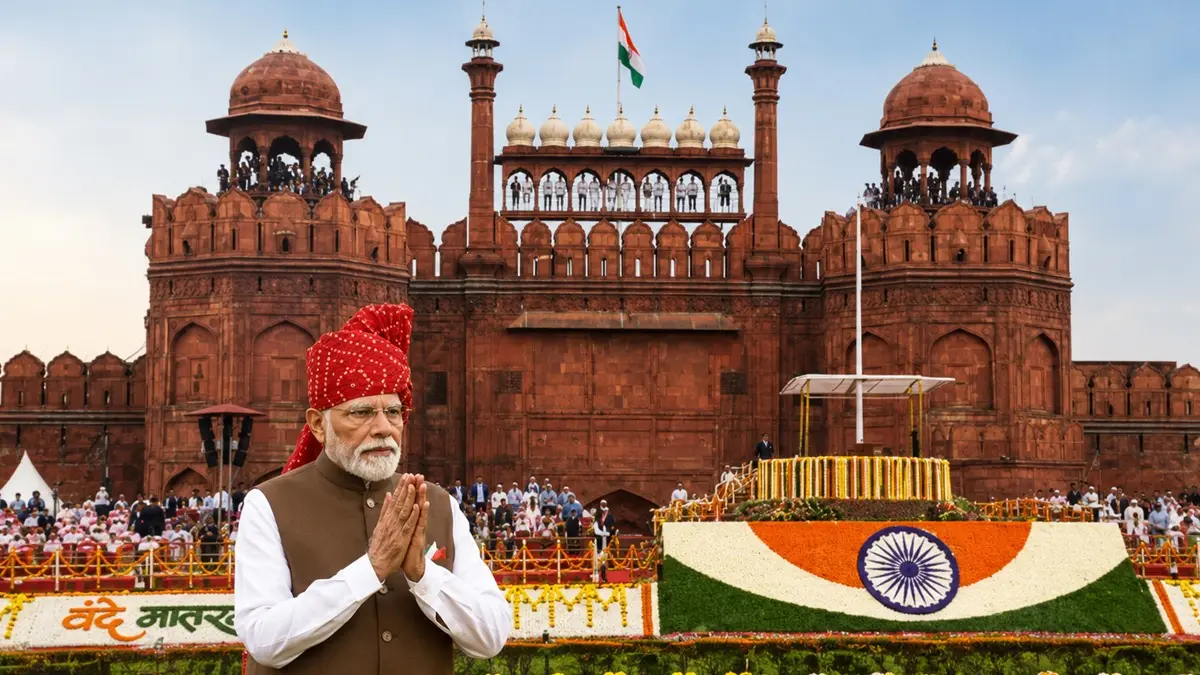
New Delhi: Prime Minister Narendra Modi marked the 80th Independence Day with his signature sartorial flair, sporting a traditional red tie-and-dye turban for his 13th consecutive address to the nation from the historic ramparts of the Red Fort in New Delhi.
PM Modi paired his white kurta-pyjama with a chocolate-brown vest and the striking red turban, a style closely associated with the traditional textile and turban cultures of Rajasthan and Gujarat. He also sported three pocket squares in saffron, green and white, adding a subtle Tricolour touch to his Independence Day ensemble.

The red turban marked another chapter in Modi's long-running tradition of choosing distinctive regional headgear for his August 15 appearance. Since his first Independence Day address in 2014, the Prime Minister's turbans have become a closely watched feature of his annual Red Fort appearance, with their colours, patterns and styles often drawing attention.
In 2014, during his maiden Independence Day address, Modi wore a bright red Jodhpuri Bandhej turban with contrasting green accents. The choice established what would become a recurring sartorial feature of his Independence Day appearances.
Advertisement
In 2015, he opted for a yellow turban featuring a multicoloured criss-cross pattern, while 2016 saw him wear a vibrant pink-and-yellow Bandhej turban with a long trailing end.
For 2017, Modi chose a red-and-yellow turban with intricate golden detailing. In 2018, he went with a bright saffron turban decorated with red motifs and a flowing tail.
Advertisement
The 2019 turban reflected Rajasthan's textile heritage, featuring a multicoloured leheriya pattern. During the COVID-19 pandemic in 2020, Modi wore a saffron-and-cream turban with a long tail and paired it with a white-and-saffron stole that was also used as a face covering.
In 2021, saffron again dominated his turban, this time with red patterns and a long pink trail.
One of the most recognisable choices came in 2022, when Modi's turban mirrored the colours of the national flag. The white headgear featured saffron and green stripes as India celebrated 75 years of Independence and the government pushed the Har Ghar Tiranga campaign.
In 2023, he returned to the traditional Rajasthani Bandhani style, wearing a vibrant multicoloured turban featuring yellow, green and red.
The 2024 Independence Day look featured another Rajasthani favourite - leheriya - with bold orange, dark green and yellow streaks and a long, heavily pleated tail.
In 2025, Modi made a more monochromatic statement, wearing an all-saffron safa with a matching saffron waistcoat and a crisp Tricolour stole.
Now, in 2026, the Prime Minister has returned to red with a tie-and-dye turban, bringing the colour back to the centre of his Independence Day wardrobe after more than a decade of experimenting with regional patterns, colours and styles.
Beyond fashion, Modi's Independence Day turbans have increasingly become a visual representation of India's regional textile traditions and craftsmanship. From Bandhej and Bandhani to leheriya, his annual choices have repeatedly showcased traditional Indian dyeing and weaving techniques before a nationwide and global audience.
The latest red turban, combined with the saffron, white and green pocket squares, adds another distinctly Indian touch to Modi's 80th Independence Day appearance as he delivered his 13th consecutive Independence Day address from the Red Fort.
Get Current Updates on India News, Entertainment News, Cricket News along with Latest News and Web Stories from India and around the world.