
From the Ghats of Tradition to Rashtrapati Bhavan: The Odyssey of Padma Shri Dr Bharat Gupt
In 2025, Dr Bharat Gupt, the 79-year-old classicist, musicologist, theatre theorist, sitar and surbahar exponent, cultural analyst, and tireless advocate for India’s heritage received the Padma Shri, India’s fourth-highest civilian honour, in the field of Art.
- India News
- 5 min read

;'%3e%3cpath%20d='m8,15.99c4.41,0,7.99-3.58,7.99-7.99S12.41,0,8,0,0,3.59,0,8s3.58,7.99,7.99,7.99Z'%20style='stroke:%23fff;%20stroke-miterlimit:10;%20stroke-width:.02px;'/%3e%3cpath%20d='m3.08,3.37l3.82,5.11-3.84,4.15h.87l3.37-3.64,2.72,3.64h2.94l-4.04-5.39,3.58-3.87h-.86l-3.1,3.35-2.5-3.35h-2.94Zm1.27.64h1.35l5.97,7.99h-1.35l-5.97-7.99Z'%20style='fill:%23fff;'/%3e%3c/g%3e%3c/svg%3e)


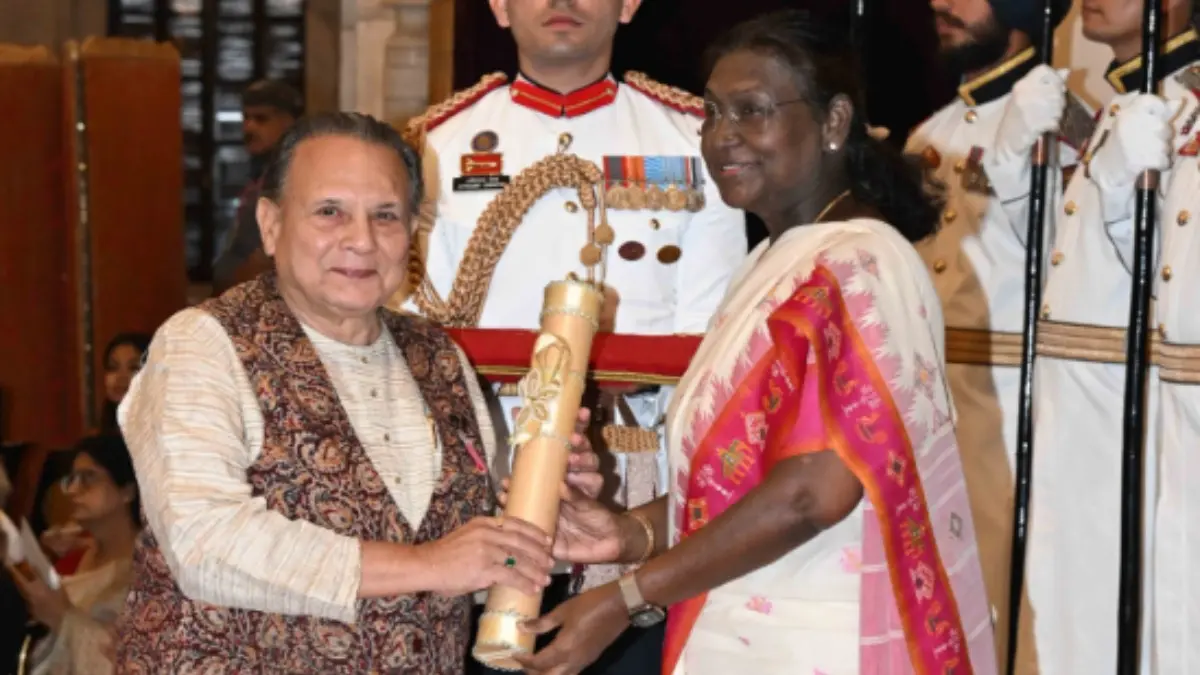
In the quiet scholarly corridors where ancient texts whisper across millennia, Bharat Gupt has spent a lifetime bridging worlds--Greek amphitheatres and Indian natya mandapas, Aristotelian Poetics and Bharata Muni’s Natyashastra, the strum of the surbahar and the rigour of university lectures. In 2025, this 79-year-old classicist, musicologist, theatre theorist, sitar and surbahar exponent, cultural analyst, and tireless advocate for India’s heritage received the Padma Shri, India’s fourth-highest civilian honour, in the field of Art.
The award, conferred by President Droupadi Murmu, recognised not a single spectacular feat but a decades-long journey of quiet reclamation: reasserting the Indo-European roots of sacred performance, translating and interpreting foundational texts, mentoring generations through lectures and writings, and championing the place of arts and shastras in modern education.
Born on November 28, 1946, in Moradabad, Uttar Pradesh, a town steeped in Hindustani classical music and Urdu poetry, Gupt grew up in a household where culture was lived, not studied. His father’s recitations of Tulsidas’s Ramcharitmanas filled the home; by age seven, the young Bharat knew the epic by heart. Summers in the district town blended with Delhi schooling and college, where he immersed himself in English, Hindi, Sanskrit, and philosophy at St. Stephen’s College.
The late 1960s found him in the United States amid the counter-culture ferment, followed by a Master’s degree at the University of Toronto. Yet, rather than drifting westward, Gupt turned homeward with renewed purpose. Back in India, he undertook rigorous traditional training: eight years learning sitar and surbahar under Pandit Uma Shankar Mishra, and deep study of musicological texts, Yoga Sutras, and classics under Acharya K.C. Brihaspati and Swami Kripalvananda. His formal credentials include an MA from Delhi and Toronto, and a PhD from M.S. University of Baroda, with a dissertation comparing Greek and Indian dramatic theories.
Advertisement
This dual formation--modern Western academia fused with indigenous guru-shishya discipline--became the bedrock of his distinctive scholarship. Gupt challenged the prevailing narrative that positioned ancient Greek drama as the purely secular origin of “Western” theatre. Instead, through travels, research, and writings, he illuminated its profound affinities with Indian natya as hieropraxis--sacred action rooted in ethics, emotion, cosmology, and ritual.
Major Contribution
Gupt's seminal work, Dramatic Concepts: Greek and Indian, first published in 1993, and reprinted six times since, has altered the standard view that Ancient Greek theatre was "Western theatre", and has established that Greek theatre was very close to the principles of ancient Indian theatre using dance, music, symbolism and ritual and divine incarnation. As a Senior Fellow of the Alexander S. Onassis Public Benefit Foundation (1995-96), he researched modern Greek productions of ancient plays, photographed amphitheatres and antiquities across Greece and Syracuse, and served on the jury for the Onassis Prize for Drama. He lectured extensively across India, North America, Europe, and Greece, and held visiting professorships.
Advertisement
A pivotal contribution is his translation and commentary on Chapter 28 of the Natyashastra, exploring ancient Indian musical scales, drawing on his guru Acharya Brihaspati’s insights. He has produced further works on Greek literary criticism (including translations into Hindi), cultural analysis in India: A Cultural Decline or Revival? (2008), and ongoing engagements with the Natyashastra. As a columnist and public intellectual, he has addressed education, heritage, ritual, and the deritualisation of Indian life under colonial and post-colonial influences.
Gupt’s impact extends beyond academia. He was a founding member of the International Forum for India’s Heritage (IFIH), serves as Vice Chairman of the National School of Drama, and as Trustee and Executive Committee member of the Indira Gandhi National Centre for the Arts (IGNCA). He initiated the construction of a traditional nagar-style Sri Ram Mandir in Delhi’s Ashok Vihar, embodying his commitment to living vaastu and temple arts.
Awards and Honours
In 2023, President Murmu had already honoured him with the Sangeet Natak Akademi Award for his contributions to musicology. The Padma Shri in 2025 crowns a journey that began in the syncretic lanes of Moradabad and wound through global scholarly arenas, always returning to the imperative of cultural self-understanding.
At its heart, Gupt’s work is a call to restore balance: to reinstate the arts--not as extracurricular frills but as central to personality development, creativity, and moral formation--in education; to value the teacher and oral tradition alongside modern tools; and to see India’s classical heritage not as relic but as vibrant resource for the present. He has argued passionately for Sanskrit, shastras, and performing arts in curricula, critiquing systems that sidelined them in favour of narrow utility.
In an era of rapid change, Bharat Gupt’s Padma Shri is more than personal recognition. It affirms the quiet labours of those who keep civilisational memory alive--translating ancient wisdom, performing its music, theorising its drama, and insisting that a nation’s future must be rooted in its deepest cultural springs. From the Ramcharitmanas of his childhood to the Natyashastra he expounds worldwide, his journey reminds us that true honour often arrives not as destination, but as validation of a path walked with unwavering integrity.
Get Current Updates on India News, Entertainment News, Cricket News along with Latest News and Web Stories from India and around the world.