
Harish Salve Scorches Ex-CJI DY Chandrachud For BBC Interview: Has NO Right to Put Supreme Court On Trial
Harish Salve, Senior Advocate SC of India & King's Counsel, UK retort to DY Chandrachud's BBC interview has raised solid questions on the ex-CJI and his intent
- India News
- 6 min read

;'%3e%3cpath%20d='m8,15.99c4.41,0,7.99-3.58,7.99-7.99S12.41,0,8,0,0,3.59,0,8s3.58,7.99,7.99,7.99Z'%20style='stroke:%23fff;%20stroke-miterlimit:10;%20stroke-width:.02px;'/%3e%3cpath%20d='m3.08,3.37l3.82,5.11-3.84,4.15h.87l3.37-3.64,2.72,3.64h2.94l-4.04-5.39,3.58-3.87h-.86l-3.1,3.35-2.5-3.35h-2.94Zm1.27.64h1.35l5.97,7.99h-1.35l-5.97-7.99Z'%20style='fill:%23fff;'/%3e%3c/g%3e%3c/svg%3e)


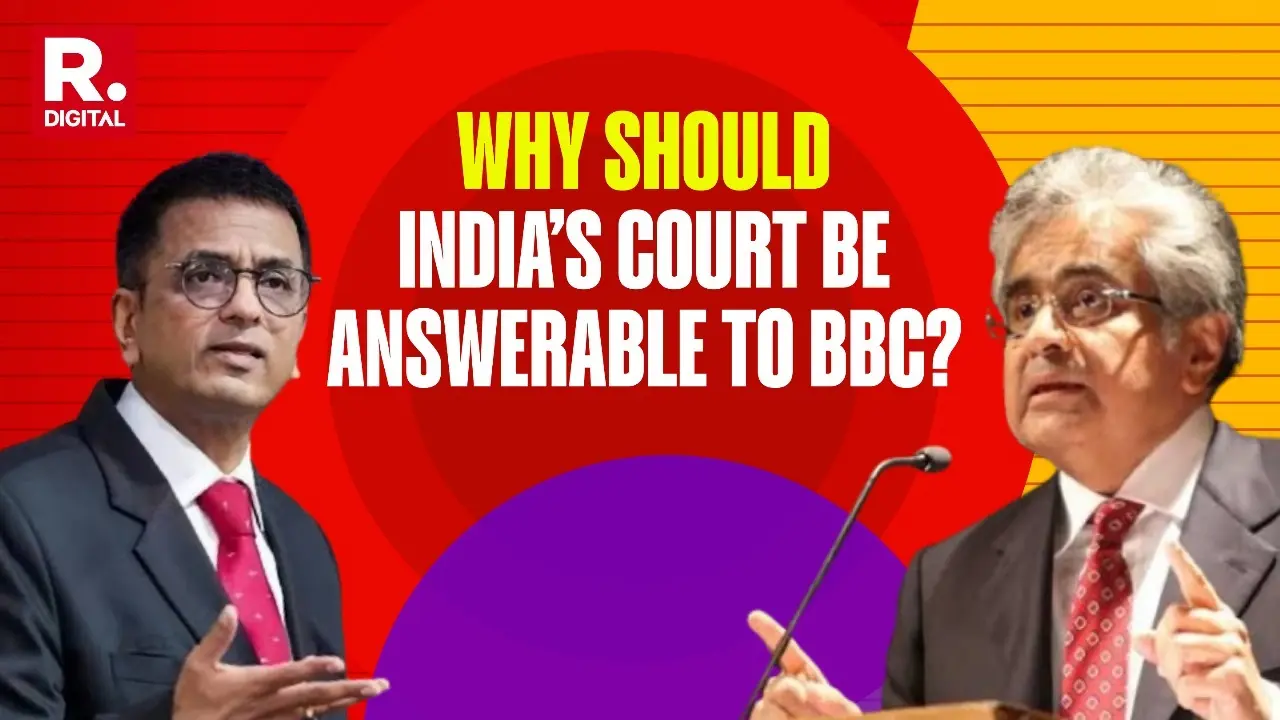
New Delhi, India: Harish Salve, Senior Advocate Supreme Court of India and King's Counsel, UK, came down heavily on former Chief Justice of India (CJI) D.Y. Chandrachud for his recent interview with the BBC.
In a conversation with Republic TV, Salve raised pertinent questions on Chandrachud’s utterances on the foreign media platform, and raised concerns regarding the intent that puts Supreme Court of India "on trial".
Salve’s outlook went against the precedent that was set by Justice Chandrachud of seeming to offer detailed explanations to foreign narratives on judicial verdicts of the Honourable Supreme Court of India.
“You get a BBC journalist, you should know you are heading for trouble. The second and more important thing- the Chief Justice of India is a part of Supreme Court of India and I don’t think he should be speaking of what the court does because it’s not him, it’s the Supreme Court which is actually on trial in that interview. We always say judges should only speak through their judgements,” said Salve.
Advertisement
Speaking exclusively to Republic TV’s Rhythm Anand Bhardwaj, Executive Editor - Law and Governance, Salve raised serious concerns about the act of members of the judiciary publicly discussing judicial decisions outside the courtroom.
‘Judges Should Speak Through Judgments’
Salve’s premise stated that judicial reasoning should be confined to court verdicts, not media interviews. "We always say judges should only speak through their judgments," Salve asserted.
Advertisement
On BBC journalist Stephen Sackur questioning former CJI D.Y. Chandrachud about, conveniently generic, ‘legal scholars' disappointment with the stance on Article 370, Harish Salve criticized the premise of Chandrachud’s seemingly detailed explanation, stating that judicial decisions should not be scrutinized outside the courtroom.

"The judgment gave reasons why it upheld the abrogation. But when the same issue is brought up in a private interview, all sorts of aspersions are cast, and motives for the judgment are questioned," Salve said.
During the BBC interview, Sackur, who was recently rebutted into silence for bias by Union Minister Hardeep Puri, asked Justice Chandrachud, “Article 370 was part of the Constitution, which guaranteed the special status and autonomy of the state of Jammu and Kashmir. It had been in place since the very inception of modern India. You agreed that the government had the right to abrogate Article 370. Many legal scholars were deeply disappointed with your decision because they felt you had failed to uphold the Constitution. Explain to me why you took the decision you did?”
To this Justice Chandrachud replied “Since I was the author of one of the judgments in the case, a judge by their very nature of profession has some restraints on either defending or critiquing their judgments… Article 370 of the Constitution when it was introduced into the Constitution at the birth of the Constitution was part of a chapter which is titled ‘transitional arrangments’ or ‘transitional provisions’. It was later renamed as ‘temporary and transitional provisions’, and therefore at the birth of the Constitution, the assumption was that what was transitional would have to fade away and have to merge with the overall text, the context of the Constitution. Now is 75 plus years too less for abrogating a transitional provision.”
He said the Supreme Court acknowledged that if the elected government decides to abrogate a provision meant to be transitional, it is acceptable.
“We said that what was intended to be transitional provision, if the government which is accountable to the people and the elected government takes the view, the Centre that were are abrogating what was essentially transitional that is fine. Second, the Supreme Court said that the democratic process in Jammu and Kashmir must be restored effectively setting a timeline for that,” he added.
Salve took issue with the order of questioning and response, strongly arguing that the legitimacy of Supreme Court rulings is established through judicial reasoning within the verdict itself, not through media interviews. He said that revisiting judgments in public forums could lead to speculation about judicial motives, ultimately eroding trust in the institution.
“Take the Article 370- the judgement gave reasons why it upheld. You bring this up in a private interview and your motives for the judgement are questioned. All sorts of aspersions were cast,” said Salve.
The Usual BBC Bias
Strongly outlining the deep-seated BBC bias, Salve plotted the narrative that the foreign media was trying to plot by mapping the order of questions to Justice Chandrachud.
Blistering into a set of hard-hitting questions, Salve said:
"Who is a journalist to ask why our Supreme Court hears a case or does not hear a case? (…) what was the underlying suggestion? That the Supreme Court has lost its duty to the Constitution in holding the balance between caste and communities?"
Salve’s Direct Word On Judiciary's Engagement With Media
In the course of the interview Salve said that engaging with media outlets like the BBC on sensitive judicial matters could have serious repercussions.
"If you sit for an interview like this, you should know you are heading for trouble," he cautioned suggesting that “If you want to give interviews on administrative work on how you’ve introduced technology or working or improving the lot of the complete near defunct legal system - speak about that. Don’t speak about Judgments ever."
Former Chief Justice of India, DY Chandrachud’s rebuttal to the BBC journalist on the Honourable Supreme Court’s verdicts on Article 370 has come under public scrutiny.
Harish Salve’s remarks on former CJI D.Y. Chandrachud’s BBC interview highlights the risks of engaging with foreign media on sensitive judicial verdicts. Salve, one of India's top jurists, has put the focus on the sanctity of India’s highest court and impressed that it must not be compromised by narratives, let alone be reactionary to it.
It should not be lost on the reader that the narrative setting by the BBC on India has been persistent and continual. From the paucity of facts that shone through in its “reportage” post Article 370 to its recent failed attempt to tilt the narrative against India’s Energy Transition in a recent interview with Union Minister Hardeep Puri, the bias of the BBC seems settled and predetermined.
Get Current Updates on India News, Entertainment News, Cricket News along with Latest News and Web Stories from India and around the world.