
History on Loop? After Raghav Chadha’s Exit With 6 AAP MPs, Here's a Look at BJP’s Recent Power Mergers
The resignation of 7 AAP Rajya Sabha MPs & their possible merger with the BJP marks the latest chapter in a recurring pattern of legislators from smaller parties aligning with the BJP, citing ideological convergence, developmental priorities, & disillusionment with their original parties' directions
- India News
- 3 min read

;'%3e%3cpath%20d='m8,15.99c4.41,0,7.99-3.58,7.99-7.99S12.41,0,8,0,0,3.59,0,8s3.58,7.99,7.99,7.99Z'%20style='stroke:%23fff;%20stroke-miterlimit:10;%20stroke-width:.02px;'/%3e%3cpath%20d='m3.08,3.37l3.82,5.11-3.84,4.15h.87l3.37-3.64,2.72,3.64h2.94l-4.04-5.39,3.58-3.87h-.86l-3.1,3.35-2.5-3.35h-2.94Zm1.27.64h1.35l5.97,7.99h-1.35l-5.97-7.99Z'%20style='fill:%23fff;'/%3e%3c/g%3e%3c/svg%3e)


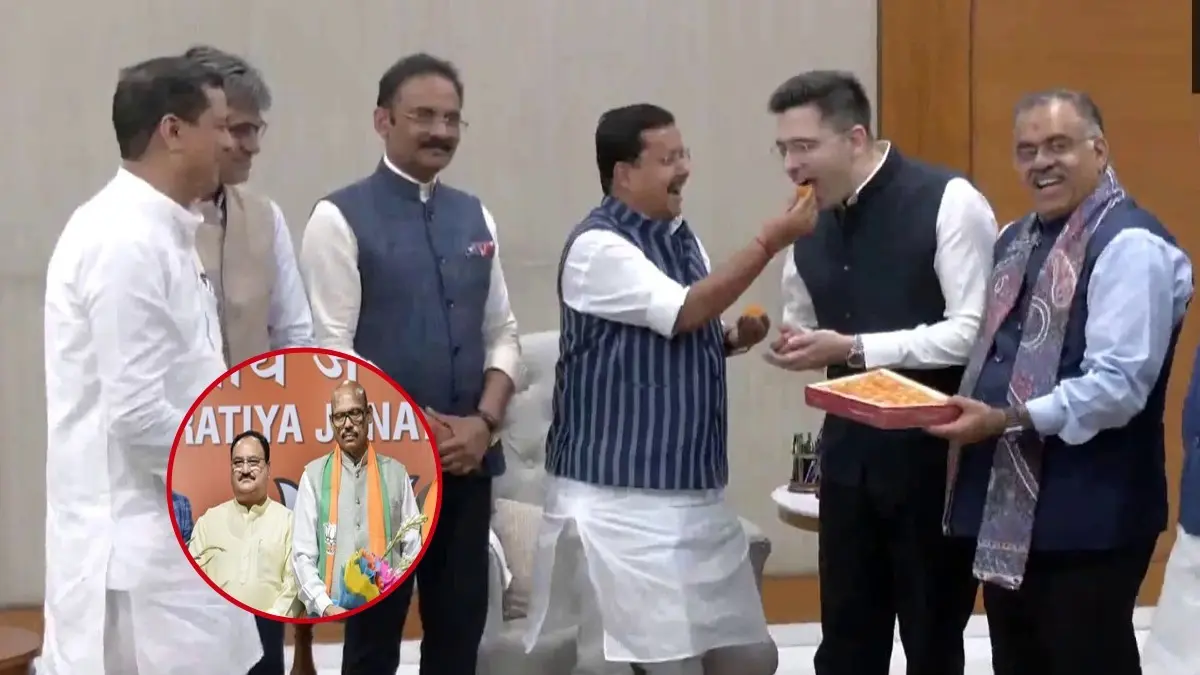
In a significant political development on Friday, April 24, 2026, seven Rajya Sabha MPs from the Aam Aadmi Party (AAP) resigned from the party and announced their merger with the Bharatiya Janata Party (BJP). Led by senior leader Raghav Chadha, the group invoked the anti-defection law's provision under the Tenth Schedule of the Constitution, claiming the support of two-thirds of AAP's Rajya Sabha strength to facilitate a smooth merger without disqualification.
This move marks the latest chapter in a recurring pattern of legislators from smaller or regional parties aligning with the BJP, citing ideological convergence, developmental priorities, and disillusionment with their original parties' directions.
The Pattern Over the Years:
TDP in 2019
Just weeks after a poor performance in the Andhra Pradesh Assembly elections, four out of six TDP Rajya Sabha MPs -- Y.S. Chowdary (Sujana Chowdary), T.G. Venkatesh, C.M. Ramesh, and Garikapati Mohan Rao -- resigned from the Telugu Desam Party. They passed a resolution to merge their legislative group with the BJP and formally joined the party in the presence of senior BJP leaders. The move was presented as being inspired by the national leadership and developmental agenda under Prime Minister Narendra Modi.
Advertisement
LJP in 2021
A dramatic split rocked the Lok Janshakti Party in Bihar when five of its six Lok Sabha MPs rebelled against party chief Chirag Paswan. The faction, led by Pashupati Kumar Paras (Chirag's uncle), effectively realigned closer to the NDA ecosystem, with the episode widely seen as strengthening BJP's influence in Bihar politics. While not a direct Rajya Sabha merger, it followed the same trajectory of internal revolt and consolidation towards the BJP-led alliance.
AAP in 2026
Today, Raghav Chadha, along with MPs including Sandeep Pathak, Ashok Mittal, Harbhajan Singh, Swati Maliwal, Vikram Sahney, and Rajinder Gupta, announced their exit from AAP. Chadha described himself as "the right man in the wrong party," alleging that AAP had drifted from its original focus on public welfare and transparency. The seven MPs, representing a clear two-thirds majority of AAP's Rajya Sabha contingent (out of approximately 10 members), formally sought merger with the BJP, boosting the ruling party's numbers in the Upper House.
Advertisement
What This Means
These repeated instances highlight a broader trend in Indian politics where MPs and legislators, often citing governance issues, leadership differences, or alignment with national development goals, choose to cross over to the BJP. The use of the anti-defection merger clause (requiring two-thirds support) has allowed such shifts without immediate disqualification, enabling smoother consolidations.
Critics from the affected parties have called these developments "Operation Lotus"-style maneuvers, while supporters view them as a natural reflection of political realignment in favor of stability and effective governance.
As the 2026 developments unfold, political observers note that history continues to repeat -- with parties losing key voices in Parliament and the BJP steadily expanding its footprint in the Rajya Sabha through such strategic mergers.
Get Current Updates on India News, Entertainment News, Cricket News along with Latest News and Web Stories from India and around the world.