
‘Illegal And Forcible Occupation’: India Firmly Rejects China-Pakistan Joint Statement on Jammu and Kashmir
India has firmly rejected references to Jammu and Kashmir in a joint statement by China and Pakistan, reaffirming that the region remains an integral part of the nation.
- India News
- 3 min read

;'%3e%3cpath%20d='m8,15.99c4.41,0,7.99-3.58,7.99-7.99S12.41,0,8,0,0,3.59,0,8s3.58,7.99,7.99,7.99Z'%20style='stroke:%23fff;%20stroke-miterlimit:10;%20stroke-width:.02px;'/%3e%3cpath%20d='m3.08,3.37l3.82,5.11-3.84,4.15h.87l3.37-3.64,2.72,3.64h2.94l-4.04-5.39,3.58-3.87h-.86l-3.1,3.35-2.5-3.35h-2.94Zm1.27.64h1.35l5.97,7.99h-1.35l-5.97-7.99Z'%20style='fill:%23fff;'/%3e%3c/g%3e%3c/svg%3e)


India has strongly opposed the recent references made to Jammu and Kashmir in a joint statement issued by China and Pakistan. The controversial remarks followed high-level bilateral talks in Beijing between Pakistani Prime Minister Shehbaz Sharif and Chinese President Xi Jinping.
India’s Uncompromising Stance on Sovereignty
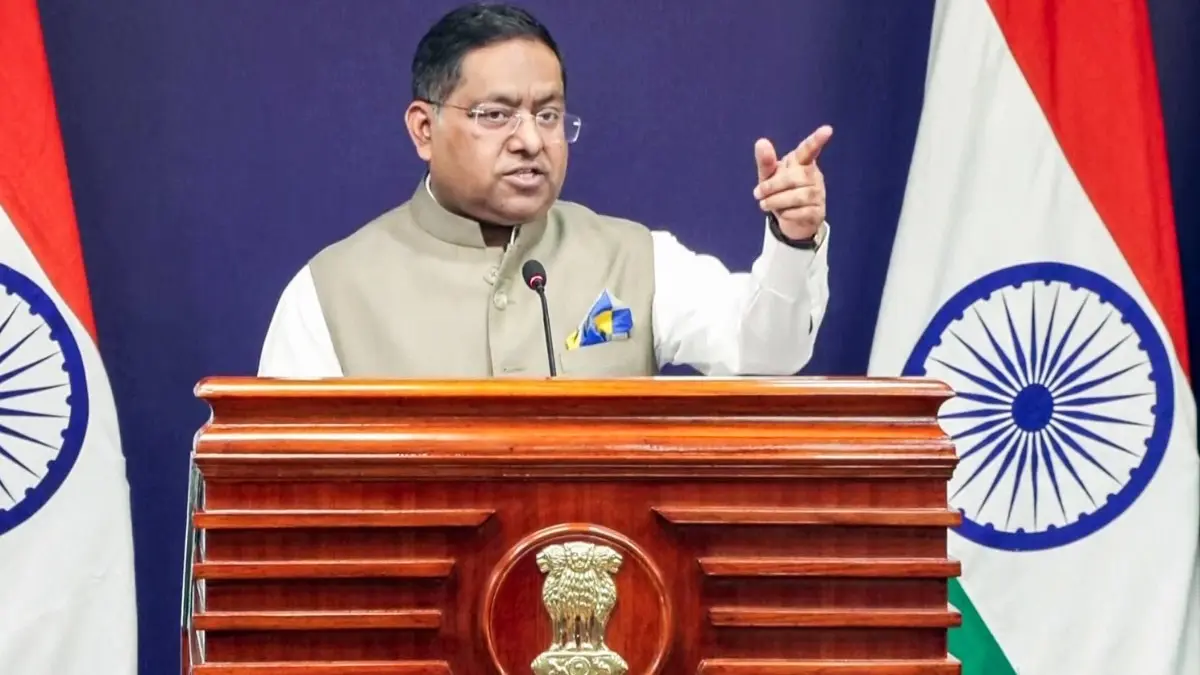
Responding directly to media queries, Ministry of External Affairs (MEA) spokesperson Randhir Jaiswal stated that New Delhi "categorically rejects" these "unwarranted references" to the Union Territory.
Jaiswal emphasized India's unwavering position on its territorial borders, making it clear that external commentary on internal matters carries no legitimacy.
"India’s position is consistent and well known to the concerned parties. The Union Territories of Jammu & Kashmir and Ladakh have been, are and will always remain integral and inalienable parts of India. No other country has the locus standi to comment on the same," Jaiswal said.
Advertisement
Direct Opposition to the CPEC Projects
Beyond the territorial dispute, India raised sharp objections to the inclusion of the China-Pakistan Economic Corridor (CPEC) in the joint discussions. New Delhi reiterated its long-standing grievance that several infrastructure projects under this corridor cut directly through Indian territory currently under Pakistan's "illegal and forcible occupation."
"We resolutely oppose and reject any moves by other countries to reinforce or legitimise Pakistan’s illegal and forcible occupation of these territories, impinging on India’s sovereignty and territorial integrity," the MEA stated. The ministry further noted that these deep concerns have been formally conveyed to both Islamabad and Beijing on numerous occasions.
Advertisement
Dismissing the 'Trans-Boundary Water' Claims
The MEA also took aim at a newer point of discussion between the two neighboring nations regarding "trans-boundary water resources cooperation." Jaiswal pointed out a basic geographical fact to dismiss the claim, highlighting that China and Pakistan do not actually share a natural, legally recognized border.
"As the two countries do not share any boundary, the question of so-called ‘trans-boundary water resources cooperation’ does not arise. India has never recognized the so-called 1963 boundary agreement between Pakistan and China," Jaiswal explained.
A Recurring Diplomatic Flashpoint
This sharp diplomatic pushback follows Pakistan's briefing to Beijing on the current situation in Jammu and Kashmir. According to a text released by Pakistan’s foreign ministry, China repeated its standard diplomatic formula, labeling the Kashmir issue as one "left over from history" that needs a peaceful resolution via the UN Charter, relevant UN Security Council resolutions, and existing bilateral agreements.
The language used in this latest communique closely echoes a similar joint declaration made in 2024. For years, India has firmly resisted any attempts by Pakistan to internationalize the Kashmir dispute, consistently reinforcing that Jammu, Kashmir, and Ladakh remain inseparable components of the Indian nation.
Get Current Updates on India News, Entertainment News, Cricket News along with Latest News and Web Stories from India and around the world.