
India Expands Trade Horizons: Piyush Goyal Reveals Upcoming Big Pacts With Canada, Chile, And Peru After US, EU Agreements
India is pursuing trade pacts with Canada, Chile, Peru, and other major economies after deals with the US and EU, confirms Commerce Minister Piyush Goyal, outlining India's efforts to expand global trade ties and strengthen economic partnerships.
- India News
- 9 min read

;'%3e%3cpath%20d='m8,15.99c4.41,0,7.99-3.58,7.99-7.99S12.41,0,8,0,0,3.59,0,8s3.58,7.99,7.99,7.99Z'%20style='stroke:%23fff;%20stroke-miterlimit:10;%20stroke-width:.02px;'/%3e%3cpath%20d='m3.08,3.37l3.82,5.11-3.84,4.15h.87l3.37-3.64,2.72,3.64h2.94l-4.04-5.39,3.58-3.87h-.86l-3.1,3.35-2.5-3.35h-2.94Zm1.27.64h1.35l5.97,7.99h-1.35l-5.97-7.99Z'%20style='fill:%23fff;'/%3e%3c/g%3e%3c/svg%3e)


New Delhi: Following the historic India-US trade pact after the deal with the European Union (EU), India is now looking for an agreement with other big global economies. Union Commerce Minister Piyush Goyal revealed on Saturday that New Delhi is simultaneously pursuing a series of high-stakes trade pacts with major global economies, including Canada, Chile, Peru and others.
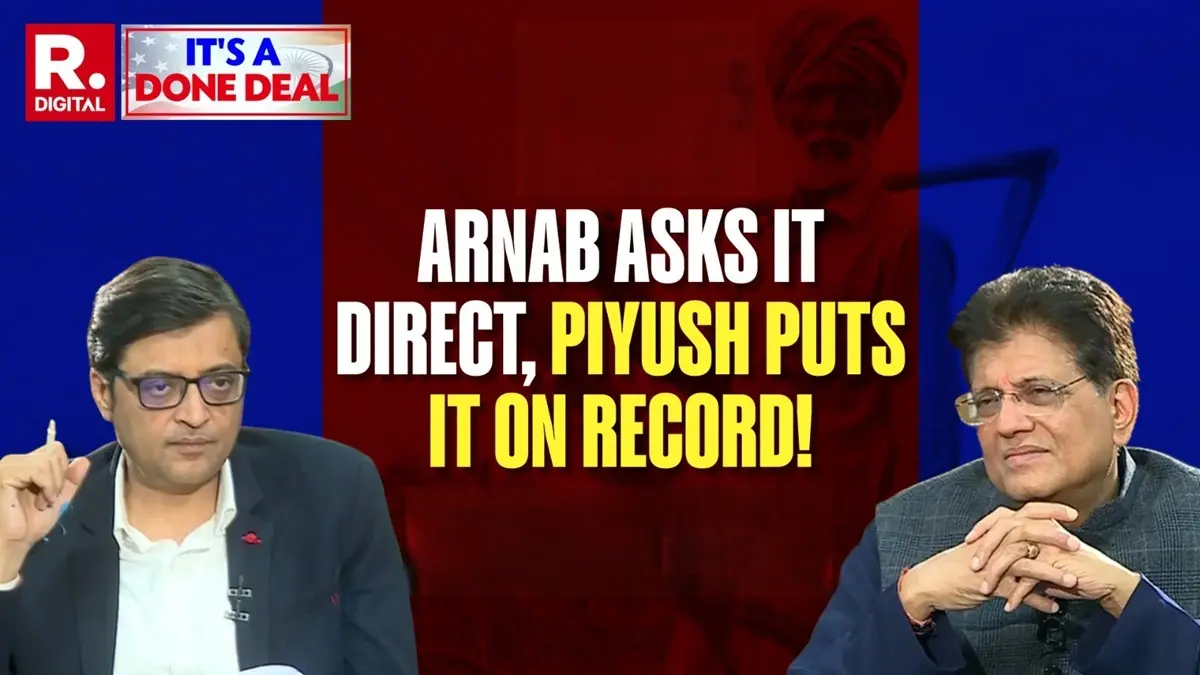
Speaking exclusively to Republic Media Network’s Editor-in-Chief Arnab Goswami on the flagship programme ‘The Nation Wants To Know’, the Union Minister detailed a series of diplomatic activity that extends far beyond Washington.
He said, "Chile and Peru negotiations are going on. We are working with Mercosur to expand the preferential trade agreement. Canada has expressed a desire that they would like to do a free trade agreement with India." Adding that a chief negotiator has already been appointed for the Canadian pact, outlining the global leaning toward India, he noted, “Canada has expressed a desire that they would like to do a free trade agreement with India. We have already got our chief negotiator appointed their finalising terms of reference. The Honourable Prime Minister of Canada is expected to visit India soon. So it's the world is seeing India and the strength of a strong decisive leadership, the demographic dividend that India offers, a democracy where the rule of law prevails, a country where the demand of 1.4 billion Indians powers India to remain probably for the next two or three decades, the fastest growing large economy, the huge amount of investments and infrastructure, the great consumer demand coming out of lower GSTs, the greater purchasing power of our middle class with lower taxes, all in all, they'll see a journey towards a developed and prosperous India, 8x growth in our economy in the next 22 years, is an offer, I think no body can reject.”
India-US Win-Win Deal
Addressing the specific mechanics of the recently announced India-US interim deal, which saw tariffs drop from 50% to as low as 18%, Union Minister Goyal characterised the agreement as a robust and mature partnership. He explained that both teams had laboured for nearly a year following the meeting between Prime Minister Narendra Modi and President Trump in February last year.
Advertisement
In response to Arnab Goswami's question, the Union Minister said, "India is the only country which has done a very detailed, very, very exhaustive negotiation and not entered into a broad agreement without the details being finalised in advance." He confirmed that for phase one of the Bilateral Trade Agreement (BTA), the negotiations are complete, and the teams are now putting the final terms to paper. “There is no more negotiation... we have to reach much greater heights to become a vixen power.”
Firm Red Lines On Agriculture And Dairy
A major portion of the conversation focused on the protection of Indian domestic interests, particularly for farmers. Arnab questioned whether the deal contained any “side letter, review clause or future trigger that can reopen dairy or any sensitive farm sectors once the final deal is signed”. Piyush Goyal was emphatic in his denial, stating that India’s ‘AatmaNirbhar (self-reliant)’ sectors are fully protected.
Advertisement
"I would like to categorically say to the viewers of Republic, Republic Bharat and to the people of India that there is absolutely no side letter, absolutely no trigger, absolutely no possibility or scope in our understanding that all these products which have been kept out and if I can name a few, meat, poultry, all forms of dairy, GM food products, soya meal, maize, cereals like rice and wheat, sugar, millets like jawar, bajra, ragi kodu, amaran, fruits which are in abundance in India like banana, strawberries, cherries, citrus fruits, pulses like green pea, kabulichana, mung, oil seeds, certain animal feed, ground nuts, honey, malt and its extracts, non-alcoholic beverages, flour and meals, starch, essential oils, ethanol for fuel, big thing that we are doing in India, tobacco, all of these things are absolutely out of the deal," Goyal asserted. He further clarified that India has maintained a firm "red line" against Genetically Modified (GM) crops, despite the US being a major exporter, citing the "high trust" and "robust friendship" between PM Modi and President Trump as the catalyst for such mutual respect of sensitivities.
$500 Billion Trade Growth And Technology Security
When asked about President Trump’s mention of a $500 billion commitment, Piyush Goyal clarified that this represents an aggregation of India’s existing growth requirements rather than a forced pledge. He described that India’s massive infrastructure and technology needs, ranging from NVIDIA chips for the national AI mission to Boeing aircraft and cooking coal, naturally align with American supply capabilities.
"What would we do? How would we set up data centres if we didn't get NVIDIA chips?" Goyal remarked. He explained that by securing these critical technologies now, India is insulating itself against future global shortages. "This agreement cements our relationship and ensures that our technology partnership also flourishes... we will need at least 2 trillion dollars of these products in the next five years." He added that this synergy would create massive job opportunities in India’s growing data center and AI ecosystems, powered by the country’s massive shift toward renewable and nuclear energy.
Commerce Minister Goyal said:
"Well, please try to understand that neither do American businesses decide the prices based on government intervention, not as Indian government decide who and from where anybody will purchase a product. But when we look at the areas where US has a comparative advantage, or they're really in a position, they're able to bring to India, a few things come to mind straight away. And as you rightly pointed out, technology is one of them. NVIDIA chips. What would we do? How would we set up data centres if we didn't get NVIDIA chips? Our whole AI mission, semiconductors, our quantum computing mission, all of that is dependent on high-quality technology products from the US. This agreement cements our relationship and ensures that our technology partnership also flourishes and we can get a free flow of these goods, which will help us get huge investments, help us create jobs in data centres, in the creation of data centres, in the operation of data centres, help the ecosystem grow, and help us earn foreign exchange. Similarly, we are a growing country as the fastest growing economy on earth. Our steel production is estimated to double from 140 million to 300 million tonnes and then go further from there. We will need more cooking coal. We already import 15 or 17 billion dollars worth of."
“It will double to 30 billion dollars every year. Similarly, oil, LNG, LPG, crude oil, we have huge requirements and none of these things we are starting from today. Even when the Congress was in government for 10 years, 4 to 14, all of this was important. Even when the government was in power in the 90s, most of these things were important. So I think what we have only done is, instead of working piecemeal, we've aggregated it, we judge that we are already importing about 300 billion dollars of goods, aircraft, you know, are orders placed on Boeing alone, with the G engines and spare parts are 80, 90 or 100 billion dollars. We need all of that in the next five years. When we aggregate all of that, even today, we are importing 300 billion dollars every year. And when we look at the growth in India, particularly in ICD products, the growth is phenomenal. We will need at least two trillion dollars of these products. We need two trillion of these products in the next five years?”
Journey Toward Developed Nation By 2047
Dismissing opposition criticism that labeled the deal as a compromise, Piyush Goyal termed the political backlash as “sour grapes (Angoor Khatte Hain)”. He maintained that the deal provided a massive advantage for Indian labour-intensive sectors, allowing products like textiles, fruits, and vegetables to enter the US market at zero duty.
"In any transaction, if you respect each other's sensitivities, you can go far. And every country has certain USPs, the American USP at a $90,000 per capita income are vastly different from India's USPs. So the tradeoff is not always a straight one is to one. If I ask for concessions in textiles, it doesn't mean that they're looking for concessions in textiles, because they can't make textiles at the cost which we can. We are actually supporting their economy. Similarly, when I asked them to supply me ICT products, they're not asking me for similar correspondingly that I'm not asking them, that you allow me ICT," the Union Minister asserted.
He concluded by confirming that the final legal agreement is expected to be signed in March, possibly during a visit by US Trade Representative Jameson Greer to New Delhi. "The world is seeing a journey towards a developed and prosperous India... 8x growth in our economy in the next 22 years is an offer I think nobody can reject."
Piyush Goyal Takes On Rahul Gandhi
On being asked about the Opposition's criticism and mockery of the trade pact, Piyush Goyal blatantly took on Rahul Gandhi and the Opposition over the India-US trade deal, reflecting his strong defence of the government's efforts. Goyal accused the Opposition, particularly Rahul Gandhi, of having "sour grapes" and being unable to reconcile with the fact that the deal is beneficial for India. He suggested that the Opposition's criticism is driven by their own interests and lack of concern for national interest.
He also criticised the Opposition for being dynastic and only looking out for their own families, rather than the country's interests. He specifically mentioned the Gandhi family, the Karunanidhi family, the Samajwadi Party family and other prominent political families in India.
Minister Piyush Goyal stressed that the India-US trade deal is an important achievement and will bring numerous benefits to India, including new opportunities for youth, women, and various industries. He accused the Opposition of being critical of the deal simply to criticise, rather than considering the country's interests. He reiterated that the government will continue to work 24/7 to ensure India's development and prosperity, with PM Modi leading the effort.
Get Current Updates on India News, Entertainment News, Cricket News along with Latest News and Web Stories from India and around the world.