
Inside Dharmendra Pradhan's Resignation: Reasons and Key Takeaways From His Letter To PM Modi
In his formal resignation statement addressed to the nation’s youth, Union Education Minister Dharmendra Pradhan framed his decision not as an admission of personal administrative failure, but as a moral step in the interest of student welfare and national unity.
- India News
- 3 min read

;'%3e%3cpath%20d='m8,15.99c4.41,0,7.99-3.58,7.99-7.99S12.41,0,8,0,0,3.59,0,8s3.58,7.99,7.99,7.99Z'%20style='stroke:%23fff;%20stroke-miterlimit:10;%20stroke-width:.02px;'/%3e%3cpath%20d='m3.08,3.37l3.82,5.11-3.84,4.15h.87l3.37-3.64,2.72,3.64h2.94l-4.04-5.39,3.58-3.87h-.86l-3.1,3.35-2.5-3.35h-2.94Zm1.27.64h1.35l5.97,7.99h-1.35l-5.97-7.99Z'%20style='fill:%23fff;'/%3e%3c/g%3e%3c/svg%3e)


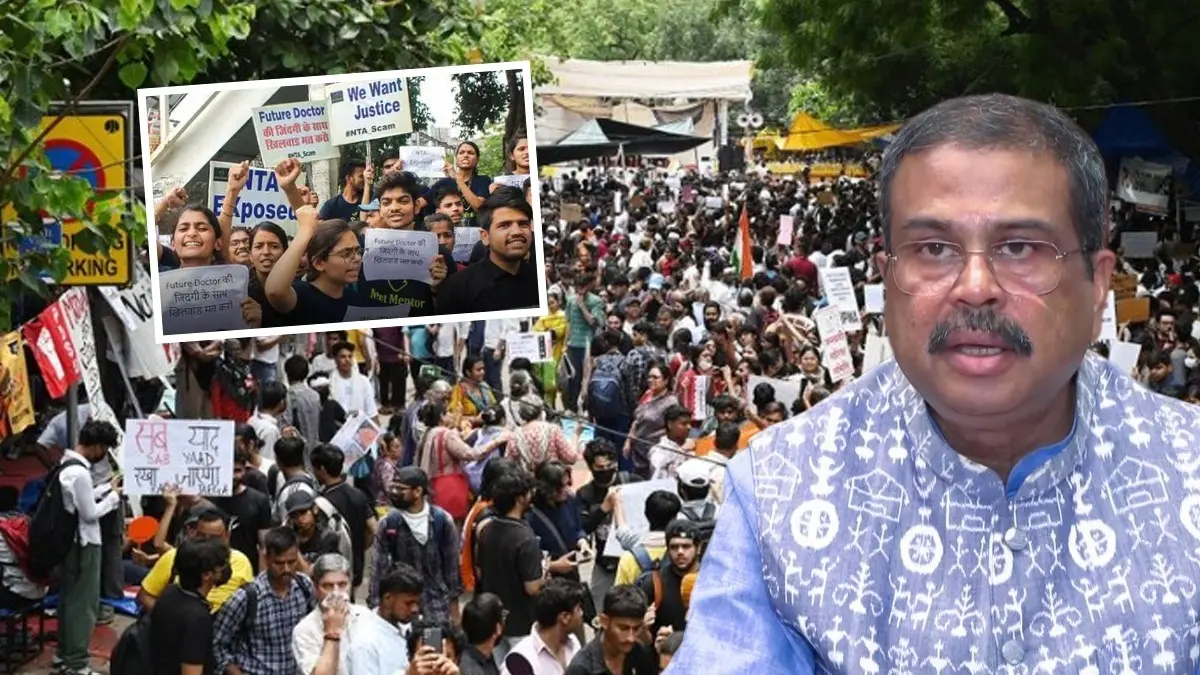
New Delhi: In a major political development following weeks of escalating student-led demonstrations over the NEET-UG 2026 examination paper leak controversy, Union Education Minister Dharmendra Pradhan has tendered his resignation to Prime Minister Narendra Modi.
Pradhan’s exit marks a rare instance of the Central government yielding to sustained street pressure and public agitation. Below is a detailed breakdown of the key factors, events, and political dynamics that culminated in the Union Minister stepping down.
Key Drivers Behind the Resignation
1. Sustained Pressure from the Cockroach Janta Party (CJP)
The agitation was primarily spearheaded by the Cockroach Janta Party (CJP), a youth-led movement holding continuous demonstrations at Delhi’s Jantar Mantar. During high-level talks with senior government functionaries, the CJP presented a slate of demands focused on comprehensive education reforms, making Pradhan’s immediate resignation non-negotiable. While the Centre initially accepted most structural demands and sought more time on the minister's departure, internal deliberations ultimately forced the government to concede.
Advertisement
2. Amplification by Sonam Wangchuk’s 26-Day Fast
The movement gained massive nationwide momentum when renowned Ladakhi activist Sonam Wangchuk joined the protest, embarking on a 26-day hunger strike starting June 28 at Jantar Mantar. Wangchuk’s fast drew global and national spotlight to systemic failures in high-stakes examinations. Although Wangchuk formally ended his fast in the presence of Union Ministers J.P. Nadda and Jitendra Singh following top-level government assurances, the momentum of the movement remained unyielding.
Advertisement
3. Allegations of Police High-Handedness & Threat of Escalation
Tensions escalated sharply after CJP Chief Spokesperson Saurav Das accused the Delhi Police of unconstitutionally detaining young protesters and creating an atmosphere of intimidation. Das cited instances where students bringing food packets to the protest site were detained by police. The CJP issued an ultimatum: if detentions did not stop immediately, protesters would march to the Delhi Police Headquarters for a mass dharna.
4. Impending Nationwide Call for Solidarity
Adding further pressure on the executive, the CJP called for a nationwide silent candle march on July 26, instructing student unions and civil society groups across all districts to gather at local Collectorates. Facing the prospect of widespread, decentralized protests across multiple states, the government opted to address the CJP's final demand ahead of the planned march.
How Pradhan Framed His Exit
In his formal resignation statement addressed to the nation’s youth, Pradhan framed his decision not as an admission of personal administrative failure, but as a moral step in the interest of student welfare and national unity.
"Considering the situation at Jantar Mantar and across the country... with the aim of preventing anti-national forces from exploiting it, preserving national unity... I have submitted my resignation to the Honorable Prime Minister," he said.
Core Arguments Presented in Pradhan’s Statement:
Executive Measures Taken: Pradhan reiterated that the government took swift action upon detecting irregularities in the May 3 test—including handing the probe over to the Central Bureau of Investigation (CBI), holding a re-examination for over 20 lakh students on June 21, and mandating Computer-Based Tests (CBT) for future NEET-UG exams.
Accountability vs. Misinformation: He asserted that he took responsibility from day one to dismantle the "exam mafia," accusing opposition political entities of misleading students and exploiting the situation for political mileage.
Depoliticizing the Issue: By stepping down, Pradhan stated he aimed to ensure that students' futures do not become entangled in prolonged legal or political confusion, allowing them to focus back on their education.

What Lies Ahead?
With Union Minister Dharmendra Pradhan’s resignation conceded, attention now turns to whether the student-led agitation at Jantar Mantar will wind down or pivot toward broader structural changes in national entrance testing frameworks.
Get Current Updates on India News, Entertainment News, Cricket News along with Latest News and Web Stories from India and around the world.