
Kashmir’s Queen of Wetlands Shrinks: Audit Warns Hokersar Losing Water, Birds, And Biodiversity
CAG warns of rampant encroachment, untreated sewage inflows, and failed conservation measures of Hokersar Lake, Kashmir’s largest wetland and a vital habitat for migratory birds, that threaten its survival and “pristine glory”.
- India News
- 2 min read

;'%3e%3cpath%20d='m8,15.99c4.41,0,7.99-3.58,7.99-7.99S12.41,0,8,0,0,3.59,0,8s3.58,7.99,7.99,7.99Z'%20style='stroke:%23fff;%20stroke-miterlimit:10;%20stroke-width:.02px;'/%3e%3cpath%20d='m3.08,3.37l3.82,5.11-3.84,4.15h.87l3.37-3.64,2.72,3.64h2.94l-4.04-5.39,3.58-3.87h-.86l-3.1,3.35-2.5-3.35h-2.94Zm1.27.64h1.35l5.97,7.99h-1.35l-5.97-7.99Z'%20style='fill:%23fff;'/%3e%3c/g%3e%3c/svg%3e)


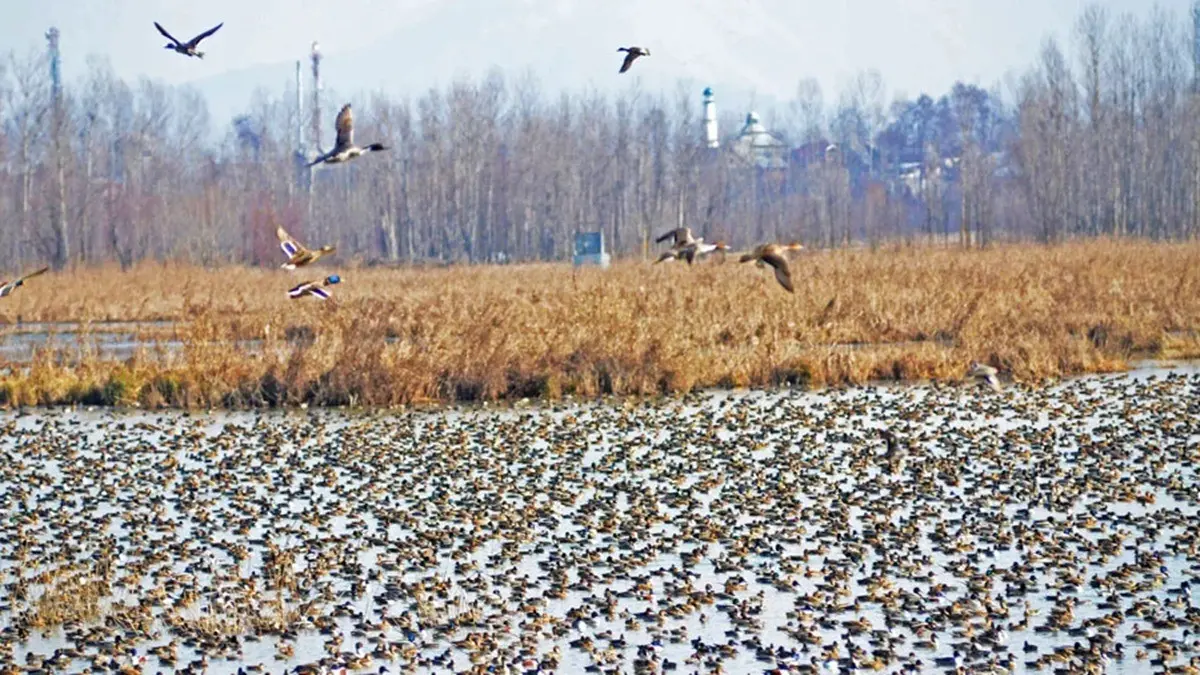
Srinagar: Hokersar Lake, Kashmir’s largest wetland and a vital habitat for migratory birds, is facing alarming ecological decline as the Comptroller and Auditor General (CAG) warns of rampant encroachment, untreated sewage inflows, and failed conservation measures that threaten its survival and “pristine glory”.
CAG’s 2023–24 audit revealed that 2,528 kanals of lake area have been encroached upon for construction, plantations, and agriculture.
Despite notices, authorities failed to reclaim the land. Land-use analysis between 2014 and 2020 showed a 7% decline in open water, while scrub habitat surged by 1,157%, built-up zones expanded by 102%, and aquatic vegetation grew by 42%, all driven by human activity and lack of scientific planning.
Audit report reveals that the Padshahi Bagh spill channel, designed to carry 17,000 cusecs, now handles only 6,000 due to siltation and debris. Despite spending Rs46.29 crore between 2018 and 2022 on dredging and slope protection, critical works like hydraulic gates, silt retention basins and sewage treatment plants were not executed, undermining the regulation of water flow and quality.
Advertisement
The audit further highlighted the disappearance of native aquatic species, the invasion of non-native plants, and declining oxygen levels caused by nutrient loading.
Catchment areas such as Haji Bagh, Soibug, and HMT (Zainakot) have seen rapid urbanization without sewage treatment facilities, worsening pollution inflows.
Advertisement
“Hokersar has always been a sanctuary for migratory birds from Central Asia, and if the wetland continues to shrink, we risk losing this irreplaceable spectacle. Wetlands are not just water bodies, they are living ecosystems, and Hokersar’s decline means the loss of biodiversity and livelihoods tied to it,” said Raouf Rasool, a local bird watcher.
The CAG criticized the Wildlife Protection Department for relying on fragmented annual plans instead of a comprehensive conservation strategy.
It recommended scientific dredging, survey and demarcation to reclaim encroached land, and a holistic plan addressing hydrology, biodiversity, and pollution to safeguard Hokersar’s ecological balance and livelihood value.
Declared a Conservation Reserve under the J&K Wildlife (Protection) Act, 1978, and fed by the Doodhganga and Sukhnag streams, Hokersar’s fate now hinges on urgent corrective measures.
“For bird watchers and environmentalists, the lake’s survival is not just about water, it is about preserving a living heritage that connects Kashmir to the migratory pathways of the world,” said Ghulam Rasool, a nature lover.
Get Current Updates on India News, Entertainment News, Cricket News along with Latest News and Web Stories from India and around the world.