
Kirana Hills Smoke Mystery Solved? Ex-CDS Anil Chauhan Reveals Why Pakistan's Nuclear Hills Were Seen Burning During Ops Sindoor
Former CDS General Anil Chauhan clarified that smoke from Kirana Hills during Operation Sindoor may have been from a loitering munition hunting radar near Sargodha that missed the target, not a deliberate strike on Pakistan's nuclear infrastructure.
- India News
- 6 min read

;'%3e%3cpath%20d='m8,15.99c4.41,0,7.99-3.58,7.99-7.99S12.41,0,8,0,0,3.59,0,8s3.58,7.99,7.99,7.99Z'%20style='stroke:%23fff;%20stroke-miterlimit:10;%20stroke-width:.02px;'/%3e%3cpath%20d='m3.08,3.37l3.82,5.11-3.84,4.15h.87l3.37-3.64,2.72,3.64h2.94l-4.04-5.39,3.58-3.87h-.86l-3.1,3.35-2.5-3.35h-2.94Zm1.27.64h1.35l5.97,7.99h-1.35l-5.97-7.99Z'%20style='fill:%23fff;'/%3e%3c/g%3e%3c/svg%3e)


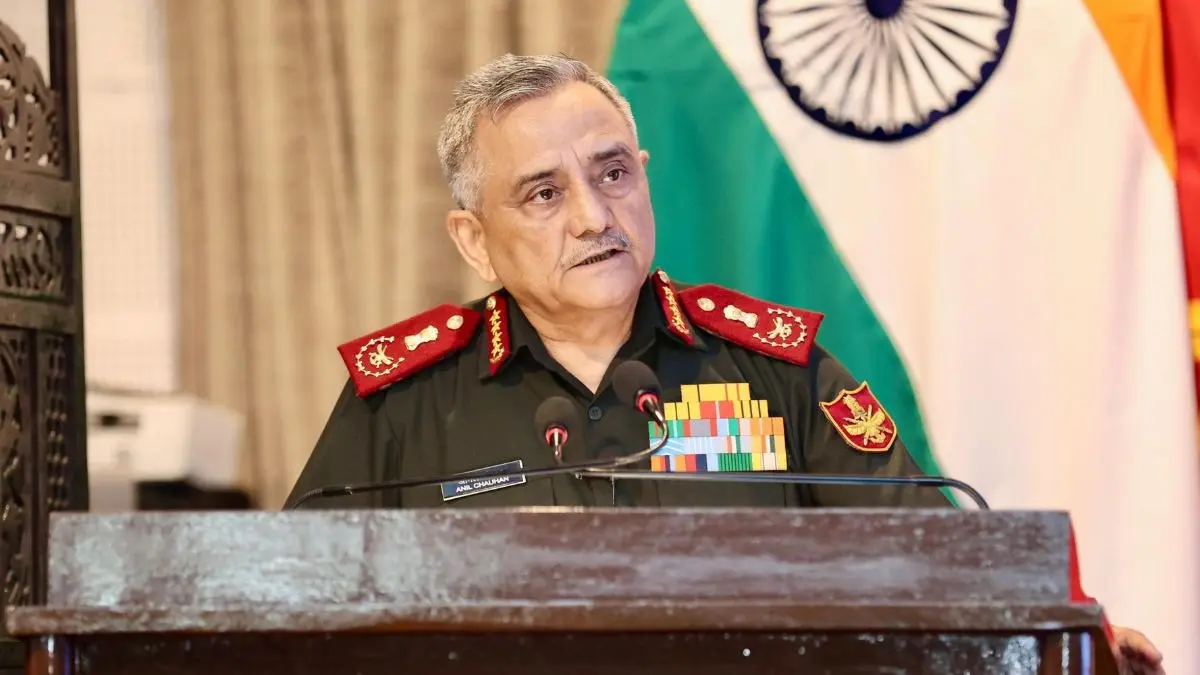
New Delhi: Former Chief of Defence Staff (CDS) General Anil Chauhan (Retd) has put to rest speculation surrounding a reported missile hit on the Kirana Hills near Sargodha during Operation Sindoor, suggesting that the smoke seen rising from the area may have been caused by a loitering munition that came down after failing to locate a radar.
Kirana Hills, situated about 10 km north of Sargodha, is linked to Pakistan's nuclear programme. The speculation that India had struck the sensitive area gained traction after Pakistani media circulated visuals showing smoke emanating from the hills amid the military face-off.
Addressing an event hosted by the Vivekananda International Foundation, Anil Chauhan offered a detailed explanation of what might have happened over Sargodha.
Loitering Munition May Have Hit Hill After Missing Radar
According to the former CDS, India had deployed a number of loitering missions in the direction of Sargodha and Kirana Hills with the specific objective of hunting for Pakistani radars. He said, "Before those strikes, we had sent in a lot of loitering missions at Sargodha and Kirana Hills. So the loitering mission was looking for radars which are in and around Sargodha."
Advertisement
Explaining the functioning of such systems, he noted that a loitering munition can stay airborne for close to 2 hours while searching for a target, and if it does not acquire one, it eventually descends and impacts the ground. "It must have come and hit one of those hills. So that could be one of the reasons... even Pakistani media showed some kind of images in which there was smoke coming out from Kirana Hills," Chauhan said.
His account made it clear that Pakistan's Kirana Hills were hit during Operation Sindoor, though he also clarified that any impact in the Kirana Hills was not a calculated strike on the location or on its nuclear-related infrastructure.
Advertisement
Lower Airspace Use Was A Calculated Third Option
General Chauhan (Retd) stated that the employment of loitering munitions around Sargodha was part of a larger operational choice to exploit the lower airspace during Operation Sindoor. He termed it as a third option, different from the ground-based retaliation undertaken after the Uri attack and the large air package that was deployed after Pulwama.
"During Operation Sindoor, we decided to use a third option, that is, to exploit the lower airspace. That means it would have kept the threshold of conflict low. It would have assured success and then there would have been an element of surprise," the retired General of the Indian Army observed.
He pointed out that the lower air domain can be effectively utilised by drones, loitering munitions, attack helicopters and other low-level platforms.
Sargodha Among Targets Cleared After Pakistan Sought Talks
The former CDS also disclosed that India had authorised additional strikes on Pakistani military assets even after Islamabad had sought dialogue, and Sargodha was among those cleared. He recalled that Pakistan had reached out for talks around 10 am, at the very moment the Air Chief sought his guidance on striking Sargodha. "Once the Pakistanis had picked up the phone and said they wanted to talk at about 10 AM, the Air Chief asked me whether he should strike Sargodha. I said, 'Go ahead'," Chauhan recounted.
He then asked the Air Chief to pick two more targets, as he stressed, "I said, could you please identify two more targets, so one of the targets he identified was Skardu. We gave a yes, but after some time, the weather was bad over it and they had to change over to Bholari," he said.
He underlined India's escalation approach, saying, "The last strike or the winning note will always be delivered by us and not by the Pakistanis." His remarks provided fresh insight into India's strategy of retaining the initiative and ensuring it delivered the final blow even after Pakistan initiated ceasefire contacts.
Pakistan Was Blind About The Strike Results
General Chauhan (Retd) further stated that Pakistan remained unaware whether its own strikes had achieved their intended effect and was looking for satellite proof until May 12. "They were actually after 10th also till about 12th they were trying their best to obtain images so that they have some evidence," he said.
He noted that commercial satellite imagery was accessible from American and Chinese firms, and Pakistan attempted to source images from other Chinese satellites as well, but could not establish that its strikes had hit anything. "But since they are not able to hit any target, they got no evidence," he added.
Why India Had The Operational Edge
Attributing India's success in Operation Sindoor to superior situational awareness, enhanced battlefield transparency and seamless networking among the 3 services, Anil Chauhan said that these factors proved decisive. He emphasised, “If I had to list out a couple of reasons for India's victory, I would say that we had better situational awareness, better battlefield transparency because we are better networked.”
He explained that the Army, Navy and Air Force shared a common operational picture, noting, “Army, Navy and Air Force, this situation was available to us in one manner for all of us. So, we were able to make better decisions.”
He also credited clear political direction for empowering the armed forces as he said, "The second thing I could attribute to victory was, I think, clear political direction, which gave us a free hand to plan operations."
3 Services Operated As One Force
Former CDS Chauhan underlined that unlike in the past, none of the 3 services projected their capability shortfalls before the political leadership during the operation. He detailed the statement, saying, "We have seen in the past, sometimes in front of political leadership, people bring out the kind of deficiencies that they have. This particular operation stands out in some particular manner in which all three services and I, right from day one, did not bring any of these kinds of deficiencies." Instead, the services worked with a unified plan and addressed operational gaps internally within the military structure.
Operation Sindoor was launched by India last year on May 7, in response to the Pahalgam terror attack of April 22, which claimed 26 lives. In the opening phase, the armed forces hit 9 facilities associated with terrorist groups in Pakistan and Pakistan-occupied Jammu and Kashmir (PoJK) using precision and stand-off weapons, enabling aircraft to engage without venturing deep into Pakistani airspace.
The operation subsequently escalated after Pakistan undertook military actions against India, leading the Indian Air Force (IAF) to target Pakistani military infrastructure, including airbases and radar sites. The confrontation concluded through direct communication between the Directors General (DGs) of Military Operations after Pakistan sought a ceasefire on the morning of May 10.
Get Current Updates on India News, Entertainment News, Cricket News along with Latest News and Web Stories from India and around the world.