
Korean Heart Emojis To 2 AM Overthinking: Gurudev’s 3-Hour Pep Talk For Gen Z At 1300 Indian Campuses Goes Viral
Gurudev Sri Sri Ravi Shankar addressed thousands of Indian students on relationships, attention spans, AI and resilience, urging them to stay mischievous, breathe through stress, and choose JOMO over FOMO.
- India News
- 5 min read

;'%3e%3cpath%20d='m8,15.99c4.41,0,7.99-3.58,7.99-7.99S12.41,0,8,0,0,3.59,0,8s3.58,7.99,7.99,7.99Z'%20style='stroke:%23fff;%20stroke-miterlimit:10;%20stroke-width:.02px;'/%3e%3cpath%20d='m3.08,3.37l3.82,5.11-3.84,4.15h.87l3.37-3.64,2.72,3.64h2.94l-4.04-5.39,3.58-3.87h-.86l-3.1,3.35-2.5-3.35h-2.94Zm1.27.64h1.35l5.97,7.99h-1.35l-5.97-7.99Z'%20style='fill:%23fff;'/%3e%3c/g%3e%3c/svg%3e)


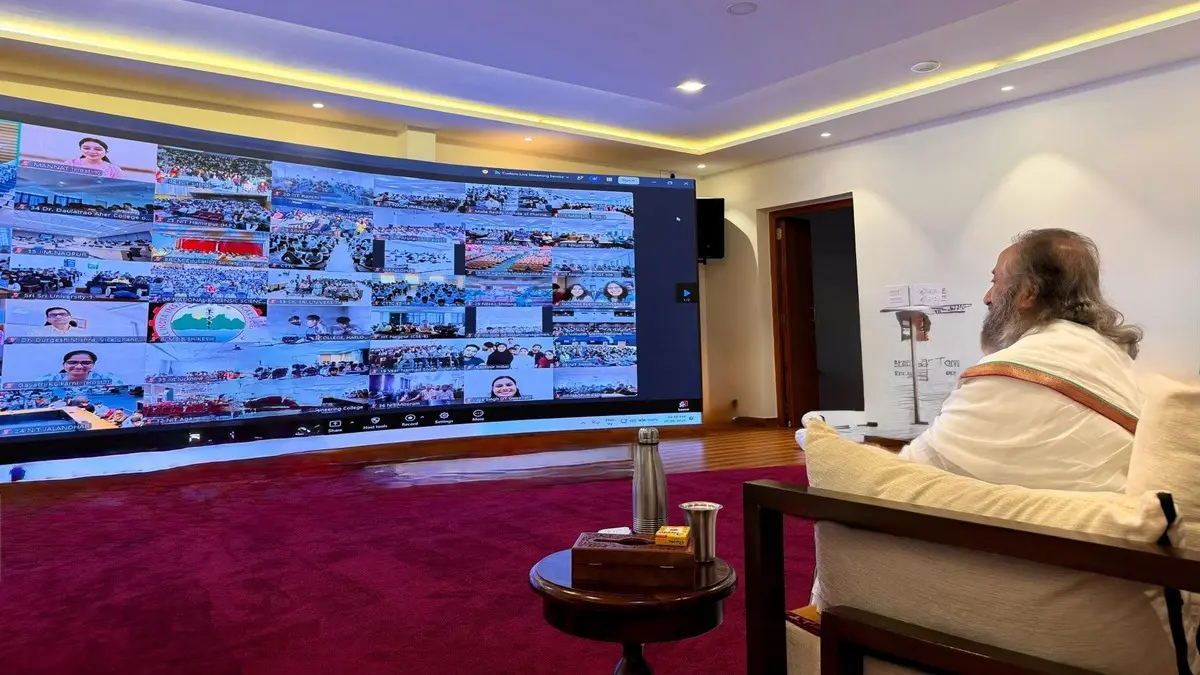
Global humanitarian and spiritual leader Gurudev Sri Sri Ravi Shankar took centre stage on Thursday in an unfiltered, 3-hour dialogue with thousands of first-year students across India, answering everything from the meaning behind the Korean heart emoji to the 2 am overthinking that keeps young minds awake.
Fielding questions with humour, candour and his trademark habit of answering with another question, Gurudev connected virtually with participants from over 1300 higher-education institutions, including IITs, IIMs, NITs and AIIMS. The session was part of the 7th edition of the National Induction Programme, convened by the Art of Living’s Youth Desk, bringing together a generation that has grown up hyper-connected yet often feels unsteady about purpose and belonging.
The session took the shape of an open conversation rather than a formal address, with students placing every concern they were carrying directly on the table while Gurudev answered with personal stories, practical breathing techniques, and a clear reminder that the mischief and curiosity which define youth must be protected so long as they do not cause pain to others.

Generation Asking Everything, From Emojis To Existential Doubt
The session began lightly but went deep as it progressed. Students asked about relationships in the age of dating apps, specifically whether to opt for situationships or soulmates. Gurudev turned the question back on them, asking, “Put yourself in the shoes of the other person. Would you like it if you chose someone as your soulmate and they only chose to see you as a situationship? What would you choose then?”
Advertisement
Another student joining from Kashmir spoke about feeling a quiet sense of meaninglessness even when life appeared “okay” on the surface. Gurudev responded with warmth, noting that her question reflected a bigger struggle among young people worldwide. He suggested something simple and immediate, which is attention to the breath, as a way to move past loneliness and reconnect with purpose.
Attention, Anger And The Scroll Economy
During the session, much of the discussion turned to the pressures of digital life, with Gurudev pointing to “attention deficiency syndrome” as increasingly common. “Before, the attention span was 40 minutes, 50 minutes. Today, it is only 30 seconds,” he said.
Advertisement
His prescription was not digital detox alone, but inner steadiness, as he said, “When they feel free from stress from inside, they have a lot of energy. Their attention also is much better.”
Gurudev addressed anger with characteristic lightness, advising, “Have some humor in life.” He explained that anger often ends up punishing the person who holds it and his practical tip was to take a few deep breaths, turn around, and try to turn the moment into humour.
On social media and artificial intelligence (AI), he urged caution, saying, “Whatever comes on social media, don’t believe everything is true. A lot of it is fake, AI-driven.”
Resilience, Ambition And The Art Of Friendship
Calling students the real wealth of the world, Gurudev outlined Indian talent across engineering, medicine, computer science, fashion and hospitality. “Wherever in the world you find top performers, there is one Indian in that, at least one,” he said, stressing that achievement alone was not enough and “what is needed is a resilient personality".
Offering balance to doubt, he explained that resilience is not about never failing, saying, “Even those who fail in the beginning, later on, become great entrepreneurs. That is why you should have confidence in yourself……There is nothing wrong having doubt, but don’t let it sink too much into you and become your own personality.”
He closed the session with advice on friendship and joy, suggesting the students navigate FOMO, saying, “A good friend is the one with whom you talk and come out of your FOMO. You live in JOMO and give others FOMO,” drawing cheers from the audience.
He was emphatic on youth itself, saying, “Stay mischievous. This is the sign of youth…..You’ll have to be dynamic and mischievous, but your mischief shouldn’t cause pain to others.” He said that the enduring message was that young people need not become less ambitious, less questioning, or less adventurous to find steadiness.
New Research Backs The Breathwork And Belonging
The conversation comes at a time when new research is drawing attention to the role of breathwork in schools. An interesting new study from UCLA followed 174 teenage girls and tested a programme that combined structured breathing with social-emotional learning. The findings pointed to a notable impact, particularly for students who had faced significant early hardship.
Further, in the data, what stood out was how strongly the girls who had experienced four or more adverse childhood experiences responded. The researchers reported that the group, often the most difficult for school mental-health initiatives to reach, showed a stronger sense of belonging and greater feelings of social connection after taking part in the programme.
The breathing practice at the centre of the UCLA study was Sudarshan Kriya, the rhythmic breathing technique taught by the Art of Living. The researchers noted that the important finding was that the young people carrying the greatest burden of adversity appeared to benefit the most, suggesting that simple, structured breath practices may offer meaningful support where it is needed most.
Get Current Updates on India News, Entertainment News, Cricket News along with Latest News and Web Stories from India and around the world.