
Merger or Defection? What Does the Law Say? Decoding Raghav Chadha’s ‘Merger With BJP’ Remark
Raghav Chadha's claim of merging with the BJP hinges on the anti-defection law in the 10th Schedule of the Indian Constitution (introduced by the 52nd Amendment in 1985 & later amended), specifically, Paragraph 4 which provides an exception to disqualification for defection in the case of a merger
- India News
- 4 min read

;'%3e%3cpath%20d='m8,15.99c4.41,0,7.99-3.58,7.99-7.99S12.41,0,8,0,0,3.59,0,8s3.58,7.99,7.99,7.99Z'%20style='stroke:%23fff;%20stroke-miterlimit:10;%20stroke-width:.02px;'/%3e%3cpath%20d='m3.08,3.37l3.82,5.11-3.84,4.15h.87l3.37-3.64,2.72,3.64h2.94l-4.04-5.39,3.58-3.87h-.86l-3.1,3.35-2.5-3.35h-2.94Zm1.27.64h1.35l5.97,7.99h-1.35l-5.97-7.99Z'%20style='fill:%23fff;'/%3e%3c/g%3e%3c/svg%3e)


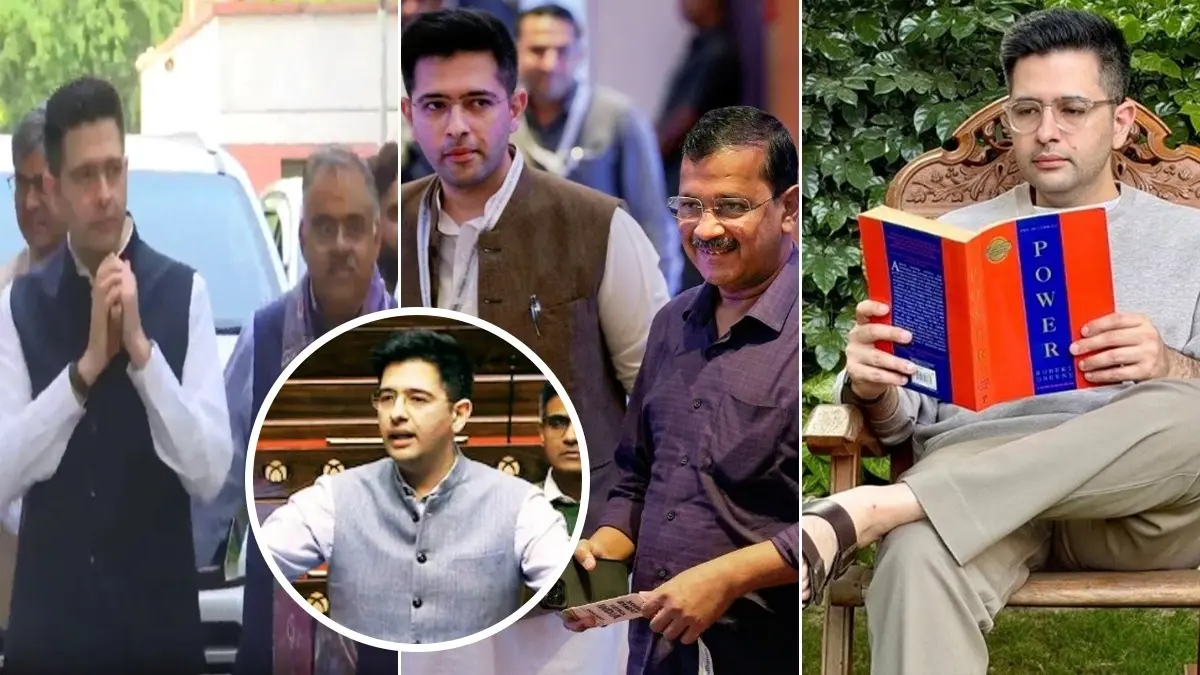
New Delhi: In a dramatic political development that has sent shockwaves through the Aam Aadmi Party (AAP), senior leader and Rajya Sabha MP Raghav Chadha announced his resignation from the party and declared that he, along with approximately two-thirds of AAP's Rajya Sabha members, are "merging" with the Bharatiya Janata Party (BJP). Flanked by MPs Sandeep Pathak and Ashok Mittal at a press conference, Chadha accused AAP of deviating from its founding principles of honest politics, calling it "corrupt and compromised" and describing himself as "the right man in the wrong party."
Chadha named several other AAP Rajya Sabha MPs, including Harbhajan Singh, Swati Maliwal, Vikram Sahney, and Rajinder Gupta, as part of the group, claiming they represent more than two-thirds of the party's 10-member strength in the Upper House. He stated that a signed letter invoking constitutional provisions had already been submitted to the Rajya Sabha Chairman earlier in the day to formalise the move.
The announcement comes days after AAP demoted Chadha from his position as deputy leader in the Rajya Sabha, amid alleged internal tensions over his approach in Parliament.
The Legal Angle: What Does the Law Actually Say?
Chadha's claim hinges on the anti-defection law enshrined in the Tenth Schedule of the Indian Constitution (introduced by the 52nd Amendment in 1985 and later amended). Specifically, Paragraph 4 provides an exception to disqualification for defection in the case of a merger.
Advertisement
As per the norms:
--A member shall not be disqualified if their "original political party" merges with another party, and they choose to join the new party or a group formed by the merger.
Advertisement
--Crucially, a merger is deemed to have taken place if not less than two-thirds of the members of the legislature party (in this case, AAP MPs in the Rajya Sabha) agree to it.
This provision is designed to protect group shifts while discouraging individual defections. In practice, it has allowed legislators to switch sides without losing their seats when a sufficient majority within the legislative wing supports the move. Chadha and his group are relying on this to retain their Rajya Sabha membership post-switch.
However, legal experts and past interpretations point to important nuances:
The exception primarily applies to the legislature party (elected representatives in a specific House). The Supreme Court has, in related split cases, emphasised that a split or merger in the legislative wing should ideally reflect a broader division in the party's organisational structure, though in many real-world instances, the two-thirds threshold in the legislature alone has been treated as sufficient for the exception to kick in.
This move does not constitute a full merger of the Aam Aadmi Party as a whole with the BJP. AAP remains a registered national party with Arvind Kejriwal as its National Convener. The organisational wing, state units (especially in Delhi and Punjab), and other elected representatives (MLAs, Lok Sabha MPs if any, and local leaders) are not bound by the Rajya Sabha group's decision.
The Election Commission of India (ECI) oversees party registrations under Section 29A of the Representation of the People Act, 1951. A complete party merger would require formal organisational approval, resolution processes as per the party's constitution, and potentially ECI scrutiny for symbol allocation, recognition, and other matters. A factional legislative shift like this does not automatically dissolve or subsume the parent party.
In short, Chadha and his colleagues may successfully protect their Rajya Sabha seats under the merger exception, but they cannot unilaterally "merge AAP with BJP" in a legal or organisational sense. AAP Convenor Arvind Kejriwal and the remaining AAP leadership retain control over the party's national structure, symbols, and broader operations.
Implications for AAP and the Political Landscape
This development marks a significant setback for Arvind Kejriwal, especially after recent challenges to AAP's dominance in Delhi and Punjab. It highlights internal fissures and could trigger further exits or legal battles over party assets, recognition, or disqualification petitions.
The BJP, on the other hand, stands to gain experienced parliamentarians without the usual defection penalties, bolstering its numbers in the Rajya Sabha.
As reactions pour in -- with Punjab CM Bhagwant Mann and other AAP leaders expected to respond strongly -- the focus now shifts to whether the Rajya Sabha Chairman accepts the merger claim, any counter-moves by AAP's organisational leadership, and potential ECI or court interventions.
This episode underscores a recurring feature of Indian politics: the anti-defection law's merger clause often enables "wholesale" shifts at the legislative level while leaving the party's core intact, raising questions about party discipline and voter mandates.
Whether this proves to be a crippling blow to AAP or merely a contained legislative rupture remains to be seen. For now, Raghav Chadha's move has rewritten the script in Delhi's power corridors.
Get Current Updates on India News, Entertainment News, Cricket News along with Latest News and Web Stories from India and around the world.