
Mothers Died, Newborns Orphaned: After Coldrif Horror, ‘Fake Oxytocin’ Exposes Deadly Drug Failure That’s Turning Hospitals Into Death Traps
From toxic cough syrups killing children to suspected fake oxytocin injections linked to deaths of new mothers in Rajasthan, Republic investigates whether corruption, weak oversight and failed accountability are turning India’s medicine system into a deadly gamble.
- India News
- 5 min read

;'%3e%3cpath%20d='m8,15.99c4.41,0,7.99-3.58,7.99-7.99S12.41,0,8,0,0,3.59,0,8s3.58,7.99,7.99,7.99Z'%20style='stroke:%23fff;%20stroke-miterlimit:10;%20stroke-width:.02px;'/%3e%3cpath%20d='m3.08,3.37l3.82,5.11-3.84,4.15h.87l3.37-3.64,2.72,3.64h2.94l-4.04-5.39,3.58-3.87h-.86l-3.1,3.35-2.5-3.35h-2.94Zm1.27.64h1.35l5.97,7.99h-1.35l-5.97-7.99Z'%20style='fill:%23fff;'/%3e%3c/g%3e%3c/svg%3e)


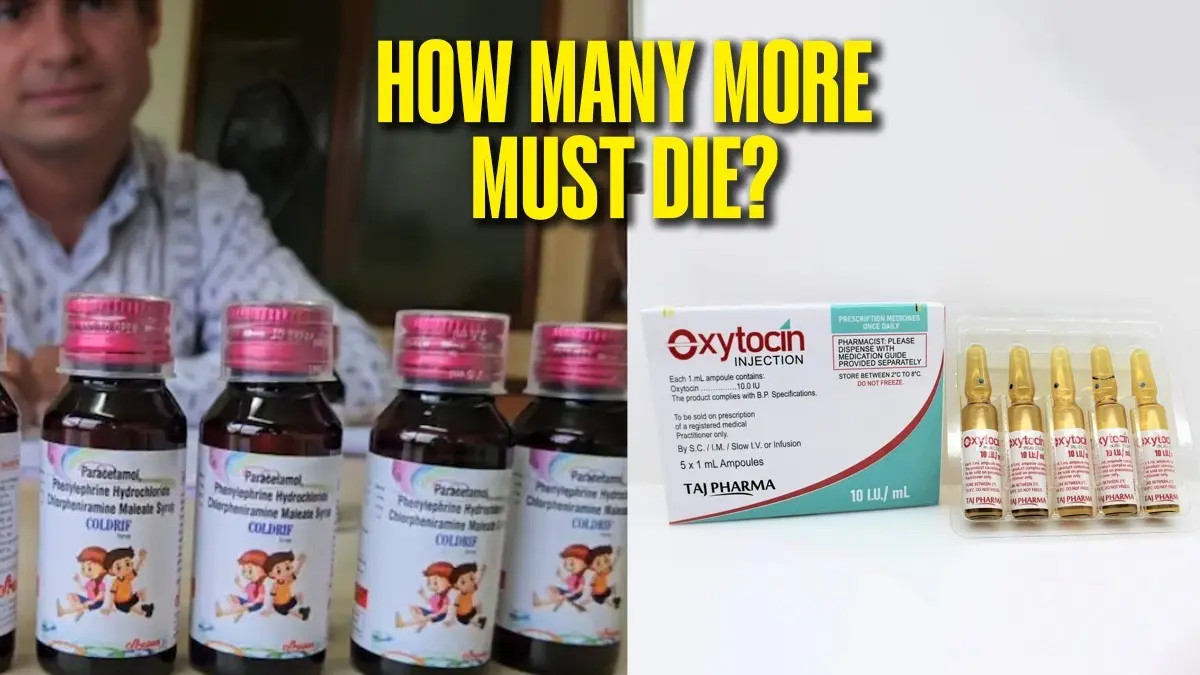
New Delhi: Just months after the Coldrif cough syrup tragedy exposed shocking lapses in the country’s pharmaceutical oversight, another chilling case has emerged. This time from Rajasthan’s Kota, where at least five women reportedly died after C-section deliveries following the administration of suspected fake oxytocin injections.
The back-to-back tragedies are now raising disturbing questions: Why are medicines repeatedly failing patients? Why are life-saving drugs turning into death traps? And most importantly, why does accountability only begin after lives are lost?
In Kota, women who had successfully undergone Caesarean deliveries reportedly developed severe complications within 8 to 12 hours after surgery. According to preliminary findings, patients suffered a sudden drop in blood pressure, rapidly falling platelet counts and symptoms consistent with acute kidney failure.
The needle of suspicion quickly turned towards oxytocin, one of the most commonly used drugs in obstetric care, administered to induce labour and prevent excessive bleeding after childbirth.
Advertisement
Laboratory tests reportedly found that the batch supplied to Rajasthan government hospitals had “zero oxytocin content” and failed quality and potency checks, triggering alarm within the health department and drug control authorities.
The Rajasthan government has since banned the suspected batch across the state, seized nearly 3,500 vials and launched a high-level investigation. Hospital staff linked to the case have been suspended, while investigative agencies are probing whether a larger counterfeit medicine racket is at play.
Advertisement
But for the families who lost mothers within hours of childbirth, the suspensions and inquiries offer little comfort.
Children who had barely entered the world were left motherless before life could even begin.
The tragedy comes close on the heels of the Coldrif cough syrup horror in Madhya Pradesh, where at least 22 children reportedly died after consuming contaminated syrup found to contain dangerously high levels of diethylene glycol (DEG), a toxic industrial chemical used in antifreeze and brake fluids.
That syrup, manufactured by a Tamil Nadu-based pharmaceutical company, allegedly contained DEG levels hundreds of times above permissible safety limits.
Authorities sealed factories, arrested company officials and ordered recalls, the familiar cycle that follows nearly every drug disaster in India.
But the larger question remains unanswered: How are such medicines reaching hospitals, pharmacies and ultimately patients in the first place?
The recurring pattern points towards deeper structural failures within India’s drug regulation system.
India’s pharmaceutical oversight operates under a fragmented dual-control model. While the Central Drugs Standard Control Organisation (CDSCO) frames national standards and oversees exports, state drug regulators are responsible for licensing manufacturers, monitoring production and conducting local inspections.
Experts and investigations have repeatedly flagged that many state regulators lack trained inspectors, accredited laboratories and robust surveillance systems capable of detecting contamination or counterfeit drugs before they enter circulation.
In the Coldrif case, reports revealed shocking violations inside the manufacturing facility: rusted machinery, unhygienic conditions, absence of proper quality testing and even attempts to destroy evidence after the tragedy surfaced.
Now, the Kota deaths are once again pointing towards alarming loopholes in procurement and quality verification systems within public healthcare supply chains.
Oxytocin itself is not an ordinary drug. Considered essential in childbirth management, the synthetic hormone helps induce labour, strengthen uterine contractions and prevent postpartum haemorrhage, one of the leading causes of maternal deaths globally.
However, medical experts classify it as a “high-alert drug” because even small dosage or quality errors can prove catastrophic.
Rapid infusion can trigger dangerous blood pressure drops, excessive doses may cause violent contractions, and poor-quality formulations can lead to fatal complications.
According to officials, several women in Kota developed complications, including kidney failure symptoms, within hours of receiving the injections after surgery.
The Rajasthan administration has now widened the investigation beyond oxytocin, examining IV fluids and other medicines used during treatment. A specialised medical team from Jaipur’s SMS Medical College and experts from AIIMS Delhi are assisting in the probe.
Speaking to Republic, Kota District Collector Piyush Samariya confirmed that suspicious patterns among women who underwent C-sections on May 4 triggered the investigation.
He said authorities are awaiting the final medical and forensic report before drawing definitive conclusions.
But the similarities between the Coldrif tragedy and the Kota oxytocin case are impossible to ignore.
In both cases, life-saving medicines allegedly failed basic safety standards. In both cases, patients developed kidney-related complications. In both cases, investigations only intensified after deaths occurred.
And in both cases, grieving families were left asking the same devastating question: Were these deaths preventable?
India has already faced international embarrassment over contaminated medicines linked to child deaths in countries like The Gambia and Uzbekistan. Yet despite repeated warnings, experts say systemic reforms remain painfully slow.
The crisis today is no longer just about counterfeit drugs. It is about collapsing public trust.
When medicines administered inside government hospitals themselves come under suspicion, the consequences go far beyond a single batch or a single state. They strike at the very foundation of healthcare delivery.
Get Current Updates on India News, Entertainment News, Cricket News along with Latest News and Web Stories from India and around the world.