
Mumbai-Ahmedabad Bullet Train Project Opens 21 Km Undersea Tunnel Between BKC And Thane, 310 Km Viaduct Completed
Mumbai-Ahmedabad Bullet Train project marks dual achievements with the 21 km undersea tunnel opening and 310 km viaduct completion.
- India News
- 4 min read

;'%3e%3cpath%20d='m8,15.99c4.41,0,7.99-3.58,7.99-7.99S12.41,0,8,0,0,3.59,0,8s3.58,7.99,7.99,7.99Z'%20style='stroke:%23fff;%20stroke-miterlimit:10;%20stroke-width:.02px;'/%3e%3cpath%20d='m3.08,3.37l3.82,5.11-3.84,4.15h.87l3.37-3.64,2.72,3.64h2.94l-4.04-5.39,3.58-3.87h-.86l-3.1,3.35-2.5-3.35h-2.94Zm1.27.64h1.35l5.97,7.99h-1.35l-5.97-7.99Z'%20style='fill:%23fff;'/%3e%3c/g%3e%3c/svg%3e)


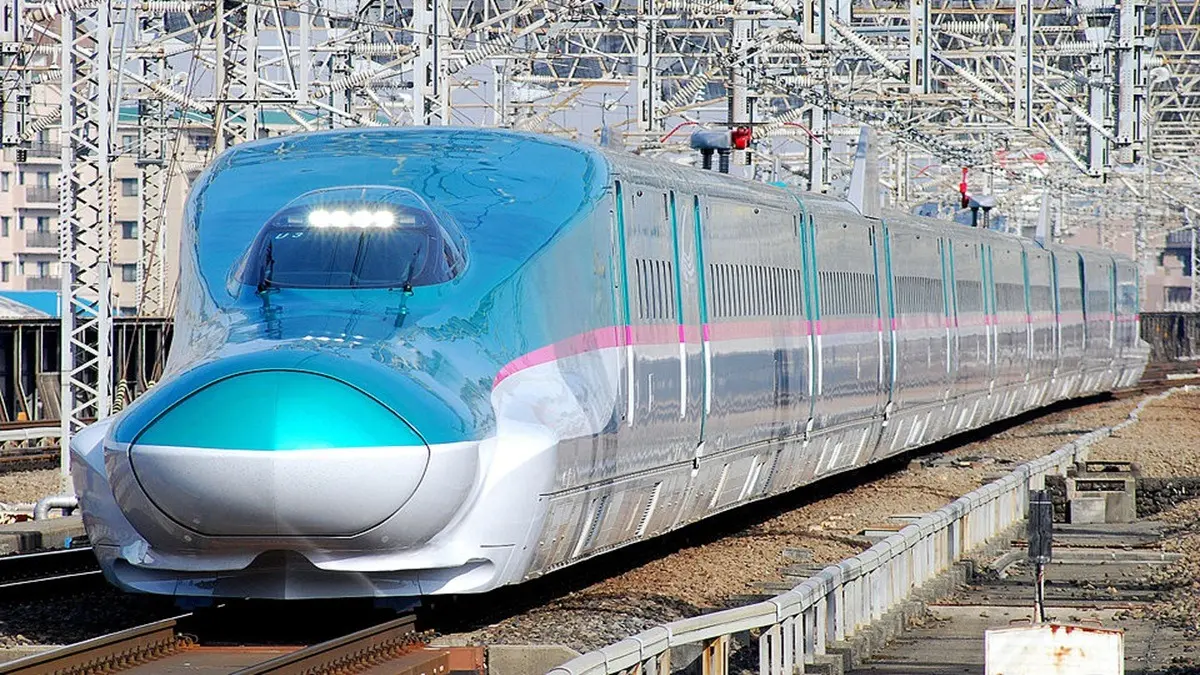
The Mumbai-Ahmedabad Bullet Train project is India's pioneering high-speed rail initiative, which is set to revolutionise the country's transportation sector. Spanning 508 km, India's ambitious project will connect major cities, reducing travel time significantly, which will be as little as three hours. The bullet train between Mumbai and Ahmedabad will operate at a speed of 320 km per hour, making it one of the fastest modes of transportation in the country.
In the latest development, the Mumbai-Ahmedabad Bullet Train project has attained another feat by opening the first section of the 21 km undersea tunnel between BKC and Thane. The achievement is termed a crucial step forward in the development of India's high-speed rail network. The project, which is being developed with Japanese Shinkansen technology, is progressing rapidly, with track laying, construction of overhead electrical wires, stations, and bridges underway.
The project's progress is evident in the rapid construction of viaducts, with 310 km of viaduct construction completed. Additionally, 15 river bridges have been completed, and four more are in advanced stages of construction. Out of 12 stations, five are completed, and three more are nearing completion. The station at BKC is a notable engineering feat, with a foundation designed to support a 95 m high building above ground.
E10 Shinkansen Trains To Be Introduced Both In India And Japan Simultaneously
The Mumbai-Ahmedabad Bullet Train project reflects the deep strategic and technological cooperation between India and Japan. The Japanese government has agreed to introduce E10 Shinkansen trains in the project, which will be introduced simultaneously in India and Japan. The partnership showcases India's capability to execute world-class infrastructure using cutting-edge global technology, with Japan playing a pivotal role as a trusted partner.
Advertisement
The success of the Mumbai-Ahmedabad High-Speed Rail (MAHSR) project is laying the foundation for future bullet train corridors in India. The future corridors are already under active consideration, and the project's progress is expected to have a transformative impact on India's transportation. The MAHSR project will set new benchmarks for speed, safety, and reliability, revolutionising the way people travel in India.
Advertisement
First Section Of Bullet Train Project Is Expected To Open In 2026 In Gujarat
The officials stated that the project has achieved another success by completing the construction of 310 km of viaduct and beginning the track laying in Gujarat. Reports suggested that the first section of the project in Gujarat is expected to open in 2026, with the entire project anticipated to be completed by the second half of 2028. The officials stated that over 1390 hectares of land have been acquired for the rail corridor, with 96% of the land acquisition process completed in Gujarat and 99.75% in Maharashtra.
The Mumbai-Ahmedabad Bullet Train project includes 12 stations, including Mumbai (Bandra Kurla Complex), Thane, Virar, Boisar, Vapi, Bilimora, Surat, Bharuch, Vadodara, Anand, Ahmedabad, and Sabarmati. The bullet train will cover 155.76 km in Maharashtra, 4.3 km in Dadra and Nagar Haveli, and 348.04 km in Gujarat.
How Much Does India's Bullet Train Project Cost
The estimated cost of the project is Rs. 1.1 lakh crore, funded through a 50-year loan from the Japan International Cooperation Agency (JICA) at an interest rate of 0.1%. The project will be funded by JICA (81%), the Government of India (15%), and the state governments of Maharashtra and Gujarat (4%).
The bullet train will have a seating capacity of 731 passengers, with 35 trains per day in one direction, running every 20 minutes during peak hours and every 30 minutes during non-peak hours. The project incorporates advanced safety features, including an Urgent Earthquake Detection and Alarm System (UrEDAS) for automatic braking in case of earthquakes. Also, noise barriers will be installed along the viaduct to minimise train noise without obstructing passengers' views.
With its rapid progress and innovative features, the Mumbai-Ahmedabad Bullet Train project is poised to become a game-changer in India's transportation sector. The project's completion will not only enhance connectivity between major cities but also contribute to the country's economic growth and development.
Get Current Updates on India News, Entertainment News, Cricket News along with Latest News and Web Stories from India and around the world.