
NCERT's Revised Class 7 Social Science Book Maps 'India And Her Neighbours' With Stronger Focus On Pak-Sponsored Terror
The NCERT has introduced a chapter titled “India and Her Neighbours” in the Class VII Social Science textbook, focusing on regional ties and geopolitical challenges. It emphasizes India's central role in South Asia, detailing relations with Pakistan, China, Bangladesh, Nepal, Bhutan, Sri Lanka, and the Maldives, while highlighting historical connections and cultural overlaps that influence contemporary diplomacy.
- India News
- 2 min read

;'%3e%3cpath%20d='m8,15.99c4.41,0,7.99-3.58,7.99-7.99S12.41,0,8,0,0,3.59,0,8s3.58,7.99,7.99,7.99Z'%20style='stroke:%23fff;%20stroke-miterlimit:10;%20stroke-width:.02px;'/%3e%3cpath%20d='m3.08,3.37l3.82,5.11-3.84,4.15h.87l3.37-3.64,2.72,3.64h2.94l-4.04-5.39,3.58-3.87h-.86l-3.1,3.35-2.5-3.35h-2.94Zm1.27.64h1.35l5.97,7.99h-1.35l-5.97-7.99Z'%20style='fill:%23fff;'/%3e%3c/g%3e%3c/svg%3e)


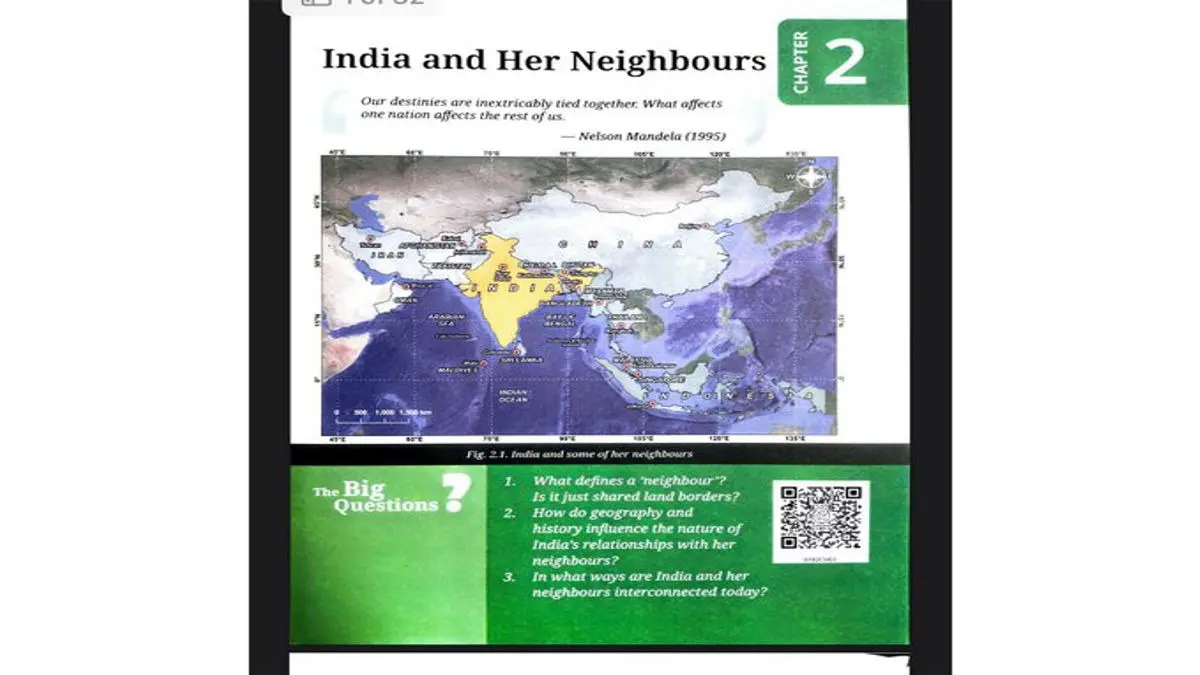
New Delhi: The National Council of Educational Research and Training (NCERT) has introduced a new chapter titled “India and Her Neighbours” in its updated Class VII Social Science textbook, placing a sharper focus on regional ties, historical links, and current geopolitical challenges.
The 31-page chapter, included in the revised edition of Exploring Society: India and Beyond, did not exist in the previous curriculum. It broadens the traditional definition of neighbourhood by including maritime partners along with land-bordering nations, situating India as a “central and strategic” player in South Asia.
One of the strongest assertions in the updated chapter concerns India-Pakistan ties. The section describes the bilateral relationship as among the most difficult in the region, shaped by Partition and four major conflicts. It states: “Frequent terrorist attacks launched against India with the support of the Pakistan Army have prevented normal relations between the two countries.”
The chapter adds that the India-Pakistan border stands not only as a territorial division but also as a symbol of shared heritage and fractured history. It also references the Kartarpur Corridor-opened in 2019-which allows Indian pilgrims access to Gurdwara Darbar Sahib in Pakistan.
Advertisement
On China, the new content highlights ancient cultural links driven by Buddhism, alongside present-day border tensions. The book notes episodes of heightened friction while also emphasising ongoing efforts toward dispute resolution through trade, dialogue and border mechanisms. A dedicated fact-box mentions Hindu temples built by Indian merchants in 13th-century Quanzhou, where carvings depict Vishnu, Shiva and scenes from the Ramayana.
The chapter further outlines India’s close ties with Bangladesh, citing shared history, language and culture. Nepal is described through the lens of open borders, people-to-people relationships, and unrestricted movement for work, education and healthcare.
Advertisement
India’s bond with Bhutan is framed around hydropower cooperation, Buddhist ties and mutual strategic trust, while relations with Sri Lanka and the Maldives highlight cultural overlaps and India’s consistent humanitarian support - including during the 2004 tsunami and Male’s 2014 water crisis.
The book also maps India’s civilisational footprint across Southeast Asia, pointing to the influence of trade routes, Sanskritic heritage, religious ideas and shared epics across Indonesia, Thailand, Malaysia and Singapore.
The concluding section emphasizes that India’s diplomacy with its neighbours is rooted in history, culture and long-standing civilisational exchanges - shaping both present-day relations and strategic engagement in the wider region.
Get Current Updates on India News, Entertainment News, Cricket News along with Latest News and Web Stories from India and around the world.