
'News Is Much Bigger Than What Is Being Told': Arnab Goswami Questions India’s Media Measurement System
Arnab Goswami, Editor-in-Chief of Republic Media Network, addressed the inadequacies in news audience measurement in India at the South India Media Summit 2026. He highlighted the need for greater transparency and access to data, asserting that existing metrics fail to represent the true scale and complexity of news consumption, particularly in diverse regions like South India.
- India News
- 5 min read

;'%3e%3cpath%20d='m8,15.99c4.41,0,7.99-3.58,7.99-7.99S12.41,0,8,0,0,3.59,0,8s3.58,7.99,7.99,7.99Z'%20style='stroke:%23fff;%20stroke-miterlimit:10;%20stroke-width:.02px;'/%3e%3cpath%20d='m3.08,3.37l3.82,5.11-3.84,4.15h.87l3.37-3.64,2.72,3.64h2.94l-4.04-5.39,3.58-3.87h-.86l-3.1,3.35-2.5-3.35h-2.94Zm1.27.64h1.35l5.97,7.99h-1.35l-5.97-7.99Z'%20style='fill:%23fff;'/%3e%3c/g%3e%3c/svg%3e)


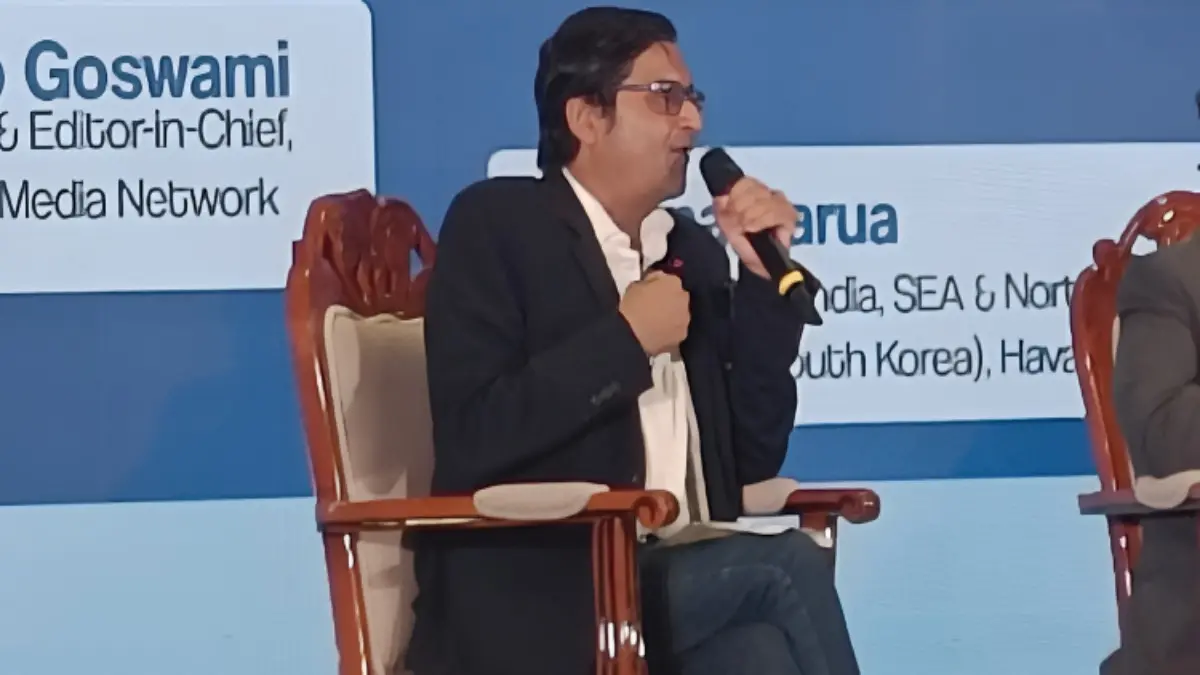
New Delhi: Republic Media Network Editor-in-Chief Arnab Goswami has raised questions over the way news audiences are measured in India, arguing that existing systems may not be capturing the full scale of news consumption across the country.
Speaking at the South India Media Summit 2026 in Hyderabad, Goswami called for greater transparency in audience measurement and access to the data and methodology used to arrive at television and digital audience numbers.
His remarks focused on a broader question confronting India's media industry: does the country's existing measurement framework accurately reflect how Indians consume news today?
‘News is Much Bigger Than What is Being Told’
Arnab said the scale of India's news audience is considerably larger and more complex than what conventional measurement figures may suggest.
Advertisement
“The first thing about news that you must know, it’s much bigger than what it is told”, he said.
He questioned whether audience numbers derived through existing measurement systems can adequately represent a country as large and diverse as India, particularly when news consumption now happens across television, websites, apps, social media, streaming platforms and connected TVs.
Advertisement
According to Arnab, the industry needs to look beyond headline audience numbers and examine the underlying data that produces them.
‘Give Me the Raw Data’
A key part of Arnab's argument was the need for greater transparency in the measurement process.
He called for media organisations to have access to the raw data behind audience measurements, rather than relying solely on final numbers presented by measurement systems.
Arnab questioned how samples are selected, how those samples are extrapolated to represent wider audiences and whether the methodology adequately reflects India's changing media consumption patterns.
He also pointed to the increasing availability of digital and return-path data as an opportunity to build a more detailed picture of audience behaviour.
Why South India Figures Prominently
Arnab also highlighted what he described as the under-representation of South Indian audiences in national media measurement. “South of India is terribly underrepresented,” he said.
India's regional markets have distinct languages and viewing patterns, making audience measurement particularly challenging. Arnab's remarks highlighted the need to account for these differences while assessing the reach of national news organisations.
The issue has implications beyond ratings. Audience figures are closely connected to advertising decisions, revenue and the commercial value assigned to media platforms.
The Business of Measuring News
Arnab also linked audience measurement to the cost of running news operations.
News organisations require substantial resources to maintain reporters, bureaus, studios and technical infrastructure across multiple regions. If audience consumption is not fully reflected in measurement systems, he argued, the economics of news could also be affected.
His larger point was that the value of journalism is directly connected to the size and nature of the audience consuming it.
Digital Video Changes the Equation
The discussion also comes against the backdrop of a rapid shift towards digital video.
Audiences are increasingly consuming news through short-form videos, livestreams, connected television, websites and social platforms, creating a fragmented ecosystem that is harder to measure through traditional television-centric methods.
Arnab pointed to Republic's digital performance as an indication of how rapidly the news audience is moving across platforms.
The changing consumption pattern has also altered the competitive landscape, allowing digital-first media organisations to reach audiences without necessarily replicating the physical distribution networks traditionally required by print and broadcast organisations.
From Platforms to Direct Audience Relationships
Arnab also spoke about the growing dependence of news organisations on large technology platforms for distribution and monetisation.
He said Republic was working towards greater technological and distribution independence, including reducing its reliance on external platforms and strengthening its own infrastructure.
The strategy is aimed at establishing a more direct relationship between the media organisation and its audience as platforms such as YouTube, Instagram and X increasingly influence how news is discovered and consumed.
‘What You Stand for’ Will Matter
Arnab also addressed the question of how media brands can differentiate themselves in an environment where technology is making content production increasingly faster.
“What you stand for will be much more important than what you serve,” he said.
He argued that speed alone may no longer be sufficient for media organisations to distinguish themselves, with the relationship between a media brand and its audience becoming increasingly important.
As artificial intelligence and other technologies accelerate content production, Goswami suggested that technology could further disrupt traditional media structures. However, he argued that technology itself cannot replicate the identity and relationship a media organisation builds with its audience.
Greater Platform Independence
Another focus of Arnab's remarks was the dependence of media organisations on global technology platforms for distribution, infrastructure and monetisation.
He said Republic was looking at strengthening its independence in areas including content delivery networks, backend technology and direct distribution, with the aim of reducing dependence on platforms such as YouTube, Instagram and X.
The broader objective, according to Goswami, is to establish a more direct relationship between the media company, its audience and advertisers rather than relying entirely on technology platforms as intermediaries.
He also spoke about Republic’s international expansion plans through Republic Global, including operations across digital, connected TV and streaming platforms.
Get Current Updates on India News, Entertainment News, Cricket News along with Latest News and Web Stories from India and around the world.