
Offline Apps, WhatsApp Groups, Masked Men: Delhi Police Probe CJP Protest Blueprint & Its Digital Trail
According to preliminary findings, protesters relied on a specialized Bluetooth-based messaging application to coordinate attacks in real time. This app reportedly functioned without internet connectivity, allowing seamless communication even when mobile data and networks were disrupted.
- India News
- 6 min read

;'%3e%3cpath%20d='m8,15.99c4.41,0,7.99-3.58,7.99-7.99S12.41,0,8,0,0,3.59,0,8s3.58,7.99,7.99,7.99Z'%20style='stroke:%23fff;%20stroke-miterlimit:10;%20stroke-width:.02px;'/%3e%3cpath%20d='m3.08,3.37l3.82,5.11-3.84,4.15h.87l3.37-3.64,2.72,3.64h2.94l-4.04-5.39,3.58-3.87h-.86l-3.1,3.35-2.5-3.35h-2.94Zm1.27.64h1.35l5.97,7.99h-1.35l-5.97-7.99Z'%20style='fill:%23fff;'/%3e%3c/g%3e%3c/svg%3e)


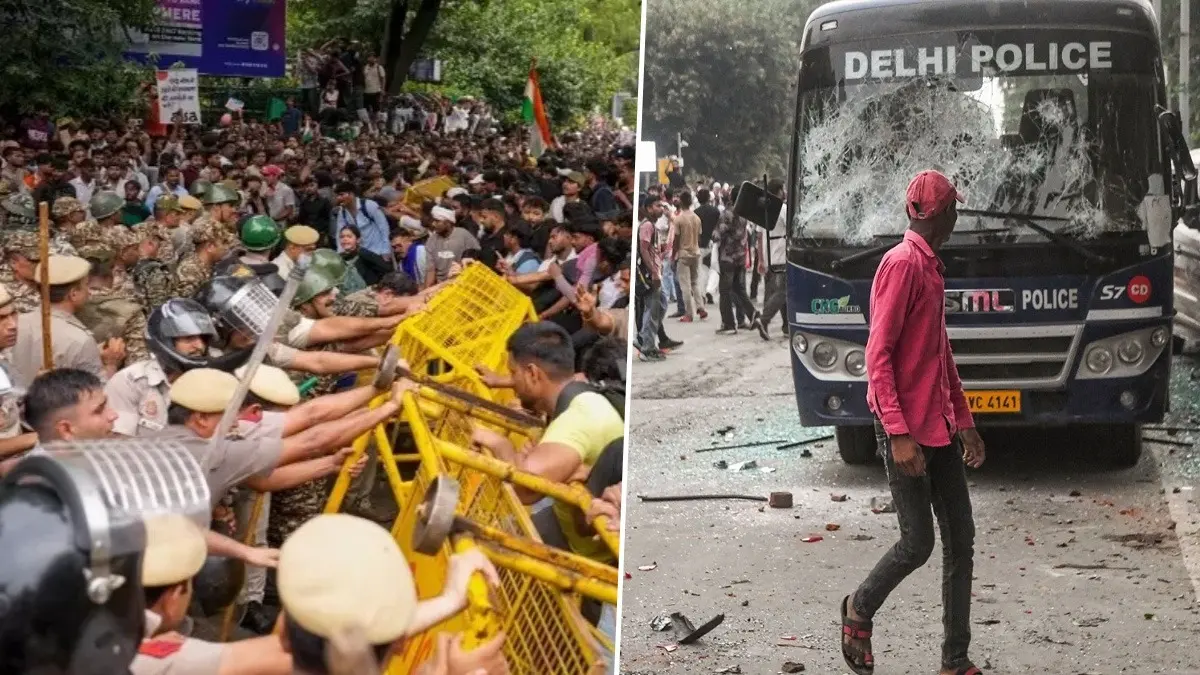
New Delhi: Investigators have uncovered a meticulously planned conspiracy involving coordinated communication tactics by protesters during the recent Parliament March, where they turned violent against police and security personnel. Delhi Police sources revealed that the disturbances were not spontaneous but part of a well-orchestrated operation with pre-planned elements for execution and escape.
According to preliminary findings, protesters relied on a specialized Bluetooth-based messaging application to coordinate attacks in real time. This app reportedly functioned without internet connectivity, allowing seamless communication even when mobile data and networks were disrupted during the clashes. Its use reportedly went undetected by security forces and investigating agencies at the time of the violence.
"The protesters used this Bluetooth application to direct attacks on police personnel, share plans for committing violence, and coordinate their getaway from the scene," a police source familiar with the probe said. The application enabled instant, localized messaging among participants at various locations around the Parliament area.
Police are now actively investigating the deployment of such offline messaging tools. Efforts are underway to identify the specific apps involved, trace their usage patterns, and gather technical details from relevant service providers. Both pre-violence mobilization and post-violence activities are under scrutiny.
Advertisement
Investigations have also revealed that WhatsApp groups were extensively used in the run-up to the march to assemble large crowds. However, once the protest escalated and internet services were affected, the shift to Bluetooth-based platforms allowed the rioters to maintain operational continuity.
In a major development, authorities have collected approximately 150 viral videos circulating on social media. These clips are being meticulously analyzed to identify stone-pelters and anti-social elements involved in assaulting police and security forces. Many of the identified protesters were reportedly dressed in similar attire and wore masks, operating in coordinated groups at multiple spots.
Advertisement
How the CJP started?
A youth-led movement that began as online satire has transformed into one of the most visible challenges to the government in recent years. The Cockroach Janata Party (CJP), a self-styled satirical collective, has brought thousands of students and young people onto the streets, centering demands for accountability in India’s education system amid repeated controversies over competitive exams.
Origins: From a Courtroom Remark to Viral Satire
The CJP traces its roots to a May 15, 2026, remark by Chief Justice of India Surya Kant during a Supreme Court hearing. While addressing issues related to fake degrees and frivolous litigation, the CJI reportedly compared certain unemployed youth turning to activism, media, or RTI filings to “cockroaches” and “parasites of society.” Though the judge later clarified the context, the comment sparked widespread outrage among young Indians facing job scarcity and exam pressures.
On May 16, 2026, Abhijeet Dipke, a political communications graduate and former activist then studying abroad, channeled the anger into humor. He launched the “Cockroach Janata Party” (a playful parody of the Bharatiya Janata Party) as an online platform. Using memes, AI-generated imagery (including a suited cockroach mascot), and sharp satire, the handle exploded in popularity--gaining millions of followers within days. What started as a meme quickly evolved into a platform for venting frustrations over education and employment.
The immediate catalyst was the NEET-UG 2026 paper leak scandal. The exam, held on May 3, faced serious allegations of leaks, leading to its cancellation and a re-test on June 21 under tight security. Reports of student suicides linked to the stress added fuel. Flaws in other systems, such as CBSE’s on-screen marking, further amplified discontent. Protests began online and moved offline in early June, with the first major gathering at Delhi’s Jantar Mantar.
How It Became Political
Initially non-partisan and youth-driven, the movement gained political traction as opposition parties, student groups, and figures like climate activist Sonam Wangchuk amplified its message. Rahul Gandhi and Congress leaders have publicly supported the protesters’ concerns, framing them as failures of governance. Left-leaning student organizations and some farmer unions have also joined rallies.
CJP itself maintains it is not a formal political party but a “people’s movement” focused on accountability. Its five-point manifesto includes broader reforms: barring post-retirement Rajya Sabha seats for Chief Justices, electoral integrity measures (including UAPA action against vote deletions), women’s reservation, media independence, and anti-defection rules. The immediate street focus, however, remains education. Protests have spread to cities like Pune, Jaipur, Lucknow, Bengaluru, and Hyderabad, with slogans like “Go Pradhan Go” targeting Union Education Minister Dharmendra Pradhan.
Tensions peaked around July 20, 2026, with a “Chalo Sansad” (March to Parliament) attempt. Police used barricades, lathi charges, and tear gas in some clashes, leading to detentions and injuries on both sides. Protesters allege excessive force; authorities cite attempts to breach security and violence against personnel. An indefinite sit-in at Jantar Mantar continues, with Wangchuk undertaking a hunger strike.
Sonam Wangchuk's Link to CJP
Renowned climate activist and educator Sonam Wangchuk joined the Cockroach Janta Party (CJP) protests in Delhi, amplifying demands for accountability in India’s education system.
On June 28, 2026, Wangchuk began an indefinite hunger strike at Jantar Mantar alongside CJP activists, who have been protesting since June 20 over alleged irregularities in exams like NEET, including paper leaks, and calling for the resignation of Union Education Minister Dharmendra Pradhan.
Wangchuk, known for his work on Ladakh’s environment and alternative education, described education as a core issue close to his heart for decades. He paid tribute to Mahatma Gandhi at Rajghat before joining and emphasized themes of truth, justice, and accountability, extending the protest’s focus beyond education to broader governance issues.
His participation has drawn significant attention to the movement, which began as a response to student distress, including reported suicides linked to exam pressures. Wangchuk has faced health challenges during the fast, losing substantial weight, but has continued his non-violent stand.
Demands of the Protesters
--Immediate resignation of Education Minister Dharmendra Pradhan over alleged mismanagement of NEET and other exams.
--Compensation (reportedly ₹1 crore) to families of students who died by suicide due to exam-related stress.
--Systemic reforms in exam conduct, transparency, and evaluation to prevent leaks and irregularities.
--Broader accountability, including judicial and electoral reforms as per the manifesto.
Protesters emphasize non-violence, carrying national flags, books, and the Constitution, while using humor and cultural symbols to sustain momentum.
What is the Government Saying?
The government has acknowledged exam irregularities and promised strict action against culprits. Prime Minister Narendra Modi has called for the “strictest possible punishment” for those involved in leaks. Parliamentary Affairs Minister Kiren Rijiju stated the Centre is ready for a constructive debate on the NEET issue in Parliament.
Education Minister Dharmendra Pradhan has refused to resign, dismissing the protests as politically motivated and linked to “disruptive elements.” BJP president J.P. Nadda met a CJP delegation, describing talks as cordial, but the government maintains that re-exams were conducted successfully under enhanced security and that broader reforms (including banning certain apps to curb leaks) are underway. Officials have warned against attempts to march toward Parliament, citing law and order.
As the movement enters its next phase, with calls for nationwide expansion, the CJP protest highlights deep youth anxiety over education, jobs, and governance. Whether it remains a focused accountability drive or broadens further will shape its impact in the coming weeks.
Get Current Updates on India News, Entertainment News, Cricket News along with Latest News and Web Stories from India and around the world.