
PM Modi Silences Naysayers And ‘Kabra Khudegi Gang’ In A Blistering Speech In Rajya Sabha | 10 Points
PM Modi takes on Opposition in Rajya Sabha, calls them 'Kabra Khudegi brigade', asserts India's global rise, and outlines government's achievements, calling 140 crore citizens solutions for challenges for 'Viksit Bharat'
- India News
- 7 min read

;'%3e%3cpath%20d='m8,15.99c4.41,0,7.99-3.58,7.99-7.99S12.41,0,8,0,0,3.59,0,8s3.58,7.99,7.99,7.99Z'%20style='stroke:%23fff;%20stroke-miterlimit:10;%20stroke-width:.02px;'/%3e%3cpath%20d='m3.08,3.37l3.82,5.11-3.84,4.15h.87l3.37-3.64,2.72,3.64h2.94l-4.04-5.39,3.58-3.87h-.86l-3.1,3.35-2.5-3.35h-2.94Zm1.27.64h1.35l5.97,7.99h-1.35l-5.97-7.99Z'%20style='fill:%23fff;'/%3e%3c/g%3e%3c/svg%3e)


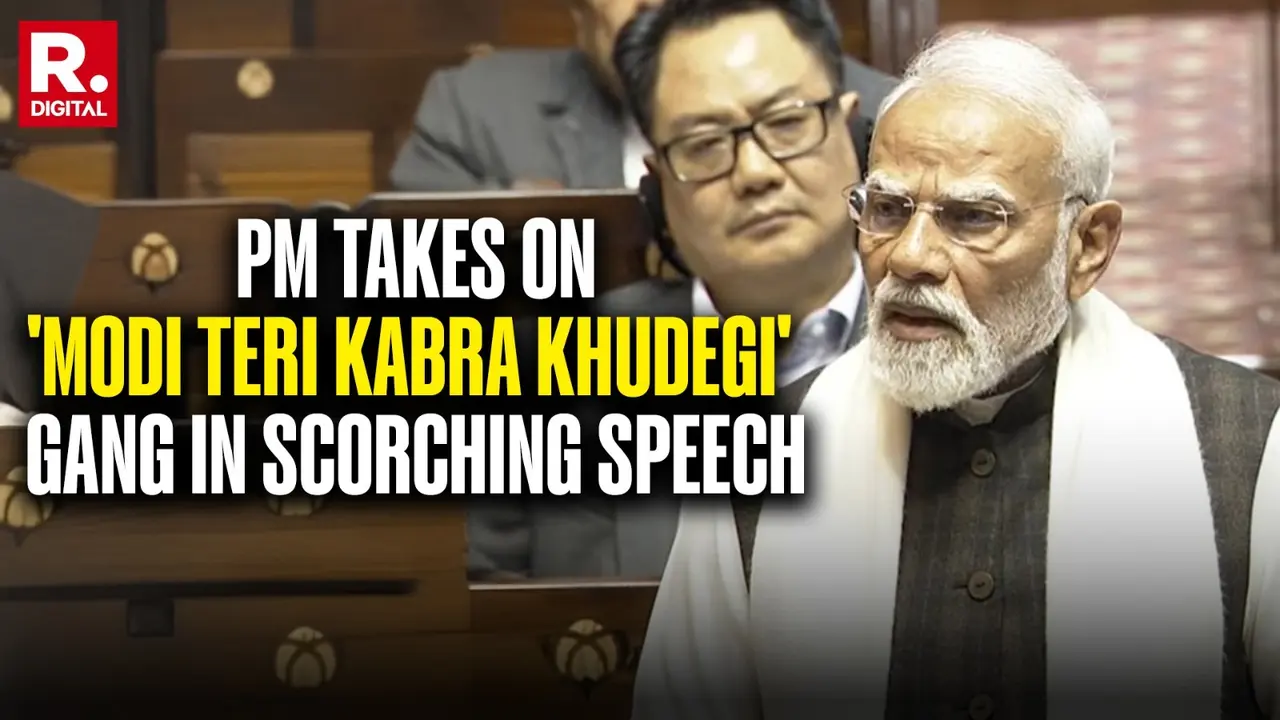
New Delhi: Prime Minister Narendra Modi on Thursday took a strong stance against the Opposition, in a high-octane address in the Rajya Sabha, launching a stinging counter-attack and deeming them as the ‘Kabra Khudegi’ brigade. Addressing the Upper House during the Motion of Thanks on the President's Address, PM Modi asserted India's growing global influence and blasted the Opposition for their alleged lack of faith in the country's capabilities. He silenced naysayers with characteristic oratory flair, outlining the government's achievements and vision for a ‘Viksit Bharat'.
The prime minister asserted that no amount of personal animosity or hatred-filled slogans from the Opposition could derail India’s transition from a middle-tier power to a global leader by 2047.
The Prime Minister’s speech was a masterclass in political messaging, framing the current century as India’s "decisive era" for economic and social transformation. He stated in the House that the nation has moved beyond an age of being a "missed-bus" economy and is now leading from the front. He drew a comparison of his governance style with his predecessors, stressing that while former leaders saw the people of India as a burden or a “problem”, his administration views the country’s 140 crore citizens as the ultimate source of solutions and the driving force behind the ”reform express”.
Addressing the controversial slogans regarding digging his grave, PM Modi rebutted, saying such rhetoric was merely a reflection of the frustration felt by those who had failed to implement projects for decades. He cited his government’s bold moves, the abrogation of Article 370, cross-border strikes against terrorists, and the electrification of over 18,000 villages as the real reasons for the opposition’s severity, stating that the "blessings of Shakti" and the protective shield of India’s mothers and sisters remain his greatest defence.
Advertisement
Challenges With 140 Crore Solutions: PM Modi
In his marathon address to the Rajya Sabha, PM Modi outlined a transformative roadmap for India’s future, asserting that the nation has moved beyond an era of missed opportunities to one of global leadership. He framed the current century as a decisive turning point, likening the next 25 years to the final surge of the independence struggle. He emphasised that while past leaders viewed India’s vast population as a series of problems, his administration sees 140 crore citizens as the primary engine of progress and the architects of a developed nation by 2047.
The prime minister also charted India’s climb from the fragile 5 to the cusp of becoming the world’s third-largest economy. He hailed the reforms currently sweeping the country, noting that structural and policy shifts have created a manufacturing ecosystem so strong that developed nations are now eager to sign historic trade agreements with India.
Advertisement
PM Modi's ‘Gandhi Surname’ Theft Jibe
Prime Minister Modi, in a veiled attack on the Gandhi family, took a sarcastic dig, terming "habitual thieves" for allegedly stealing the surname 'Gandhi', associated with Mahatma Gandhi, a great Gujarati leader. "Habitual thieves have also stolen the surname of a Gujarati, Mahatma Gandhi," PM Modi said.
PM Narendra Modi launched another blistering attack on the Congress leadership, specifically targeting Rahul Gandhi over a recent “traitor” remark on Union Minister Ravneet Singh Bittu, accusing the Opposition of harbouring a "deep-seated hatred" and suggesting that their slogans were a direct reaction to his government’s boldest security and integrationist policies.
The Prime Minister also turned his attention to state-level governance, specifically criticising the Trinamool Congress (TMC) in West Bengal for its stance on illegal immigration. He asserted that the protection of infiltrators was a direct assault on the rights and livelihoods of youths and tribal communities, suggesting that those in power were prioritising vote-bank politics over national integrity.
PM Modi spoke of the "protective shield" of blessings he receives from the women of India. Reaffirming his commitment to the "mantra" of Reform, Perform, and Transform, he vowed to deliver a prosperous and self-confident Hindustan into the hands of the younger generation, insisting that India’s march towards its 2047 goal is now "unstoppable and immortal”.
Prime Minister Modi's address focused on the government's ‘Viksit Bharat’ roadmap, stressing India's growing global influence and role in shaping the new world order.
Here are the 10 key takeaways from his address, explained:
- Vision for 2047 and the second quarter: The PM emphasised that the second quarter of the 21st century is as decisive for India’s development as the period leading up to independence was in the 20th century. His primary goal is to transform India into a developed nation by 2047, handing over a prosperous country to the next generation.
- From fragile 5 to the World’s 3rd largest economy: PM Modi outlined India’s economic journey, noting that the country has moved from the "Fragile Five" category to being the world's fastest-growing major economy. He pointed out that while India slipped from 6th to 11th place under previous management, it is now on a certain path to becoming the world's 3rd largest economy.
- The "reform express" and structural changes: The Prime Minister used the mantra "Reform, Perform, and Transform" to describe his governance model. He asserted that the country is now on a "Reform Express," powered by structural and policy changes that have strengthened the manufacturing ecosystem and empowered local entrepreneurs to compete globally.
- India as the voice of the Global South: A significant portion of the speech focused on India’s rising global stature. Modi stated that India has emerged as a "Vishwamitra" (Friend of the World) and a "Vishwabandhu," becoming the bold and resounding voice for the Global South on international platforms.
- Problems to 140 crore solutions: The PM criticized the mindsets of former Prime Ministers Nehru and Indira Gandhi, alleging they viewed India's vast population as a "problem." In contrast, he argued that his government views 140 crore Indians as "140 crore solutions," trusting in the capability and energy of the citizens.
- PM's witty rebuttal on Congress-led previous government: The remote control of governance: In a witty rebuttal to "remote control" allegations, Modi clarified the difference in governance styles: while previous governments may have been run by extra-constitutional authorities, his government is "run by the remote control of 140 crore countrymen," driven solely by their aspirations and resolves.
- Strengthening the Banking Sector and MSMEs: Prime Minister Modi explained the cleanup of the banking system, noting that Non-Performing Assets (NPAs) have dropped below 1%. He credited the MUDRA Yojana for providing Rs 30 lakh crore in collateral-free loans, specifically benefiting women and small entrepreneurs, contrasting this with the "phone banking" culture of the past.
- Focus on the Northeast and marginalised communities: The PM accused the Congress of neglecting and insulting the Northeast, citing the delay of projects like the Bogibeel Bridge. He specifically mentioned the insult to Bhupen Hazarika and criticized the opposition's stance on Article 370 and internal security, asserting that his government has replaced the "shadow of guns" with development.
- Social justice and the shield of blessings: Addressing personal attacks and slogans against him, the PM stated that he is protected by a "shield" of blessings from crores of mothers and sisters. He emphasised that his government "worships" those whom no one else cared for, including small farmers (via PM Kisan) and Aspirational Districts like Bastar.
- National security and infiltration: The Prime Minister took a firm stand on national security, mentioning "surgical strikes" and befitting replies to terror. He also criticized state governments (specifically mentioning West Bengal) for allegedly protecting illegal infiltrators for vote-bank politics, which he claimed deprives Indian youth of their rightful opportunities.
Get Current Updates on India News, Entertainment News, Cricket News along with Latest News and Web Stories from India and around the world.