
SC Asks Mumbai Serial Blasts Convict Gangster Abu Salem To Substantiate Claim Of Having Spent 25 Years In Jail
The Supreme Court was reviewing Abu Salem's challenge against a Bombay High Court decision that had denied him immediate (interim) relief.
- India News
- 6 min read

;'%3e%3cpath%20d='m8,15.99c4.41,0,7.99-3.58,7.99-7.99S12.41,0,8,0,0,3.59,0,8s3.58,7.99,7.99,7.99Z'%20style='stroke:%23fff;%20stroke-miterlimit:10;%20stroke-width:.02px;'/%3e%3cpath%20d='m3.08,3.37l3.82,5.11-3.84,4.15h.87l3.37-3.64,2.72,3.64h2.94l-4.04-5.39,3.58-3.87h-.86l-3.1,3.35-2.5-3.35h-2.94Zm1.27.64h1.35l5.97,7.99h-1.35l-5.97-7.99Z'%20style='fill:%23fff;'/%3e%3c/g%3e%3c/svg%3e)


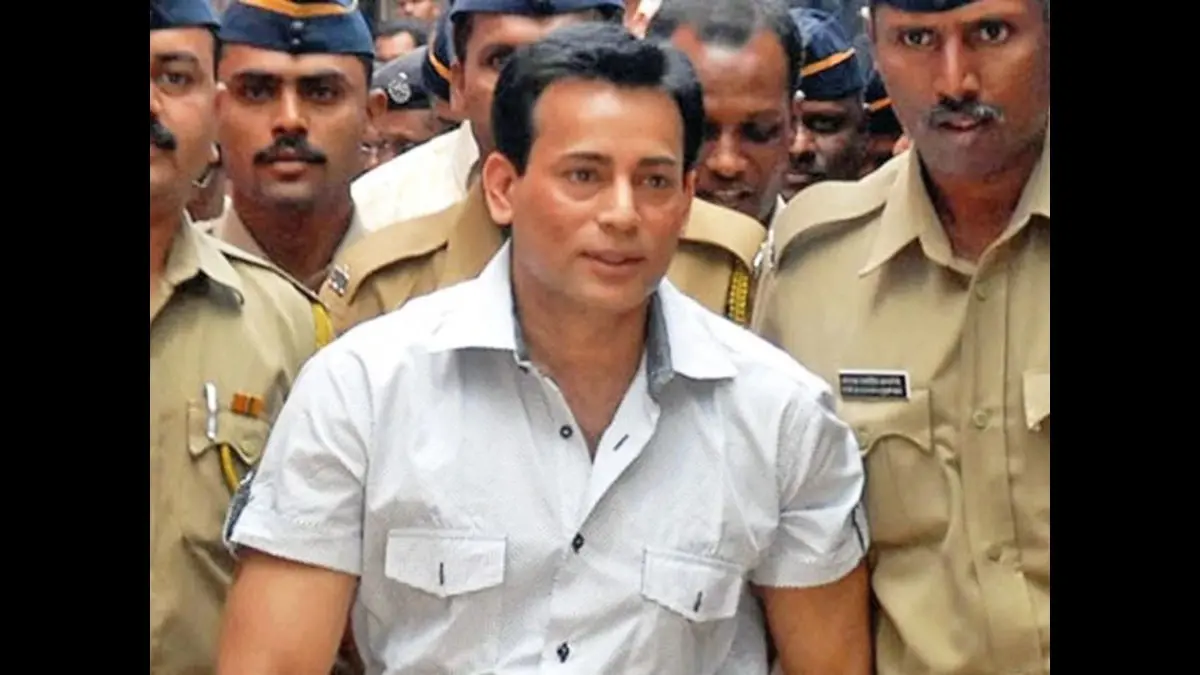
New Delhi: Convicted gangster Abu Salem has approached the Supreme Court requesting his release in connection with the 1993 Bombay blasts. He argues that he has served 25 years behind bars, meeting the maximum sentence threshold established by the apex court’s 2022 judgment regarding his extradition.
On January 12, a Supreme Court Bench comprising Justices Vikram Nath and Sandeep Mehta directed Abu Salem to submit the specific Maharashtra prison regulations regarding remission (reduction of sentence). The court has scheduled the next hearing for February 9 to further examine his plea for release.
The Supreme Court was reviewing Abu Salem's challenge against a Bombay High Court decision that had denied him immediate (interim) relief.
While the High Court had acknowledged his petition, it noted that there were “arguable questions”, meaning legal uncertainties, regarding whether he had actually finished the 25-year period in custody. Because the High Court did not grant him an immediate release, Salem moved his appeal to the Apex Court (Supreme Court).
Advertisement
What did he argue?
Salem’s primary argument is that his 25-year sentence should be calculated by combining three specific factors- the time he spent in jail during his trial (undertrial custody), the time served after his sentencing (post-conviction custody), and the "credit" he received for good behavior (remission).
By his math, this total exceeded the 25-year limit as of March 31, 2025. Consequently, he contends that any further time he spends in prison constitutes illegal detention.
Advertisement
The conflict originates from the 2002 sovereign assurance provided by the Indian government to the Portuguese authorities. To secure Salem's extradition, India promised that he would not face the death penalty or a prison sentence exceeding 25 years. Following a protracted legal battle in Europe, Salem was finally extradited to India in 2005. His official legal process in India began on November 11, 2005, when he first appeared before the specialized TADA court for his involvement in the 1993 Bombay bombings.
Salem tried in two distinct cases
Salem was tried in two distinct cases under the TADA Act where one was concerning the 1993 Bombay bombings and another unrelated criminal matter. He was found guilty in both, receiving life imprisonment sentences delivered on February 25, 2015, and September 7, 2017, respectively.
When sentencing Salem in 2017, the TADA court applied Section 428 of the CrPC, allowing him a "set-off." This means the time he had already spent in jail since his 2005 arrest was officially subtracted from his total sentence.
Furthermore, the court ruled under Section 427(2) of the CrPC that his life sentences for both cases would run concurrently (at the same time), rather than one after the other. The judge noted that because Salem had been in continuous custody since 2005, that entire decade-plus period would be credited against his final punishment, regardless of which case it was tied to.
Following his conviction, Salem appealed to the Supreme Court. In July 2022, a Bench consisting of Justices Sanjay Kishan Kaul and M.M. Sundresh delivered a landmark ruling. The court held that the Indian government is legally obligated to honor the international extradition treaty. Specifically, the Central government must ensure Salem is released once he completes 25 years in prison, as per the sovereign assurance given to Portugal.
The Supreme Court directed that once Salem completes 25 years, the Central government must facilitate his release within one month by using the President’s pardon powers (Article 72) or the government’s own powers to reduce sentences (Sections 432/433 CrPC). However, the Court clarified it was not officially "shortening" his life sentence yet. Crucially, it ruled that the time Salem spent in a Portuguese jail for passport fraud cannot be counted toward his 25-year limit in India, as that was a separate punishment for a different crime.
25-year prison term almost finished?
Following the Supreme Court's 2022 judgment, Abu Salem began claiming that his 25-year prison term was almost finished. However, in December 2024, a special TADA court dismissed his application for early release.
He then approached the Bombay High Court in February 2025 seeking a writ directing the jail authorities to give him a release date.
Although the High Court accepted his petition and acknowledged that his case involved complex legal issues ("arguable questions"), it declined to grant him immediate temporary release. Basing its decision on the Supreme Court’s 2022 ruling, the Court noted that Salem's arrest date was October 12, 2005; therefore, at first glance (prima facie), he had not yet finished the required 25-year sentence.
Salem contends that the High Court's perspective overlooks subsequent rulings from the TADA court. He specifically points to a June 2024 order confirming that his time spent as an undertrial in the Bombay blasts case—from October 12, 2005, until his conviction on September 7, 2017, must be credited toward his sentence. According to Salem’s calculations, this alone accounts for a period of 11 years, 9 months, and 26 days.
Salem further asserts that his time served after conviction, from February 25, 2015, to April 30, 2025, totals 10 years, 2 months, and 4 days. Additionally, he points to an official jail certificate confirming he has earned 3 years, 2 months, and 14 days of remission for good behavior. By combining his undertrial time, post-conviction service, and earned remission, Salem claims his total sentence served reached 25 years, 4 months, and 14 days by April 30, 2025.
Salem’s petition
Salem’s petition also argues that prison officials incorrectly calculated his undertrial period by ending it in 2015 rather than 2017. He claims this administrative error unfairly removed over two years of credit from his total time served.
Salem further highlighted conflicting positions held by various government departments, noting that some authorities suggest he must serve 50 years, others cite the 25-year limit, and some even claim his release has already been recommended. According to him, these inconsistent statements demonstrate a state of total administrative confusion regarding his status.
In the January 12 hearing, the Supreme Court focused on a single decisive factor: whether Maharashtra’s prison rules actually allow convicts under the TADA Act to earn remission. The Bench noted that the answer to this question will determine if Salem’s claim of completing 25 years has any legal standing. The case is set for its next hearing on February 9.
Get Current Updates on India News, Entertainment News, Cricket News along with Latest News and Web Stories from India and around the world.