
Shardiya Navratri Begins: Devotees Throng Vaishno Devi, Kamakhya Temples; Lucknow Shrine Shut
Shardiya Navratri begins with devotees thronging Vaishno Devi, Kamakhya and Mansa Devi temples. Entry to Lucknow’s Maa Chandrika Devi Temple was temporarily barred due to waterlogging.
- India News
- 5 min read

;'%3e%3cpath%20d='m8,15.99c4.41,0,7.99-3.58,7.99-7.99S12.41,0,8,0,0,3.59,0,8s3.58,7.99,7.99,7.99Z'%20style='stroke:%23fff;%20stroke-miterlimit:10;%20stroke-width:.02px;'/%3e%3cpath%20d='m3.08,3.37l3.82,5.11-3.84,4.15h.87l3.37-3.64,2.72,3.64h2.94l-4.04-5.39,3.58-3.87h-.86l-3.1,3.35-2.5-3.35h-2.94Zm1.27.64h1.35l5.97,7.99h-1.35l-5.97-7.99Z'%20style='fill:%23fff;'/%3e%3c/g%3e%3c/svg%3e)


New Delhi: Marking the commencement of the nine-day Shardiya Navratri festival, thousands of devotees on Sunday thronged prominent temples across the country from the early hours of the morning to offer prayers and seek divine blessings.
In Jammu and Kashmir, the pilgrimage town of Katra wore a festive look as an influx of pilgrims arrived at the base camp of the Shri Mata Vaishno Devi shrine. Long queues can be seen at the starting point – Darshani Deodi to embark on the uphill trek. Shri Mata Vaishno Devi Bhawan has been illuminated with elegant lights, creating a divine ambience amid the Trikuta Hills.
A similar wave of devotion was witnessed in Kathua district, where large crowds gathered at the historic Sukrala Mata temple in Billawar. The shrine premises were adorned with fresh flowers and fruits, with local authorities putting in place multi-tier security and civic amenities to manage the influx.
Speaking to ANI on the arrangements, Additional Deputy Commissioner (ADC) of Billawar, Vishwajit Singh, said, "This time, we have made every effort to thoroughly beautify and decorate Mata’s sanctum. We are fully prepared to welcome the pilgrims so that they can come here and receive the blessings of Mata Sukhrala at this holy shrine. As you can see, we made sure the inner sanctum is beautifully adorned with fresh flowers and fruits. Furthermore, the security arrangements here are well in place. We have CRPF, Jammu & Kashmir Police (JKP), and other security agencies deployed for area domination. There are no concerns at all."
Advertisement
Visiting devotees and community langar organisers also expressed satisfaction over recent infrastructural upgrades at the shrine, pointing to the newly constructed two-storey sarai (pilgrim rest house) and paved pathways.
"Yesterday, when we arrived and saw the newly constructed sarai (pilgrim rest house/inn), our hearts were filled with joy. We also met the ADC and praised him for his outstanding work and for the sarai that has been built wonderfully. What has been achieved in the last four months was never seen earlier," a pilgrim told ANI.
Advertisement
The shrine's head priest stated that doors were opened for darshan at 4:00 AM, adding that special fasting food (falahar) and round-the-clock facilities have been arranged to accommodate the sustained rush over the next nine days. He also hailed the ADC for all the arrangements made.
"We have been facilitating darshan for devotees since 4:00 AM. It will be quite crowded today since it is Sunday. A huge rush of pilgrims is expected throughout all nine days. Langar facilities are in place, including special falahar (fasting food) for those who are fasting. From the administration, our ADC Sahib has taken immense initiative. In just three months, he has completely transformed the place. Look at all these new gates installed. All this decoration is taking place under their direction. The ADC made remarkable arrangements for the dharamshala—installing marble, constructing a two-storey sarai, washrooms, and other facilities... A grand yajna (sacred fire ritual) takes place here on Ram Navami.
The ADC Sahib is organising a massive, magnificent langar this time, and I pray for its success. There is Mata’s holy baoli (natural spring) here, where bathing rituals are performed. We fetch sacred water at 4:00 AM and again in the evening for Mata’s holy bath. Pilgrims visit here in huge numbers—from Jammu, Himachal Pradesh, Punjab, Delhi, and even from abroad," the priest told ANI.
Extending beyond Jammu and Kashmir, spiritual fervour gripped other key pilgrimage sites in northern and eastern India.
In Assam, the sacred Kamakhya Temple atop Guwahati’s Nilachal Hills saw a heavy influx of devotees who gathered for early morning rituals. In Uttarakhand, devotees thronged the Mansa Devi temple in Haridwar to offer prayers on the first day of the festival.
In the national capital, devotees were seen offering prayers at prominent temples including the Chhatarpur Temple and Kali Bari on the occasion.
However, in Uttar Pradesh's Lucknow, the entry of devotees was temporarily prohibited at the famous Maa Chandrika Devi Temple due to waterlogging caused by the rising water levels of the Gomti River. Public entry was barred as a safety precaution, while priests performed the daily rituals within the sanctum sanctorum.
During Shardiya Navaratri, Sri Kanakadurga is adorned as Sri Maha Chandika Devi. Sri Maha Chandika embodies the 'Trishakti' aspect of Mahalakshmi, Mahakali, and Mahasaraswati. She was born to fulfil divine purposes, punish the wicked, and protect the righteous.
Within Sri Chandika Devi, many deities are enshrined. Worshipping Sri Maha Chandika is akin to worshipping all deities; through her grace, one attains knowledge, fame, and wealth, and enemies turn into friends. All desires prayed for are granted swiftly.
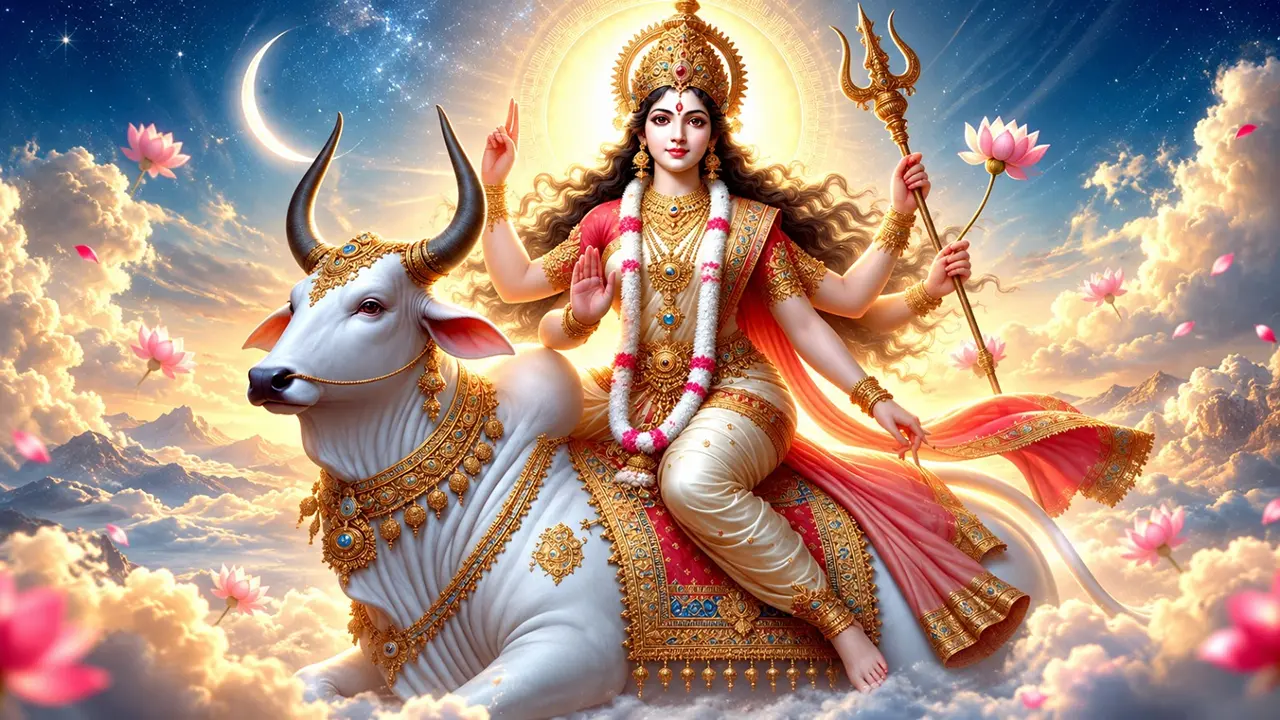
Sharadiya Navratri is a vibrant and sacred Hindu festival that spans nine nights, celebrating the divine feminine energy embodied by Goddess Durga. Observed in the lunar month of Ashwin, this festival is marked by fervent worship, elaborate rituals, and cultural performances.
Each day is dedicated to a different form of the goddess, symbolising various aspects of strength, compassion, and wisdom. Devotees engage in fasting, singing devotional songs, and participating in traditional dances like Garba and Dandiya, creating a joyful atmosphere.
Navratri days hold great significance among Hindus, and these days are celebrated with great grandeur. Navratri will conclude on October 20 with Vijayadashami or Dussehra.
Get Current Updates on India News, Entertainment News, Cricket News along with Latest News and Web Stories from India and around the world.