
Snow Drought In The Himalayas: Scientists Warn Of Ecological Crisis In Jammu & Kashmir
Himalayan ‘snow drought’: Jammu & Kashmir sees 86% rain deficit, 46.6% snow drop as districts like Shopian hit 90% deficits, leading to water, agriculture concerns.
- India News
- 3 min read

;'%3e%3cpath%20d='m8,15.99c4.41,0,7.99-3.58,7.99-7.99S12.41,0,8,0,0,3.59,0,8s3.58,7.99,7.99,7.99Z'%20style='stroke:%23fff;%20stroke-miterlimit:10;%20stroke-width:.02px;'/%3e%3cpath%20d='m3.08,3.37l3.82,5.11-3.84,4.15h.87l3.37-3.64,2.72,3.64h2.94l-4.04-5.39,3.58-3.87h-.86l-3.1,3.35-2.5-3.35h-2.94Zm1.27.64h1.35l5.97,7.99h-1.35l-5.97-7.99Z'%20style='fill:%23fff;'/%3e%3c/g%3e%3c/svg%3e)


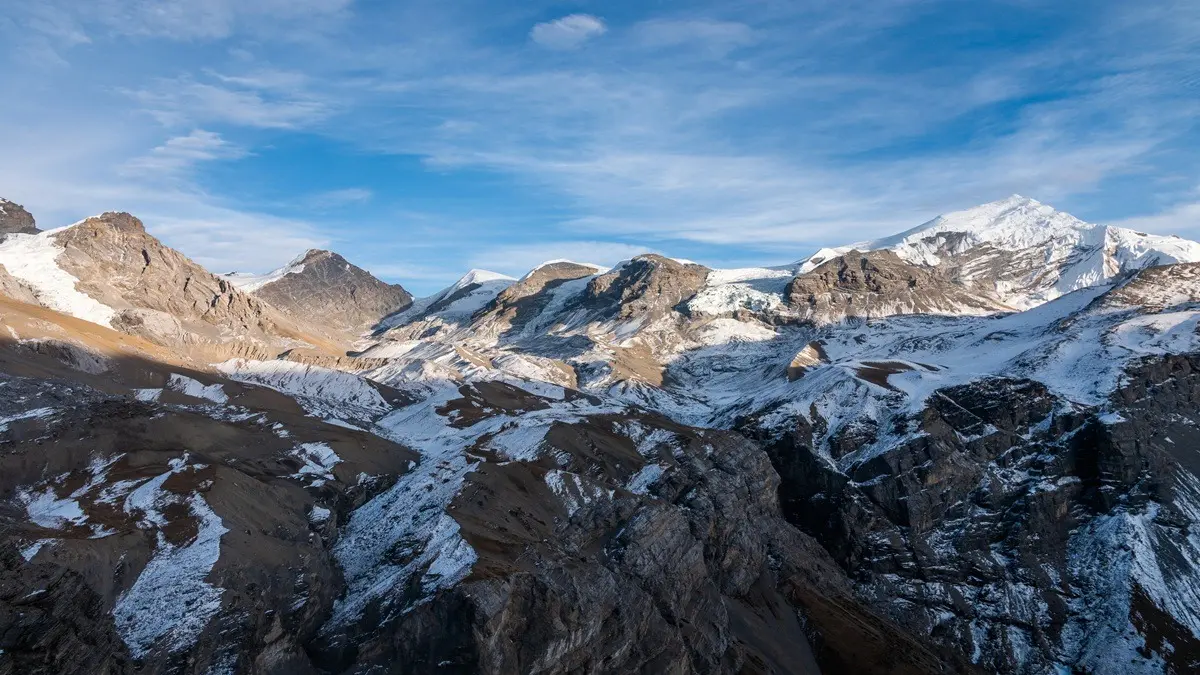
New Delhi: Scientists are warning of an unfolding “snow drought” in the Himalayas, as Jammu and Kashmir reels under one of its driest early winters in decades. The Meteorological department here has reported an 86 percent rainfall deficit between November 1 and December 9, while snowfall across the Himalayan belt has plunged by 46.6 percent since November, raising fears of an ecological crisis that could disrupt water security, agriculture, and forest ecosystems.
According to official data, the Kashmir division has been hit hardest. Shopian and Kulgam reported deficits of 90.5 percent, Baramulla 87.7 percent, Ganderbal 88 percent, Bandipora 81.5 percent, Budgam 77.5 percent, Kupwara 77.4 percent, Pulwama 60.7 percent and Srinagar 83.3 percent. In the Jammu division, Kathua and Kishtwar recorded a complete absence of rainfall, while Doda saw a 90.2 percent deficit, Rajouri 93.5 percent and Poonch 90.4 percent.
The impact is visible on the ground as the Jhelum River at Sangam has slipped to minus 0.59 ft below the zero-gauge level, one of the lowest readings in recent years. Tributaries such as Vaishaw, Brengi, Sandran and Romshi Nallahs are flowing far below normal, with some stretches drying up completely.
Drinking water shortages are already being reported in Baramulla and Kupwara, while irrigation channels have shrunk to trickles.
Advertisement
Adding to the crisis are temperature anomalies as summer capital, Srinagar, recorded a night low of –2.9 degree Celsius on December 10, which is 2.3 degree Celsius below the seasonal average. Kupwara plunged to –4.2 degree Celsius, Pulwama and Shopian to –5.2 degree Celsius, while Gulmarg hovered around 0 degree Celsius.
Meanwhile, Independent observers revealed that Srinagar touched –4 degree Celsius earlier this month, Ladakh sank to –9 degree Celsius, and Zojila dropped to –17 degree Celsius. Despite the cold, precipitation has remained absent, leading scientists to classify the situation as a “snow drought”, a rare but increasingly frequent phenomenon in the Himalayas.
Advertisement
The meteorologists attribute the dry phase to weak western disturbances, the Madden–Julian Oscillation, and broader climate variability. “This is not a single-event anomaly but part of a larger pattern of erratic precipitation and warming winters,” said Dr. Parvez Dar, an environmental scientist.
“Snowfall is not just about beauty; it replenishes glaciers, rivers, and groundwater. Without it, Kashmir’s water security and agriculture face a grave threat,” he added.
The agriculture experts warn that the absence of snow cover could devastate Kashmir’s agrarian economy. “Moisture is critical for saffron, apple orchards, and winter crops like mustard,” explained Dr. Manzoor Riyaz, an agroecologist. “Without winter precipitation, soil fertility and groundwater recharge will collapse, leading to long-term damage,”.
The prolonged dry spell has also heightened the risk of forest fires, as dry vegetation and rising surface heat create favourable conditions for ignition. The authorities have already reported small outbreaks in vulnerable belts of north Kashmir.
The environmentalists argue that the crisis underscores the need for scientific water management measures, including rainwater harvesting, wetland restoration, regulated groundwater extraction, and climate-resilient farming practices. “We are witnessing the convergence of climate change and local vulnerabilities,” said Dr. Bashir Ahmed Khan. “Unless adaptive measures are taken, the Valley could face recurring droughts in the coming years,” he added.
“The scenario is stark, shrinking rivers, vanishing snow cover, and erratic weather patterns are reshaping daily life in Jammu and Kashmir. Unless precipitation returns soon, the Valley may be heading toward one of its harshest winters in decades; without the snow and rain it desperately needs to sustain its ecology, economy, and people,” said Khan.
Get Current Updates on India News, Entertainment News, Cricket News along with Latest News and Web Stories from India and around the world.