
'To Be, or Not To Be': National Award Winning Writer's Short Film ‘Kothala’ Rekindles Debate on Female Infanticide
Set in rural Bihar, the film draws its title from the traditional clay grain-storage structure that, in certain communities, became linked to the killing of newborn girls. Kothala reminds us that female infanticide remains an intolerable denial of the most basic human right: the right simply to be.
- India News
- 6 min read


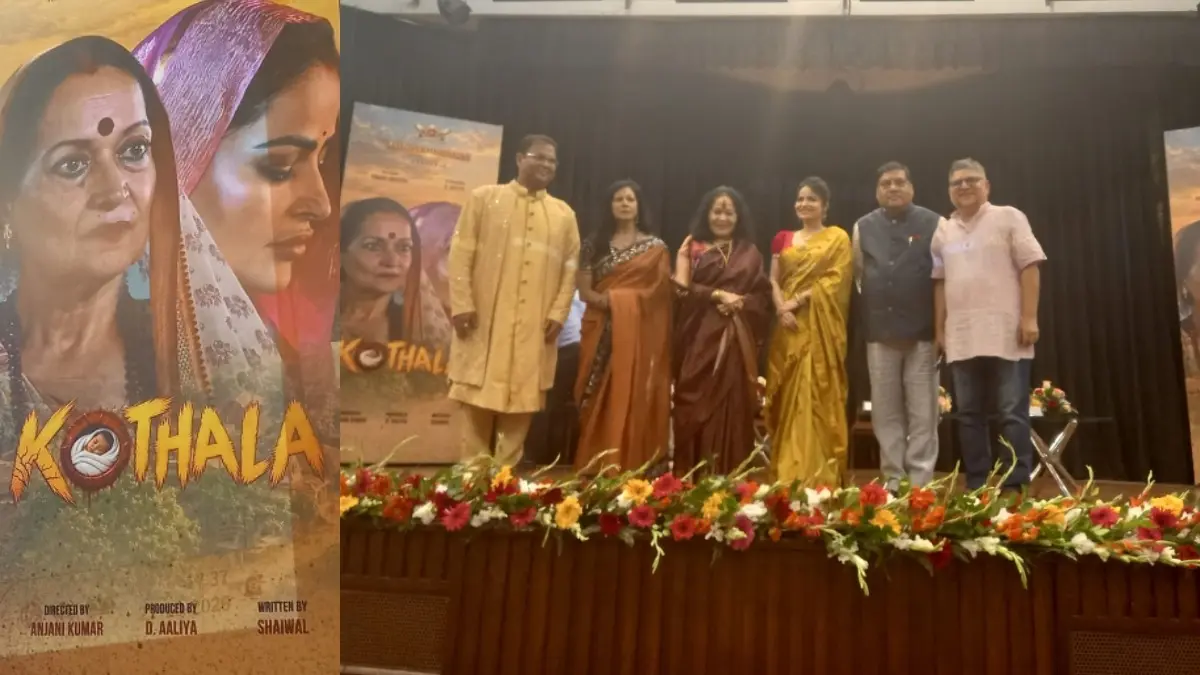
New Delhi: The haunting question from Shakespeare’s Hamlet -- “To be, or not to be” -- took on a grim contemporary resonance at the India International Centre on 27 October 2026. A special screening of the short film Kothala, followed by a candid panel discussion, brought into sharp focus the lingering shadows of female infanticide in pockets of rural India and the urgent need to confront it.
Written by national award-winning writer Shaiwal (known for films such as Damul and Mrityudand), directed by Anjani Kumar and produced by D. Aaliya under Aaliyas Entertainment, Kothala stars veteran actress Himani Shivpuri and debutante D. Aaliya in pivotal roles. Set in rural Bihar, the film draws its title from the traditional clay grain-storage structure that, in certain communities, became linked to the killing of newborn girls. At its heart is a pregnant woman (played by D. Aaliya) who witnesses the practice in her affluent in-laws’ household, flees to protect her unborn daughter, and raises the child alone. That daughter later thrives -- earning an education that takes her to Harvard and becoming an entrepreneur whose social initiatives create wider change -- before dedicating a prestigious honour to the mother who chose life over tradition.
The screening was followed by a thoughtful panel moderated by senior bureaucrat K. Mahesh (IAS).
“The practice of female infanticide/foeticide takes away the right to be born or live,” K Mahesh observed at the outset. He later noted how women themselves can perpetuate the crime after internalising discrimination to the point of seeing it as normal.
Advertisement
D. Aaliya, who also produced the film, recalled her initial disbelief. “When I met the Writer, he shared the subject and I did not agree that such things happen. I was born in Bihar. We are seven sisters and the youngest one and I was the most pampered like I am a single child.” It was only after hearing from the director’s wife, who belongs to the Bhojpur region, that the reality sank in. Aaliya recounted how large numbers of eagles circling kothalas had once prompted inquiry with a midwife, revealing the dark practice. She also referenced the documentary The Midwife’s Confession, which recorded troubling admissions from traditional midwives, including one who reportedly killed around 12–13 infant girls over as many years and another who confessed to at least 15.
“Child killing is still a norm in many places,” she said. “Many children who are rescued go on to become well educated and have prominent positions in society.” Superstition and greed, often masked as dowry expectations, continue to play roles even in financially secure families, she added.
Advertisement
Padma Vibhushan recipient and former Rajya Sabha MP Dr Sonal Mansingh spoke from personal and cultural memory.
“It’s a sensitive subject. It is said that it doesn’t happen now but it is still prevalent. My mother is from Saurashtra and it was quite rampant there. I have heard these things from my mother a lot,” she said. Dowry traditions persist, she noted, and in some places women are even “imported” to fill demographic gaps.
“There cannot be any doubt that we still live in a patriarchal society… We are talking about betis (daughters). What about betas (sons)?. We should teach them [sons] to respect women right from a young age. This film moved me deeply. Films are a powerful medium to reach masses and create awareness.” She also pointed out regional variations: the practice is largely absent in the Northeast and Kerala, yet rate cards for dowry reportedly exist in parts of Bihar for highly placed grooms. “What about the man? Does he not have any self respect and confidence in himself?,” she asked.
Asked if she had ever faced discrimination as a woman, having been the granddaughter of one of the first Governors of India (Mangaldas Pakvasa), legendary dancer Dr Sonal Mansingh said, “Society did not accept dancers when I started my journey, and the profession was considered equivalent to prostitution. It's strange and funny that even elite, educated people thought like that. There were innuendos thrown at women who chose their calling, more so if it did not fit society’s norms. When I told my family about my decision to choose dance for the rest of my life, even after having the academic credentials to pursue a more conventional career, they did not agree. But later, when they realised they could not change my mind, they gave me two conditions -- one, that I could not make a business out of my art, and second, that I could never compromise on my self-respect. I have never seen my craft as an entrepreneurial venture. Throughout my life I have been called arrogant, hot-headed, temperamental and difficult for speaking the truth and not succumbing to any pressure, but I have never compromised on my self-respect. So I fulfilled those two conditions and here I am today.”

Padma Shri Kathak exponent Shovana Narayan described the film as “very moving and sensitive,” linking the issue to a broader “poverty of mind, poverty of character” that appears in different forms worldwide.
“Silence gives impetus to it,” she said, while acknowledging that women from disadvantaged backgrounds are increasingly breaking free. Discrimination, she observed, can persist even among the well-educated and well-placed.
“Kothala speaks about how much we are investing in the future of our girl children,” she said.
National award-winning film critic and cultural historian Dr Vinod Anupam stressed that the problem is not confined to Uttar Pradesh or Bihar. He said that women’s rights and identity remain a national concern. “If we give freedom to our women to choose for themselves in marriage, the problem of Dowry will end,” he said, calling outdated the mindset of guardians who presume to decide on their daughters’ behalf.
Amit Garg (IPS), Director General and Special Secretary, Ministry of Home Affairs, who attended the screening, captured the subject’s complexity with a pointed observation: “We see that in Haryana, we hear that female foeticide and infanticide is still a reality. Yet, on the other side, we get the best women sports personalities from Haryana.”
In one of the film’s most searing moments, a woman who had been pregnant remarks that she “did not even see the face of the child” on two previous occasions -- both times because the newborns were girls killed immediately after birth. Himani Shivpuri’s portrayal of a tyrannical mother-in-law who blindly follows a spiritual leader’s dictates and pleads “Ek pota de dijiye” (please bless us with a grandson) highlights how orthodoxy, superstition and patriarchal control can converge.
Legendary Kuchipudi dancing couple Raja and Radha Reddy, and KN Srivastava (IAS, Retd) were also present as distinguished guests at the event.
The discussion repeatedly returned to the power of education, dialogue and cultural expression to challenge harmful norms. Organisers emphasised that the event sought to highlight the dignity and rights of women and girls and to encourage collective reflection on the changes needed so that every girl can live, learn and pursue her aspirations without discrimination.
Kothala does not claim the practice is widespread across modern India. Instead, it insists -- through story, performance and the conversation it sparked -- that wherever it survives, even in small pockets, it remains an intolerable denial of the most basic human right: the right simply to be.
Get Current Updates on India News, Entertainment News, Cricket News along with Latest News and Web Stories from India and around the world.