
'Tried to Erase History': PM Modi Lashes Out At 'Colonial Mindset' On Somnath Swabhiman Parv
Prime Minister Narendra Modi criticised certain historians and politicians for a "colonial mindset", accusing them of distorting history by labelling religious invasions as mere "loot" in textbooks.
- India News
- 4 min read

;'%3e%3cpath%20d='m8,15.99c4.41,0,7.99-3.58,7.99-7.99S12.41,0,8,0,0,3.59,0,8s3.58,7.99,7.99,7.99Z'%20style='stroke:%23fff;%20stroke-miterlimit:10;%20stroke-width:.02px;'/%3e%3cpath%20d='m3.08,3.37l3.82,5.11-3.84,4.15h.87l3.37-3.64,2.72,3.64h2.94l-4.04-5.39,3.58-3.87h-.86l-3.1,3.35-2.5-3.35h-2.94Zm1.27.64h1.35l5.97,7.99h-1.35l-5.97-7.99Z'%20style='fill:%23fff;'/%3e%3c/g%3e%3c/svg%3e)


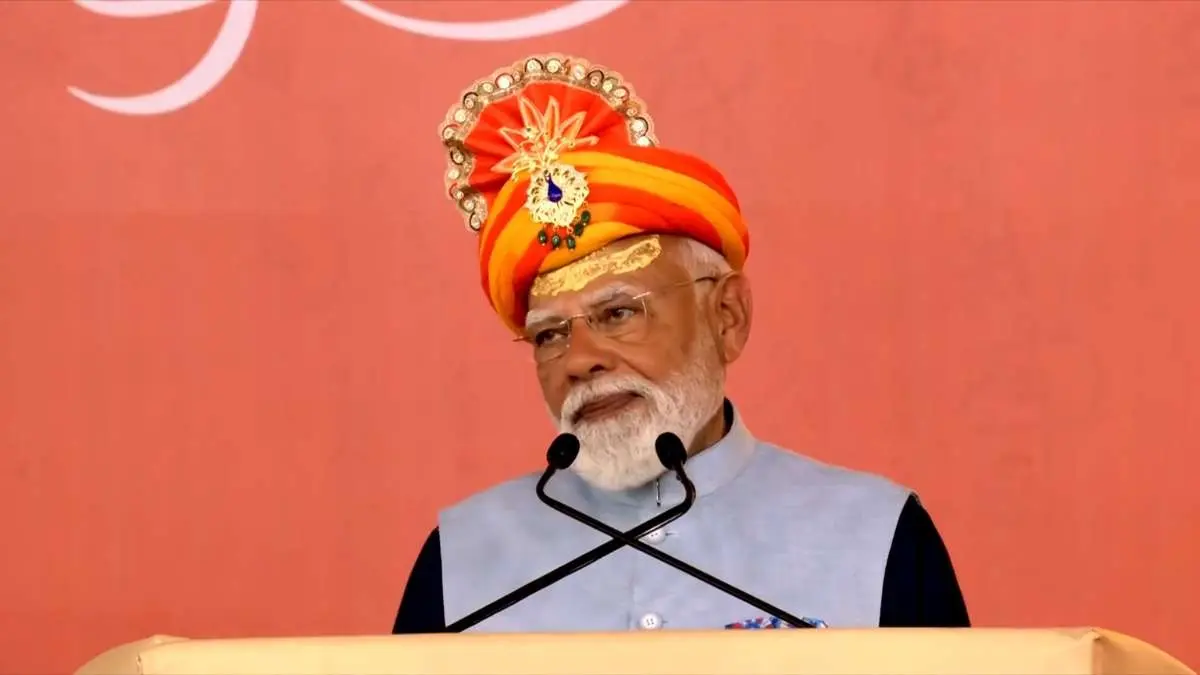
Somanth: Prime Minister Narendra Modi on Sunday hit out at "people with a colonial mindset" in post-Independence historical narratives attempting to "erase history" of India's glorious past.
Addressing a massive gathering after the culmination of the Shaurya Yatra here, the PM asserted that some historians and politicians tried to distort accounts of historical invasions in textbooks, where "religious invasion was labelled as loot".
"Unfortunately, after independence, people with a colonial mindset tried to get rid of our glorious past. They tried all they could to erase history. Those who fought for the Somnath Temple were not given their due recognition and importance. Some historians and politicians even tried to whitewash the history of these invaders. Religious invasion was labelled as loot. We have been taught in our textbooks that the Somnath Temple was demolished to loot its treasures. The cruel history of hate, atrocities and terror was hidden from us," PM Modi said.
The PM said that after independence, when Sardar Vallabhbhai Patel pledged to renovate the Somnath Temple, he was stopped from doing so. He added that objections had been raised even during President Rajendra Prasad's 1951 visit.
He further warned, saying the powers that had opposed the redevelopment back then were still active, now using hidden conspiracies instead of swords against India.
Advertisement
"After independence, when Sardar Vallabhbhai Patel pledged the renovation of the Somnath Temple, he was stopped from doing so. Objections were raised in 1951 on the visit of then-President Rajendra Prasad to Somnath. Unfortunately, even today, the powers that opposed the redevelopment of the Somnath Temple are present and active. Swords have been replaced with hidden conspiracies against India," PM Modi said.
We need to be more aware of them. We need to strengthen ourselves and remain united. We need to defeat every power that tries to divide us. The journey of the last 1000 years will inspire us to be prepared for the next 1000 years," he added. Prime Minister Narendra Modi further underscored the significance of India's ancient sacred sites, citing Somnath as an example.
Advertisement
"India has thousands of sacred sites like Somnath that are thousands of years old. These sites have been symbols of our strength, resilience, and tradition. But unfortunately, after independence, people with a slave mentality tried to distance themselves from these. Despicable attempts were made to forget that history," he said.
Prime Minister Modi participated in a 'Shaurya Yatra' at Somnath as part of a four-day national commemoration marking 1,000 years of unbroken faith and resilience since Mahmud of Ghazni's first attack on the Somnath Temple in 1026.
The 'Shaurya Yatra' is a symbolic procession organised as part of the Somnath Swabhiman Parv. It represents courage, sacrifice and the indomitable spirit that preserved Somnath through centuries of adversity.
Ahead of the yatra, 108 horses of the Gujarat Police Mounted Unit arrived to participate in the event.
The attack marked the beginning of a long period during which the temple was repeatedly destroyed and rebuilt over centuries. Despite this, Somnath never ceased to exist in the collective consciousness of the people. The cycle of the temple's devastation and revival is unparalleled in world history. It demonstrated that Somnath was never merely a stone structure but a living embodiment of belief, identity, and civilisational pride.
On Kartak Sud 1, Diwali day, November 12, 1947, Sardar Vallabhbhai Patel visited the ruins of Somnath and expressed his resolve to rebuild the temple, viewing its restoration as essential to reviving India's cultural confidence. The reconstruction, carried out with public participation, culminated in the consecration of the present temple on May 11, 1951, in the presence of then-President Rajendra Prasad.
In 2026, the nation marks 75 years since the historic 1951 ceremony, reaffirming India's civilisational self-respect. Revered as the first among the 12 Aadi Jyotirlingas of Lord Shiva, the Somnath Temple complex stands majestically along the Arabian Sea, crowned by a 150-foot shikhar, symbolising enduring faith and national resolve.
Get Current Updates on India News, Entertainment News, Cricket News along with Latest News and Web Stories from India and around the world.