
US Envoy’s Srinagar Visit Signals Recognition of Kashmir’s Changed Ground Realities
US envoy Sergio Gor’s Srinagar visit signals a shift in Kashmir’s global image, with Washington reassessing travel advisories amid changing ground realities.
- India News
- 5 min read

;'%3e%3cpath%20d='m8,15.99c4.41,0,7.99-3.58,7.99-7.99S12.41,0,8,0,0,3.59,0,8s3.58,7.99,7.99,7.99Z'%20style='stroke:%23fff;%20stroke-miterlimit:10;%20stroke-width:.02px;'/%3e%3cpath%20d='m3.08,3.37l3.82,5.11-3.84,4.15h.87l3.37-3.64,2.72,3.64h2.94l-4.04-5.39,3.58-3.87h-.86l-3.1,3.35-2.5-3.35h-2.94Zm1.27.64h1.35l5.97,7.99h-1.35l-5.97-7.99Z'%20style='fill:%23fff;'/%3e%3c/g%3e%3c/svg%3e)


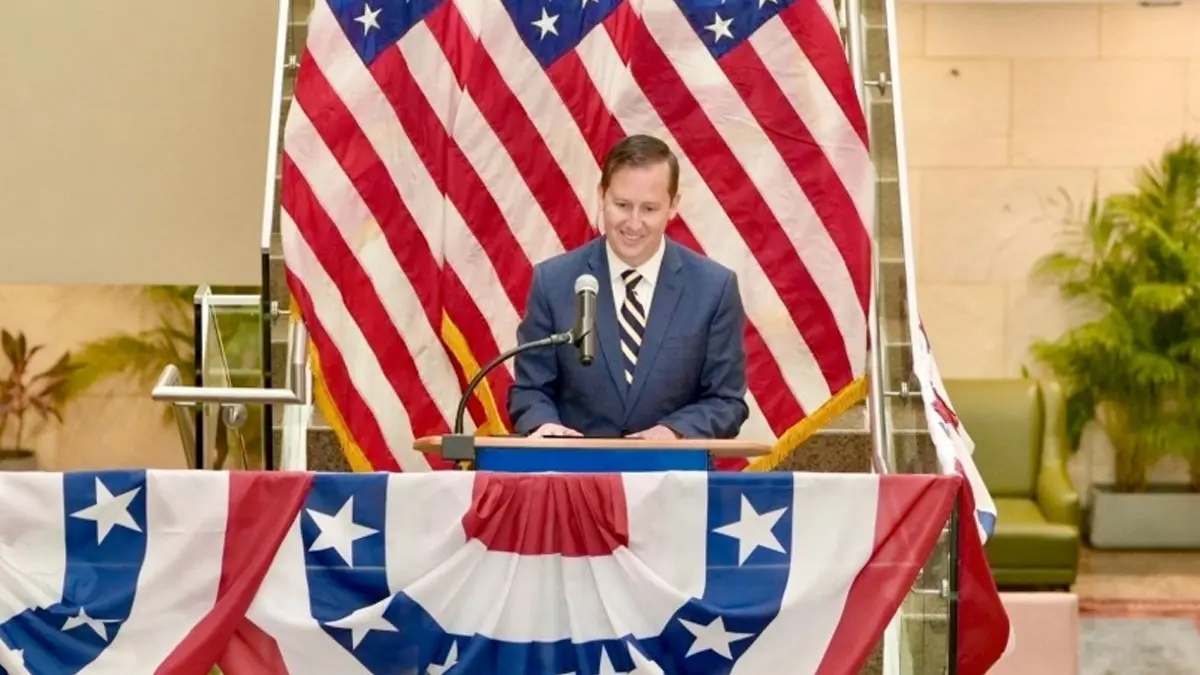
The arrival of United States Ambassador Sergio Gor in Srinagar was not a routine courtesy call. For those who have followed Kashmir’s trajectory over decades, his presence carried the weight of history. Valley has long been a prism through which the world viewed India’s fragility: hartals that emptied streets, stone‑pelting that became ritual defiance, and separatist slogans that echoed across international headlines. That hardened image shaped foreign advisories and global perceptions. Gor’s visit came at a moment when New Delhi insists those patterns have ended, and the Valley is being reintroduced to the world in a different light.
His remark that the United States “constantly re‑evaluates its travel warnings” touched a nerve. Since the Al‑Faran kidnapping in 1995, when six Western trekkers were abducted near Pahalgam, south Kashmir has been marked in red ink on the maps of Washington, London, Berlin, and Paris. One hostage was killed, four disappeared without trace, and only one escaped. That tragedy froze the Valley’s reputation in the eyes of the West. Advisories became permanent, shaping perceptions of Kashmir as a place where danger lurked even in its mountains and meadows. Gor’s suggestion that the advisory could be reconsidered was not a policy change, but it was a signal that the Valley’s image may finally be unfrozen.
Equally telling was his engagement with Chief Minister Omar Abdullah, who described the meeting as constructive. For years, separatist politics monopolized international attention, but since 2019 their absence has created room for new dialogues. Abdullah’s acknowledgment of “legacy issues” was candid, yet his hope for expanded engagement showed how local leaders see opportunity in Washington’s renewed interest. The symbolism of an American envoy meeting local leadership in Srinagar indicates that Washington is willing to listen to perspectives from the ground even while its official policy remains cautious.
What makes Gor’s presence more consequential is his dual role as Ambassador to India and Washington’s Special Envoy for South and Central Asia. That places him at the heart of American strategy in a region where China’s influence is expanding and Turkey–Saudi defense cooperation is reshaping balances. His stop in Srinagar was therefore not incidental. It was a reminder that Kashmir, once seen only as a domestic flashpoint, is now being factored into wider geopolitical calculations. India’s claim that stability in the Valley strengthens its position as a counterweight to China gains resonance when a US envoy acknowledges the changed ground situation.
Advertisement
India–US partnership provides the larger backdrop. Over recent years, ties have deepened through defense agreements, technology partnerships, and trade discussions. Cooperation has expanded into critical minerals, counter‑terrorism, and narcotics control. Gor’s meetings in New Delhi with Home Minister Amit Shah and National Security Adviser Ajit Doval highlighted that trajectory. His outreach in Kashmir linked the Valley’s domestic stability to the broader bilateral agenda, situating it within the matrix of strategic cooperation rather than leaving it as an isolated trouble spot.
No immediate policy change was announced, and Washington’s review of its advisory will take time. Yet the signals are clear. United States is willing to revisit its stance, and India is keen to showcase progress. For Kashmiris, the implications are layered. A softened advisory could revive tourism and investment, but more importantly, it would mark a symbolic shift in how the Valley is perceived internationally. For India, it would be validation of its claim that the abrogation of Article 370 has ushered stability. For Washington, it would be a recalibration of its South Asia policy, aligning perception with new realities.
Advertisement
Another layer of importance lies in the economic dimension. For years, Kashmir’s tourism industry has been constrained not only by local unrest but also by the persistence of foreign advisories that discouraged international visitors. Valley’s famed landscapes, from Gulmarg to Pahalgam, remained largely a domestic attraction, while foreign arrivals dwindled to negligible numbers. If Washington were to ease its advisory, it could open the door for a revival of international tourism, bringing in revenue and reshaping the Valley’s global image from a conflict zone to a destination of natural beauty. This would dovetail with India’s broader push to project Kashmir as a hub for investment and development, aligning local aspirations with national economic strategy.
Equally significant is the diplomatic signaling embedded in Gor’s itinerary. By meeting both national security leaders in New Delhi and local political figures in Srinagar, he bridged two levels of engagement that rarely intersect in foreign diplomacy on Kashmir. This dual approach suggests that Washington is not only interested in India’s narrative of stability but also attentive to voices from the Valley itself. For observers, this is a subtle but important shift: Kashmir is being placed within the framework of India–US relations, not as a peripheral issue but as part of the strategic geography that matters to both capitals. In the long arc of Kashmir’s history, where international attention often came only during crises, Gor’s visit is an attempt to integrate the Valley into a larger conversation about regional security, economic opportunity, and geopolitical balance.
The visit therefore stands at the intersection of three narratives: it highlights India’s security management in Kashmir after 2019, reinforces the India–US strategic partnership by situating the Valley within bilateral discussions, and positions Kashmir within a shifting geopolitical landscape where American interests are shaped by regional defense alignments and China’s influence. Valley, once seen only through the lens of unrest, is being reframed as part of India’s strategic geography in which Washington has a stake.
For those of us who have chronicled Kashmir’s journey through its most turbulent decades, the symbolism of Gor’s presence is unmistakable. It is not about a single advisory or a diplomatic courtesy. It is about recalibrating perceptions of a region that has lived under the shadow of terrorism, and situating it within the evolving balance of power in South Asia. Valley’s story is being rewritten, and the US envoy’s footsteps in Srinagar are part of that new chapter.
Get Current Updates on India News, Entertainment News, Cricket News along with Latest News and Web Stories from India and around the world.