
When Rahul Gandhi Admitted 'Congressmen Were Probably Involved' In 1984 Anti-Sikh Riots In Delhi
Rahul Gandhi’s 2014 interview with Arnab shredded Congress' hypocrisy on the 1984 riots, as Arnab relentlessly exposed his evasions & weak defence.
- India News
- 5 min read

New Delhi: In what seems to be a long-overdue case of justice finally being served, former Congress MP Sajjan Kumar has been sentenced to life imprisonment by a special court for orchestrating the brutal murder of a father and son in the Saraswati Vihar killings. This marks his second life sentence for his role in the 1984 anti-Sikh riots, following his conviction in the Delhi Cantonment case. Special Judge Kaveri Baweja delivered the verdict, bringing a measure of closure to the victims who have waited nearly four decades for accountability.
The 1984 anti-Sikh riots remain one of India's darkest chapters, where thousands of innocent Sikhs were slaughtered in a Congress-led pogrom. Yet, instead of ensuring justice, Congress shamelessly shielded Sajjan Kumar and other perpetrators, rewarding them with power and influence while systematically blocking legal action against them. The party’s disgraceful history of protecting mass murderers exposes its deep-rooted complicity in one of independent India’s worst communal atrocities.

Rahul Gandhi’s Evasive Stand on the 1984 Riots
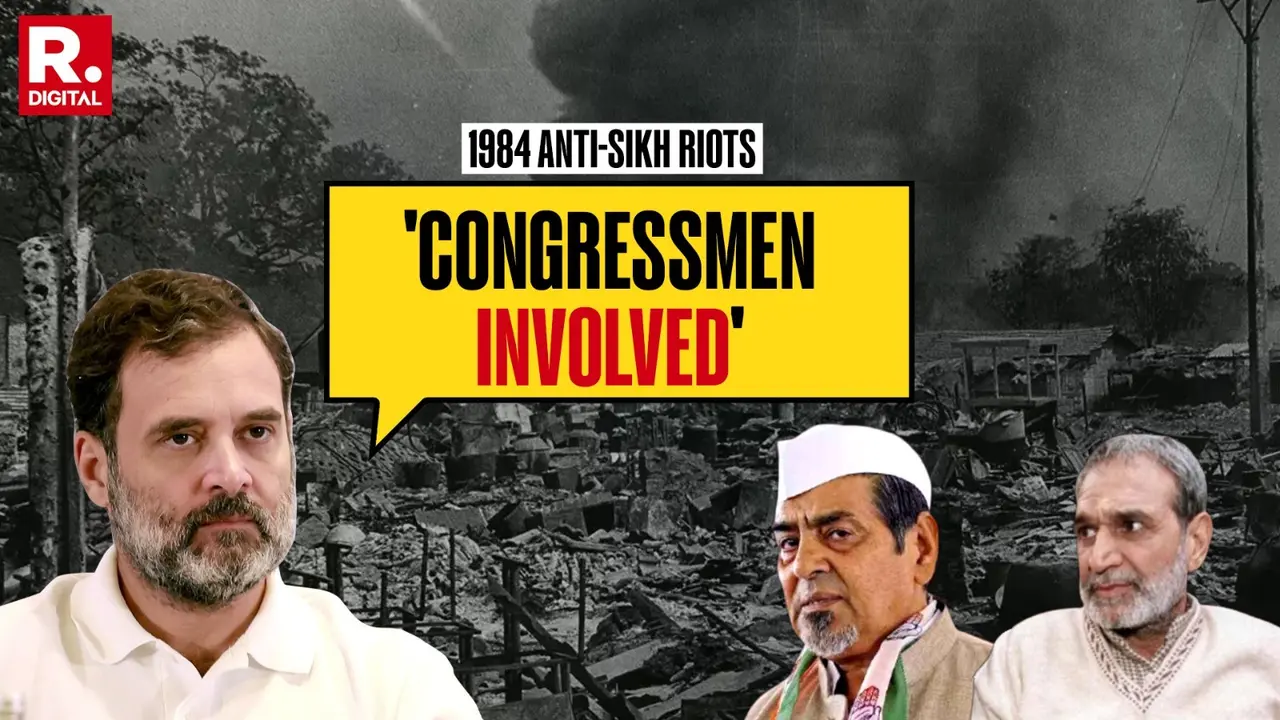
Congress’ hypocrisy on the issue was further exposed in 2014 when Rahul Gandhi, in a rare and most detailed interview with Arnab Goswami , triggered a political storm with his remarks on the 1984 riots. While he vaguely admitted that “some Congressmen were probably involved,” he conveniently dodged any direct accountability for the massacre, which saw more than 3,000 Sikhs killed in cold blood.
When questioned by Arnab about whether the then Congress-led UPA government would take responsibility for the pogrom, Rahul Gandhi deflected, instead reminiscing about how Sikhs supported his grandmother Indira Gandhi after she lost the 1977 election.
Advertisement
While he praised the Sikh community as "one of the most industrious people of the country," he failed to address the party’s role in orchestrating the violence against them after the assassination of Indira Gandhi by her Sikh bodyguards.
Rather than offering a sincere apology, Rahul attempted to shift blame, arguing that he was not personally involved in the riots and claiming, "I wasn’t part of it... I was not into party operations."
Advertisement
His refusal to take moral responsibility for his party’s actions further highlighted Congress' reluctance to acknowledge its hand in the massacre.
When Rahul Evaded Arnab's Questions Deliberately
Rahul Gandhi also deliberately evaded questions about Congress’ repeated endorsement of key riot-accused leaders, including Jagdish Tytler, who was originally set to contest the 2009 elections before a media uproar forced his candidature to be withdrawn.
Instead of addressing why leaders like Tytler, Sajjan Kumar, and HKL Bhagat were continuously rewarded with high positions, Rahul attempted to divert attention by drawing comparisons to the 2002 Gujarat riots.
Even when confronted with evidence by Arnab that Congress had failed to act against its own leaders accused of inciting the carnage, Rahul Gandhi offered a weak defence, claiming, "There is a legal process, and the process is on." His response mirrored Congress’ long-standing strategy—denial, deflection, and delay—ensuring that justice remained elusive for the thousands of Sikh families devastated by the violence.
Why No Death Sentence For Sajjan Kumar?
Some members of the Sikh community demanded the death penalty for former Congress MP Sajjan Kumar. Gurlad Singh, who was leading the protest outside the court premises, said, "Four decades have passed now, and it is the judiciary's phrase that justice delayed is justice denied. We demand only the death penalty for Sajjan Kumar." Singh said the crime fell under the "rarest of the rare" category as the 1984 riots were a "pre-planned genocide".
‘Wheels of Justice Moving’—But Is Life Imprisonment Enough for a Mass Murderer?
The conviction of former Congress MP Sajjan Kumar is a big step towards justice, but it falls short of what the nation truly expected—capital punishment for a man who played a key role in the 1984 anti-Sikh genocide. Pointing out that the “wheels of justice” have started moving, the BJP , however, questioned, should those responsible for mass murder be allowed to escape with life imprisonment.
BJP national spokesperson RP Singh made a powerful appeal to Prime Minister Narendra Modi and Home Minister Amit Shah , urging them to direct the CBI to seek the death penalty for Kumar. This is not a case of ordinary murder; it was a well-organized pogrom unleashed at the behest of Congress leadership, particularly under Rajiv Gandhi’s watch. Justice demands that those who orchestrated the killing of over 3,000 Sikhs face the strictest punishment possible.
BJP IT Cell chief Amit Malviya pointed out that Sajjan Kumar was a close aide of both Rajiv and Sonia Gandhi , yet Congress protected him for decades. If the legal system is to truly uphold justice, the remaining accused—including senior Congress figures—must also face the consequences. The long arm of the law is catching up, and this verdict should only be the beginning.
Congress’ Enduring Betrayal of Justice in the 1984 Anti-Sikh Riots
For nearly four decades, the Congress party has systematically shielded its leaders from accountability for the 1984 anti-Sikh riots, one of independent India’s darkest chapters. The second life sentence handed to Sajjan Kumar is not just a conviction of an individual—it is an indictment of an entire party that enabled, protected, and rewarded those responsible for orchestrating mass murder.
Despite overwhelming evidence, eyewitness testimonies, and public outcry, Congress brazenly defended its leaders accused of inciting mob violence against Sikhs. Sajjan Kumar, Jagdish Tytler, and others were not only allowed to evade justice for decades but were also given powerful positions within the party, reinforcing Congress’ complicity in obstructing the judicial process. Even when justice seemed inevitable, the party either downplayed the atrocities or resorted to deflection, often invoking the Gujarat riots to shift blame.
Sajjan Kumar’s sentencing is a long-overdue step towards justice, but it does not absolve Congress of its moral failure. The party that claims to uphold secularism and minority rights must answer for its dark past. Until every perpetrator is held accountable, the scars of 1984 will remain a lasting reminder of Congress’ betrayal of justice.
Get Current Updates on India News, Entertainment News, Cricket News along with Latest News and Web Stories from India and around the world.