
Where Does The Aravalli Begin And End? Supreme Court Seeks Answers Through New Expert Panel | Key Takeaways From The Ruling
The Supreme Court has formed a five-member expert panel, which will be headed by Kanchan Devi, Director General of the Indian Council of Forestry Research and Education (ICFRE). The panel will review the definition of the Aravalli range and submit its findings by August 31 and the court will take up the matter on September 7. Here are the key takeaways from the ruling and what it means for mining and conservation.
- India News
- 5 min read

;'%3e%3cpath%20d='m8,15.99c4.41,0,7.99-3.58,7.99-7.99S12.41,0,8,0,0,3.59,0,8s3.58,7.99,7.99,7.99Z'%20style='stroke:%23fff;%20stroke-miterlimit:10;%20stroke-width:.02px;'/%3e%3cpath%20d='m3.08,3.37l3.82,5.11-3.84,4.15h.87l3.37-3.64,2.72,3.64h2.94l-4.04-5.39,3.58-3.87h-.86l-3.1,3.35-2.5-3.35h-2.94Zm1.27.64h1.35l5.97,7.99h-1.35l-5.97-7.99Z'%20style='fill:%23fff;'/%3e%3c/g%3e%3c/svg%3e)


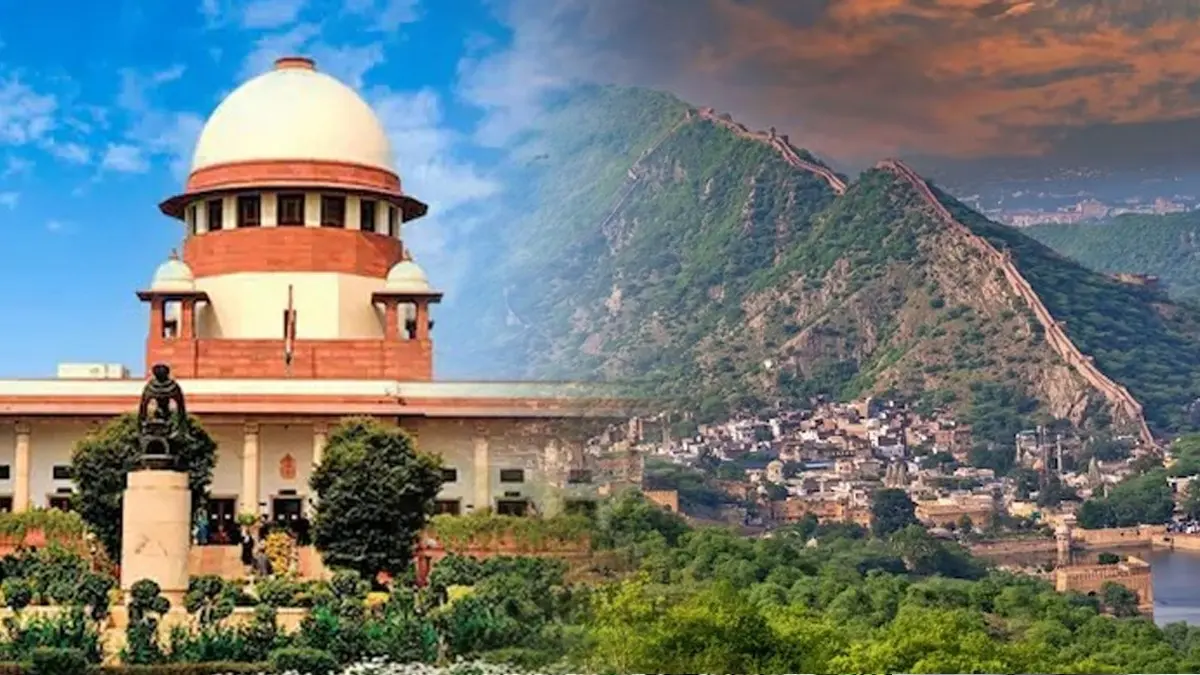
New Delhi: The Supreme Court has formed a high-powered expert committee to undertake a fresh scientific review of the definition and delineation of the Aravalli hill range.
In an order, passed on May 25 and made public on Tuesday, the Supreme Court said an independent assessment was necessary to resolve critical ambiguities in an earlier report prepared by a committee headed by the Secretary of the Ministry of Environment, Forest and Climate Change (MoEFCC). The new panel has been directed to submit its findings by August 31, 2026.
The move comes nearly six months after the court stayed the implementation of the Centre-backed report amid concerns that its proposed definition could significantly reduce the extent of the protected Aravalli ecosystem.
Why Has The Supreme Court Ordered A Fresh Review?
The court observed that a "fair, impartial and independent expert opinion" was required before any final decision could be taken on how the Aravalli range should be identified and protected.
Advertisement
The Bench, headed by Chief Justice of India Justice Surya Kant, noted that the issue has significant ecological, environmental and developmental consequences and therefore warrants a detailed scientific examination involving all stakeholders.
The Supreme Court has already stayed the implementation of the October 2025 report and halted the grant or renewal of mining leases in the Aravalli region until the issue is finally resolved.
Advertisement
What Did The Earlier Report Say?
The controversy stems from recommendations made by an eight-member committee headed by the Environment Ministry Secretary.
The committee proposed that:
Any landform with an elevation of 100 metres or more above local relief should qualify as an Aravalli hill.
Two or more such hills located within 500 metres of each other should be considered part of the Aravalli Range.
While intended to provide a uniform definition, environmental groups and experts argued that the criteria could exclude large stretches of fragmented hill formations from protection and potentially facilitate mining activities in ecologically sensitive areas.
The criticism prompted the Supreme Court to take suo motu cognisance of the matter and suspend the implementation of its earlier order.
Who Is On The New Expert Panel?
The newly formed high-powered committee will be chaired by Kanchan Devi, Director General of the Indian Council of Forestry Research and Education (ICFRE).
Other members include Dr Subhash Ashutosh, former Director General, Forest Survey of India; Dr Rajendra Kumar Sharma, former Director, Geological Survey of India; Brij Mohan Singh Rathore, former Joint Secretary, Ministry of Environment; and Prof Ashok K Bhatnagar, former Head, Department of Botany, Delhi University.
The court has also appointed Prof Jagdish Krishnaswamy of the Indian Institute for Human Settlements, Bengaluru, and Prof Laxmikant Sharma of the Central University of Haryana as special invitees who may be consulted by the committee whenever required.
Key Questions The Committee Must Answer
The Supreme Court has tasked the committee with examining several contentious issues.
1. Does The 500-Metre Rule Shrink The Aravalli Range?
One of the most important questions before the panel is whether limiting the Aravalli range to hills located within 500 metres of each other artificially narrows the extent of the ecosystem.
The court has asked the committee to assess whether such a definition could lead to fragmentation of protected areas and enable environmentally disruptive activities in the gaps between hill formations.
2. Can Hills Separated By Larger Distances Still Form One Ecological System?
The panel must determine whether Aravalli hills rising 100 metres or more continue to function as a connected ecological and geological formation even when separated by distances greater than 500 metres.
The answer could have a direct bearing on whether mining should be permitted in such intervening areas.
3. Are Most Aravalli Hills Being Left Out?
The October 2025 report had concluded that only 1,048 of Rajasthan's 12,081 hills meet the proposed 100-metre elevation criterion.
The Supreme Court has asked the committee to verify whether this assessment is scientifically and factually accurate and whether thousands of lower-elevation hill formations risk losing environmental protection.
4. Are Existing Safeguards Adequate?
The committee will also evaluate whether current regulatory mechanisms are sufficient to protect the Aravalli ecosystem or whether a more exhaustive scientific and geological investigation is required.
Why Is The Aravalli Range Important?
The Aravallis are among the oldest fold mountain systems in the world and serve as a critical ecological barrier in northwestern India.
The range acts as a natural shield against the eastward expansion of the Thar Desert, supports groundwater recharge, regulates local climate and provides ecological security to densely populated regions, including Delhi-NCR.
Over the years, the Supreme Court has repeatedly intervened to curb illegal mining in the region. A 2018 Forest Survey of India report had documented the disappearance of several hillocks due to mining activities in Rajasthan and Haryana.
Stakeholders To Be Consulted
The court has directed the committee to engage with a broad range of stakeholders before finalising its report.
These include the governments of Delhi, Rajasthan and Haryana, environmentalists, non-governmental organisations, mining lease holders, project proponents, farmers, villagers and local communities whose livelihoods are linked to the Aravalli landscape.
According to the court, any recommendation must balance environmental protection with sustainable development while remaining scientifically sound and practically implementable.
What Happens Next?
The high-powered committee has been directed to submit its report by August 31, 2026.
The matter is scheduled to come up before the Supreme Court on September 7, when the court is expected to examine the committee's findings and decide the future course of action.
Until then, the freeze on new mining permissions and lease renewals in the Aravalli region will remain in force.
The committee's conclusions are likely to play a decisive role in determining not just where the Aravallis begin and end, but also how one of India's most ecologically significant landscapes is protected in the years ahead.
Get Current Updates on India News, Entertainment News, Cricket News along with Latest News and Web Stories from India and around the world.