
Why China’s Ease On Export Curbs Of Rare Earths Is Indeed A Rare Sign Of Mutual Interest | Explained
China lifts export curbs on rare earth magnets, fertilizers, and tunnel-boring machines to India, signalling improved bilateral ties and supporting India's manufacturing ambitions.
- India News
- 3 min read

;'%3e%3cpath%20d='m8,15.99c4.41,0,7.99-3.58,7.99-7.99S12.41,0,8,0,0,3.59,0,8s3.58,7.99,7.99,7.99Z'%20style='stroke:%23fff;%20stroke-miterlimit:10;%20stroke-width:.02px;'/%3e%3cpath%20d='m3.08,3.37l3.82,5.11-3.84,4.15h.87l3.37-3.64,2.72,3.64h2.94l-4.04-5.39,3.58-3.87h-.86l-3.1,3.35-2.5-3.35h-2.94Zm1.27.64h1.35l5.97,7.99h-1.35l-5.97-7.99Z'%20style='fill:%23fff;'/%3e%3c/g%3e%3c/svg%3e)


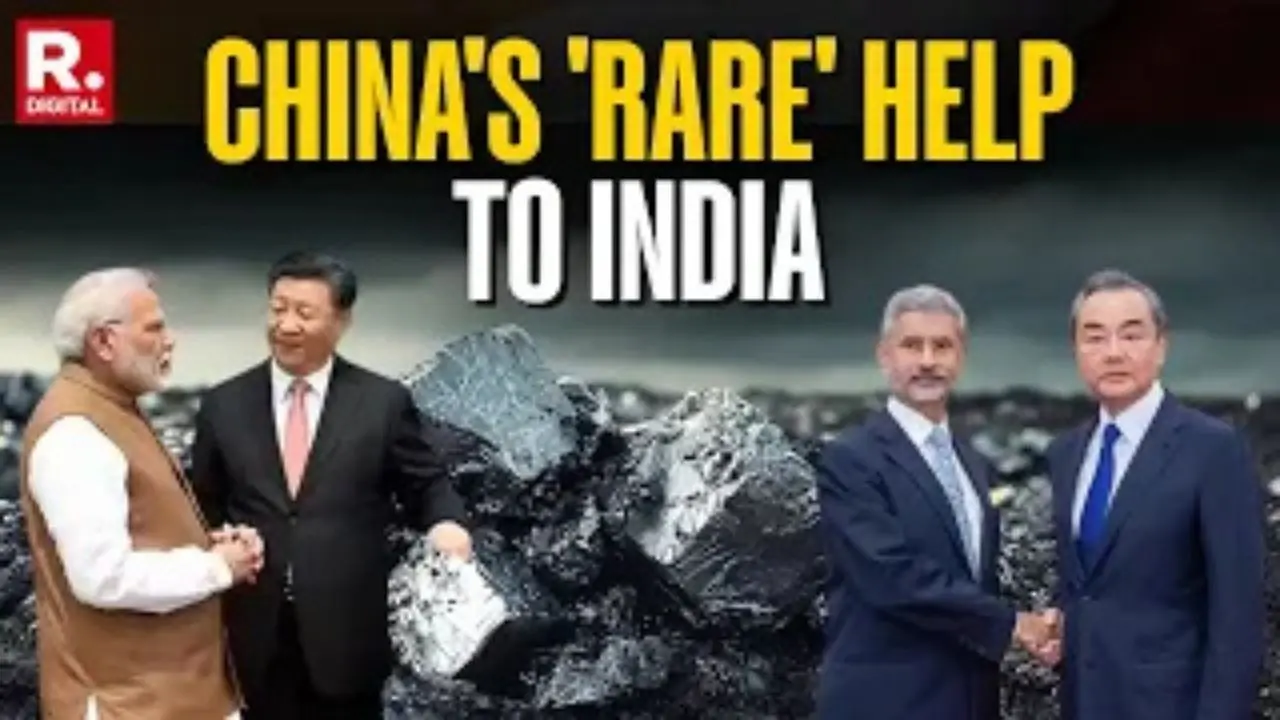
New Delhi: In a significant move with potential long-term ripple effects for bilateral trade dynamics, China has agreed to lift restrictions on exports of rare earth magnets, fertilizers, and tunnel-boring machines to India. This development comes at a time when New Delhi is ramping up efforts to transition from being overwhelmingly import-dependent to building a self-sustaining manufacturing ecosystem, powered by schemes such as the ₹18,100 crore PLI initiative and recent discoveries of domestic rare earth reserves.
The symbolism of this gesture cannot be overlooked. Rare earth materials are the backbone of next-generation technologies, from electric vehicles and wind turbines to advanced electronics. Similarly, fertilizers are vital for India’s agrarian economy, while tunnel-boring machines play a critical role in urban infrastructure and connectivity. By easing curbs on these crucial commodities, Beijing seems to be signalling a greater willingness to accommodate India’s developmental aspirations and reduce friction in an otherwise fraught relationship.
India's High Trade Deficit With China
However, the deeper question is whether this unlocks anything beyond temporary relief. India’s trade deficit with China remains staggeringly high, not only because of essential imports but also due to the sheer dominance of Chinese intermediate goods in key industries like electronics, telecom, and green technology. While limited relaxation may help unclog supply bottlenecks, dependency is unlikely to dissipate unless India builds its own competitive ecosystems.
This is where India’s larger economic vision comes into play. The production-linked incentive schemes are designed to give domestic manufacturers the ability to scale, innovate, and compete with Chinese firms. The discovery of rare earth deposits within India adds another dimension, potentially enabling New Delhi to insulate itself from external supply shocks in the long term. For now, however, Chinese exports remain an unavoidable bridge to sustain growth, particularly as India intensifies its push to become a global manufacturing hub.
Advertisement
From a geopolitical lens, Beijing’s decision carries undertones of strategic repositioning. In extending such trade concessions to India, China could be attempting to soften tensions and build limited goodwill at a time when global supply chains are realigning. For India, this presents both an opportunity and a reminder: while short-term import reliance may be unavoidable, the long-term goal lies in reducing structural vulnerabilities.
In essence, what appears today as a concession by China may tomorrow serve as a catalyst for India’s self-sufficiency. If New Delhi can leverage the temporary reprieve to accelerate domestic innovation, diversify supply chains, and nurture competitive industries, it will mark not just an economic transition but a geo-economic rebalancing in Asia.
Advertisement
Get Current Updates on India News, Entertainment News, Cricket News along with Latest News and Web Stories from India and around the world.