
Why Supreme Court Denied Bail To Umar Khalid & Sharjeel Imam In Delhi Riots Case
From alleged chakka jam calls to a 20,000-page chargesheet mapping coordination and planning, the Supreme Court said the UAPA threshold is crossed, making bail unjustified at this stage for Umar Khalid and Sharjeel Imam.
- India News
- 5 min read

;'%3e%3cpath%20d='m8,15.99c4.41,0,7.99-3.58,7.99-7.99S12.41,0,8,0,0,3.59,0,8s3.58,7.99,7.99,7.99Z'%20style='stroke:%23fff;%20stroke-miterlimit:10;%20stroke-width:.02px;'/%3e%3cpath%20d='m3.08,3.37l3.82,5.11-3.84,4.15h.87l3.37-3.64,2.72,3.64h2.94l-4.04-5.39,3.58-3.87h-.86l-3.1,3.35-2.5-3.35h-2.94Zm1.27.64h1.35l5.97,7.99h-1.35l-5.97-7.99Z'%20style='fill:%23fff;'/%3e%3c/g%3e%3c/svg%3e)


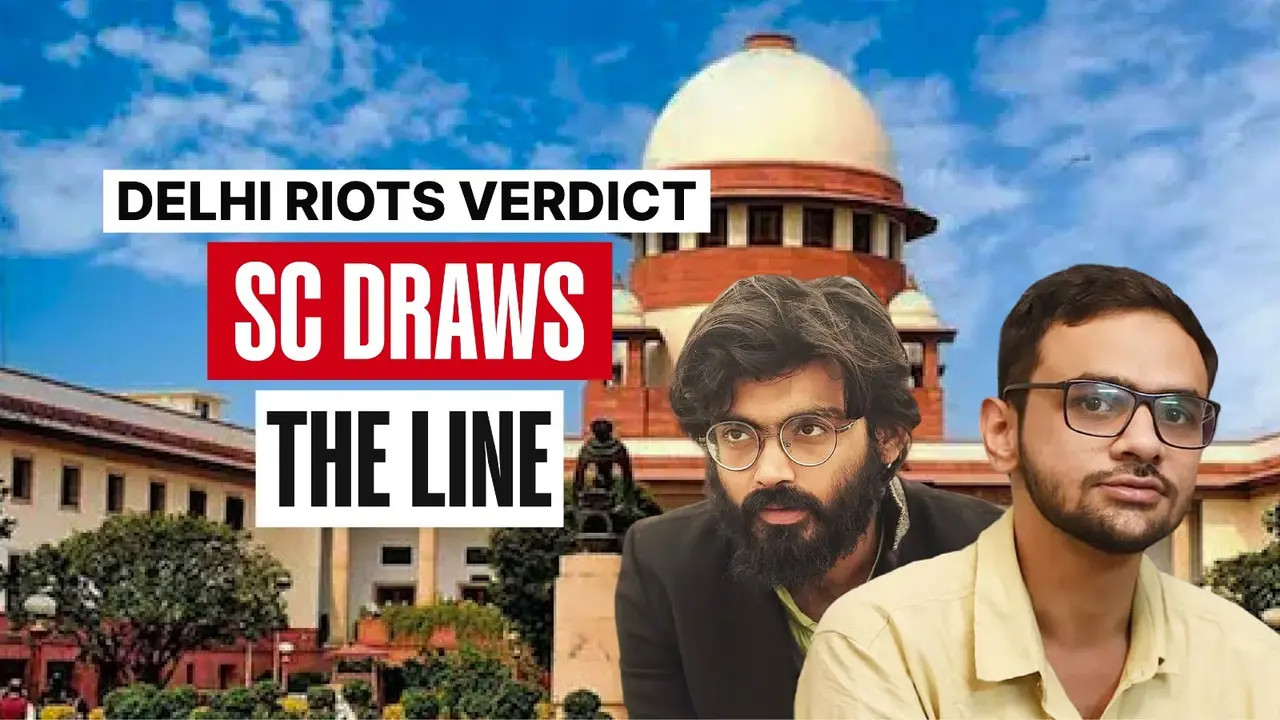
New Delhi: The Supreme Court on Monday refused to grant bail to Umar Khalid and Sharjeel Imam in the 2020 Delhi riots case, holding that the material placed on record establishes a prima facie case under the Unlawful Activities (Prevention) Act (UAPA) and places the two accused on a “different footing” from others who were granted bail.
A Bench comprising Justice Aravind Kumar and Justice NV Anjaria said the allegations against Khalid and Imam go beyond participation in protests and point towards an alleged mastermind role in a larger conspiracy behind the communal violence that erupted in northeast Delhi in February 2020.
‘Different Footing’ From Other Accused
The apex court made it clear that while bail was granted to five other accused in the same case, Umar Khalid and Sharjeel Imam could not be treated on a par with them.
According to the Bench, the prosecution material indicates that Khalid and Imam were not peripheral players but were allegedly involved in planning, coordination and mobilisation, which distinguishes their role from others.
Advertisement
“The masterminds stand on a different footing,” the court observed, underlining that bail considerations under UAPA require a higher statutory threshold.
Prima Facie Case Under UAPA
The Supreme Court held that the statutory bar under Section 43D(5) of UAPA was attracted in the case of Khalid and Imam.
Advertisement
The provision restricts the grant of bail if the court is satisfied that the accusations are prima facie true. After examining the chargesheet and supporting material, the Bench ruled that this threshold had been crossed.
“The court has consciously avoided a collective or unified approach… This court is satisfied that the prosecution material disclosed a prima facie allegation against the appellants Umar Khalid and Sharjeel Imam. The statutory threshold stands attracted qua these appellants. This stage of proceedings do not justify their enlargement on bail,” the court said.
“The prosecution material discloses a prima facie case,” the court said, concluding that granting bail at this stage would be legally unjustified.
One of the key factors weighed by the court was the prosecution’s reliance on Sharjeel Imam’s speeches, portions of which were supported by video footage.
The prosecution argued that Imam’s calls for “chakka jams”, road blockades and obstruction of essential supplies were not mere political speeches but actions aimed at disrupting normal life and economic activity, thereby falling within the scope of UAPA provisions related to economic security.
The court took note of these submissions while assessing whether the allegations met the prima facie standard under the anti-terror law.
20,000-Page Chargesheet & Alleged Conspiracy
The Supreme Court also referred to the voluminous chargesheet running into nearly 20,000 pages, filed by the Delhi Police Special Cell.
According to the prosecution, the chargesheet details:
- Coordination through multiple WhatsApp groups
- Structured mobilisation of protestors
- A pattern of planning and execution
- Alleged attempts to escalate protests into violence
The court noted that the allegations point towards organised planning rather than spontaneous protests, a distinction that weighed heavily against the accused at the bail stage.
Delay In Trial Not Sole Ground For Bail
Addressing arguments on prolonged incarceration and delay in trial, the Supreme Court acknowledged that delay can invite judicial scrutiny even in UAPA cases.
However, it categorically ruled that delay alone cannot be a ground for bail when the court finds that a prima facie case exists under the stringent provisions of UAPA.
The Bench held that the seriousness of allegations and the nature of material on record outweigh the argument of delay at this stage.
Liberty To Reapply For Bail
While refusing bail, the Supreme Court left the door open for future relief.
It said that Umar Khalid and Sharjeel Imam are at liberty to apply for bail again, saying, “On completion of examination of protected witnesses or completion of one year from this order these appellants may be at liberty to move an application for grant of bail.”
Bail Granted to Five Other Accused
In contrast, the Supreme Court granted bail to five other accused in the same case, subject to strict conditions, holding that their alleged roles did not meet the same threshold of culpability at this stage.
The court reiterated that bail decisions must be based on individual roles, even within the same conspiracy case.
The case pertains to the February 2020 Delhi riots, which left over 50 people dead and hundreds injured. The Delhi Police have described the violence as the outcome of a larger conspiracy, a charge denied by the accused.
Get Current Updates on India News, Entertainment News, Cricket News along with Latest News and Web Stories from India and around the world.