
Women's Quota Ahead Of 2029: How Centre's 50% Seat Hike, 2011 Census Formula & 2051 Freeze Aim To Fast-Track Reservation
The Centre's revised delimitation Bills seek to fast-track 33% women's reservation ahead of the 2029 elections through a 50% seat increase, use of 2011 Census data and a freeze on inter-state seat readjustments until 2051.
- India News
- 6 min read


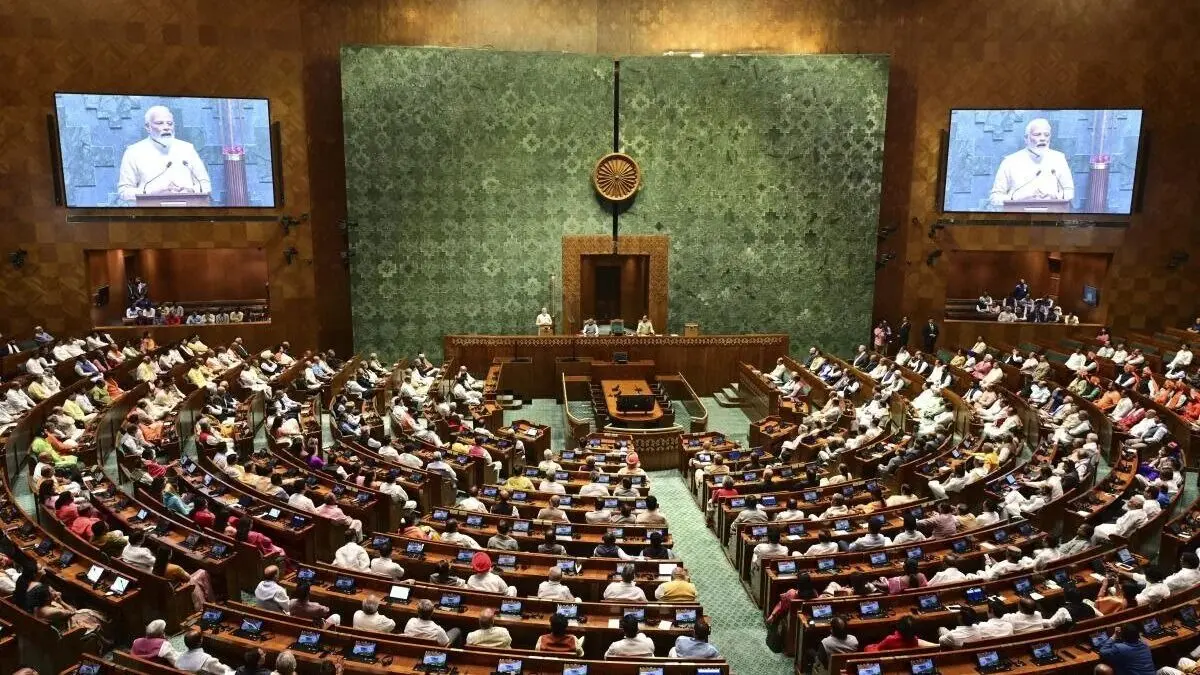
New Delhi: In a decisive push to bring one-third reservation for women into Parliament and State Assemblies ahead of the 2029 General Elections, the Bharatiya Janata Party-led Centre has engineered a practical legislative solution that decouples delimitation from the ongoing 2026–27 Census, using the already published 2011 Census figures alongside a flat 50 per cent increase in legislative seats so every state gains without losing ground.
Framing the twin measures as a historic step toward removing every obstacle for Nari Shakti and advancing the vision of Viksit Bharat@2047, Prime Minister Narendra Modi, in a Saturday video message, underscored the government’s commitment to women’s empowerment, while Union Home Minister Amit Shah appealed to all political parties across the spectrum to back the landmark reform.
The blueprint rests on two Bills prepared for introduction in the Lok Sabha on November 27 by Union Minister of State (Independent Charge) for Law and Justice Arjun Ram Meghwal—The Constitution (One Hundred and Thirty-second Amendment) Bill, 2026 (Bill No. 158 of 2026) and The Delimitation (Second) Bill, 2026 (Bill No. 159 of 2026).
Under the Nari Shakti Vandan Adhiniyam (Constitution One Hundred and Sixth Amendment Act, 2023), the 33 per cent reservation for women could only take effect after a delimitation exercise following the first census conducted after the 2023 Act came into force.
Advertisement
The government’s new legislative package removes that bottleneck in several targeted ways. Bill No. 158 of 2026 substitutes Article 334A so that women’s reservation takes effect immediately after the first delimitation exercise undertaken upon the commencement of the 2026 Amendment Act, with reservation remaining in force for 15 years from the commencement of the 2023 Act unless extended by Parliament, and seats allotted by rotation as determined by law.
The Bill amends Articles 81, 82, 170, and 330 to replace references to the "2001 census" with the "latest published census figures available on the date of the commencement" of the 2026 Act, allowing the Delimitation Commission to use 2011 Census data to redraw territorial constituencies and determine Scheduled Caste and Scheduled Tribe proportions in time for 2029 rather than waiting for the 2026–27 Census.
Advertisement
Both the proposed Article 334A and Section 10 of the Delimitation (Second) Bill mandate a 50 per cent increase in the number of seats allocated to each State and Union Territory in the Lok Sabha, as well as in the total seats of each State and UT Legislative Assembly, over existing levels.
Article 81’s maximum elective Lok Sabha strength is raised from 530 to 815 members from the States and from 20 to 35 from the Union Territories (lifting the overall ceiling from 550 to 850), while Article 170 raises the maximum strength of a State Legislative Assembly from 500 to 650 seats.
The Bill extends the freeze on fresh inter-state census-based seat readjustments, the 1971 Census basis for Presidential election vote values under Article 55, and special ST seat protections in the Assemblies of Arunachal Pradesh, Meghalaya, Mizoram, Nagaland, and Tripura under Article 332 until 2051, while expanding women’s reservation under Article 334A to the Legislative Assemblies of Puducherry and Jammu and Kashmir and bringing J&K into the Presidential electoral college under Article 54.
Repealing the Delimitation Act, 2002, the Delimitation (Second) Bill, 2026 establishes a structured, transparent mechanism to execute the expansion smoothly.
Constituted by the Central Government, the Delimitation Commission is headed by a serving or retired Supreme Court Judge, with the Chief Election Commissioner (or a nominated Election Commissioner) and the concerned State Election Commissioner serving as ex officio members, assisted by ten non-voting associate members per State (five Lok Sabha MPs and five MLAs).
Every State’s total Assembly seats must be an integral multiple of its Lok Sabha seats, every Assembly constituency must fall wholly within one Parliamentary constituency, and one-third of women’s reserved seats within SC and ST categories will be rotated within constituencies already reserved for those respective categories.
After draft publications and public sittings in each State, final orders take effect upon publication in the Gazette of India and cannot be questioned in court, while existing Houses and Assemblies continue undisturbed until dissolution.
While the 2051 freeze applies to inter-state seat readjustments and Article 55/332 protections, the 33 per cent women’s reservation under the 2023 Act carries an initial 15-year duration from its commencement unless extended by Parliament.
Politically, the NDA’s floor prospects have strengthened ahead of Monday’s Lok Sabha reconvening (followed by the Rajya Sabha on December 2), with indications of backing from the DMK and NCP–Sharadchandra Pawar lifting the ruling bloc’s estimated Lok Sabha tally from around 320 to roughly 350 MPs.
With five vacancies in the 543-member Lok Sabha leaving 538 sitting members—meaning 359 votes would represent a two-thirds threshold if all 538 participate—the alliance stands within 10 votes of that benchmark even before factoring in attendance and abstentions under Article 368’s requirement of a majority of total membership and at least two-thirds of members present and voting.
Indications of backing from the DMK and NCP-Sharadchandra Pawar have lifted the NDA's estimated Lok Sabha tally from around 320 to roughly 350 MPs.The ruling NDA's estimated strength stands at around 320 MPs. Both the DMK, with 22 MPs, and the NCP-Sharadchandra Pawar, with 8 MPs, have indicated support for the Centre's revised delimitation proposal, which provides for a uniform 50% increase in seats across states while preserving their relative representation. Adding those 30 MPs takes the projected tally to around 350.
In practice, the Speaker does not vote in the first instance, only casting a deciding vote in the event of a tie. Only 539 members, including the Speaker, can attend, making 538 members eligible to vote and lowering the full-attendance two-thirds mark to 359.
The two-thirds requirement applies only to those present and voting; absences or abstentions reduce the denominator and lower the exact number of votes needed to pass the bill.
Under Article 368, a constitutional amendment requires a majority of total membership and at least two-thirds of members present and voting, meaning attendance and abstentions affect the final threshold.
Get Current Updates on India News, Entertainment News, Cricket News along with Latest News and Web Stories from India and around the world.