
Zojila Tunnel: All About India's Himalayan Engineering Marvel Connecting Kashmir to Ladakh
The Zojila Tunnel is one of India's most ambitious infrastructure projects, designed to provide all-weather connectivity between Kashmir and Ladakh. Here's everything you need to know about the engineering marvel.
- India News
- 3 min read

;'%3e%3cpath%20d='m8,15.99c4.41,0,7.99-3.58,7.99-7.99S12.41,0,8,0,0,3.59,0,8s3.58,7.99,7.99,7.99Z'%20style='stroke:%23fff;%20stroke-miterlimit:10;%20stroke-width:.02px;'/%3e%3cpath%20d='m3.08,3.37l3.82,5.11-3.84,4.15h.87l3.37-3.64,2.72,3.64h2.94l-4.04-5.39,3.58-3.87h-.86l-3.1,3.35-2.5-3.35h-2.94Zm1.27.64h1.35l5.97,7.99h-1.35l-5.97-7.99Z'%20style='fill:%23fff;'/%3e%3c/g%3e%3c/svg%3e)


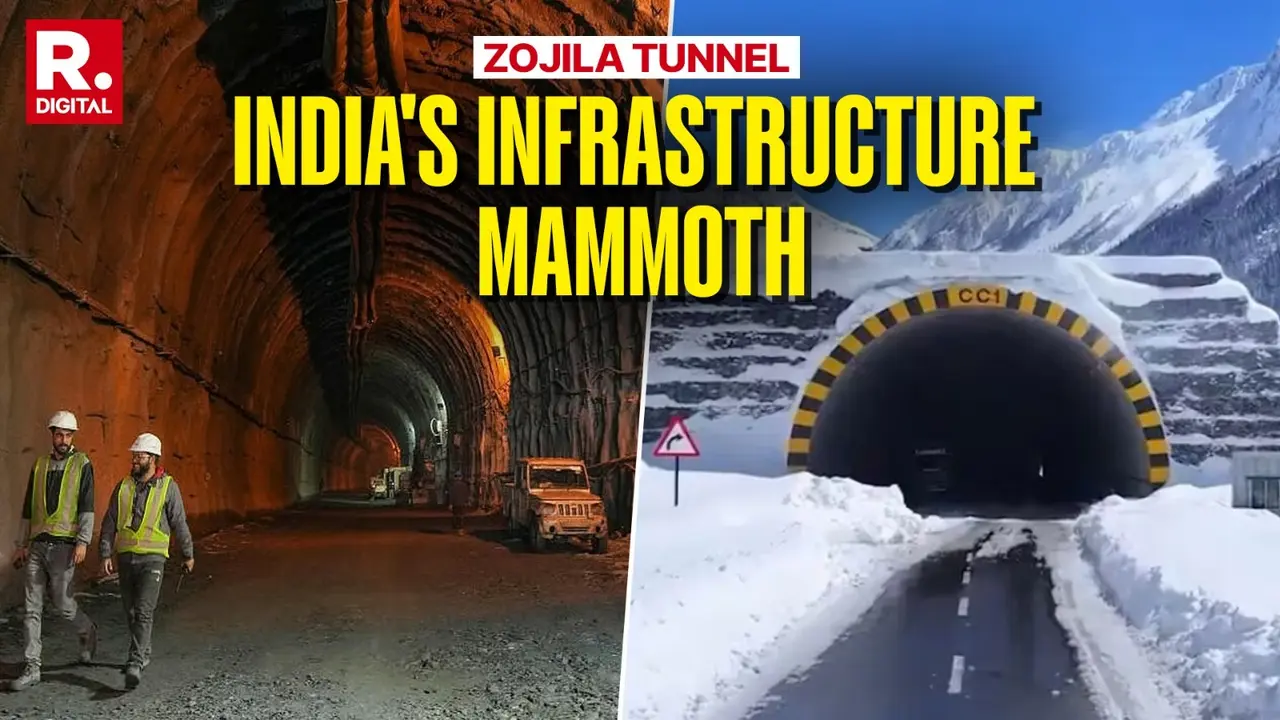
Sonamarg: India has historic infrastructure with the final structural excavation breakthrough of the highly anticipated Zojila Tunnel.
Union Minister for Road Transport and Highways Nitin Gadkari triggered the historic final breakthrough blast at the project site near Minamarg, marking the completion of the gruelling underground excavation phase.
The 13.153-kilometre-long engineering marvel is located at a dizzying altitude of 11,578 feet above sea level.
It is constructed by Hyderabad-based Megha Engineering & Infrastructures Limited (MEIL) under the supervision of the National Highways and Infrastructure Development Corporation Limited (NHIDCL).
Advertisement
Once fully operational, it will be Asia’s longest bi-directional, single-tube road tunnel and the world's longest at such a high altitude.
It establishes a permanent, year-round link between Baltal (near Sonamarg in Jammu and Kashmir) and Meenamarg (near Drass and Kargil in Ladakh).
Advertisement
Bypassing the Treacherous Zojila Pass
For generations, the Zojila Pass on National Highway-1 (Srinagar-Leh Highway) has been a vital but dangerous bottleneck.
Heavy winter snowfall, extreme blizzards, and severe avalanches routinely force the pass to shut for three to four months every year, completely isolating the Union Territory of Ladakh from the rest of India.
The Zojila Tunnel rewrites this geographic reality. By completely bypassing the most hazard-prone, avalanche-heavy stretches of the pass, the project will transform regional transit:
Crossing this mountain sector currently takes over three arduous hours. The tunnel shrinks the transit to a mere 15 to 20 minutes.
Civilian mobility, medical emergencies, and trade will flow smoothly 365 days a year, completely unhindered by severe winter weather.
Unprecedented Himalayan Engineering
Building a tunnel through fragile, high-altitude Himalayan geology is widely considered one of the most dangerous infrastructure tasks in the world.
| S. No | Project Attribute | Technical Specifications |
| 1. | Main Tunnel Length | 13.153 km (Single-tube, two-lane, bi-directional) |
| 2. | Total Project Scope | ~30.18 km (Includes approach roads, 2 mini-tunnels, and 4 bridges) |
| 3. | Elevation | 11,578 feet (approx. 3,529 meters) above sea level |
| 4. | Tunnelling Technology | New Austrian Tunnelling Method (NATM) |
| 5. | Total Estimated Cost | Over ₹6,800 crore (approx. USD 815 million) |
Engineers utilised the advanced New Austrian Tunnelling Method (NATM), which relies on strategic, sequential excavation and immediate rock-bolting support to adapt to unstable rock formations and counter heavy water ingress.
More than 1,200 technicians and workers, nearly 80% of whom were hired locally, braved sub-zero winter temperatures of minus 30 degrees Celsius.
Despite facing multiple severe avalanche crises over the last five years, the team successfully logged over 10 million safe man-hours.
Strategic and Economic Significance
Beyond its engineering brilliance, the Zojila Tunnel holds immense geostrategic weight for the Indian Armed Forces.
Positioned near sensitive border regions, this all-weather route ensures the uninterrupted, rapid movement of troops, heavy military equipment, and essential military logistics to the Line of Actual Control (LAC) throughout the frozen winter months.
Economically, the year-round highway will breathe new life into the local economy of Jammu and Kashmir and Ladakh.
Following the final breakthrough blast, officials conducted a symbolic first drive through the mountain, moving the tunnel a massive step closer toward its final public commissioning.
Get Current Updates on India News, Entertainment News, Cricket News along with Latest News and Web Stories from India and around the world.