
From AI to Automation: How Intelligent Cooking Is Transforming India's Commercial Kitchens for Future
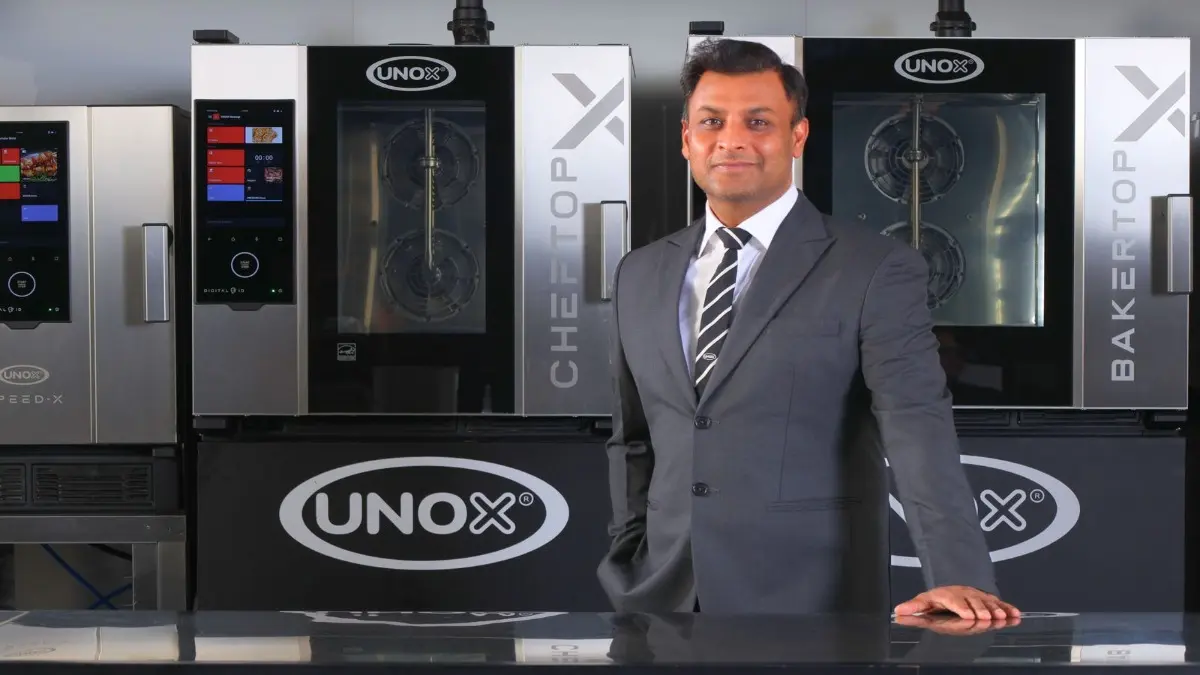
UNOX Regional Director Vikram Goel explores the future of India's commercial kitchens, discussing AI, automation, connected equipment and intelligent cooking technologies, and how they can address labour challenges while improving productivity, consistency, energy efficiency and ROI.
- Utility News
- 5 min read

;'%3e%3cpath%20d='m8,15.99c4.41,0,7.99-3.58,7.99-7.99S12.41,0,8,0,0,3.59,0,8s3.58,7.99,7.99,7.99Z'%20style='stroke:%23fff;%20stroke-miterlimit:10;%20stroke-width:.02px;'/%3e%3cpath%20d='m3.08,3.37l3.82,5.11-3.84,4.15h.87l3.37-3.64,2.72,3.64h2.94l-4.04-5.39,3.58-3.87h-.86l-3.1,3.35-2.5-3.35h-2.94Zm1.27.64h1.35l5.97,7.99h-1.35l-5.97-7.99Z'%20style='fill:%23fff;'/%3e%3c/g%3e%3c/svg%3e)


1. Why is the commercial kitchen emerging as the next major investment area for India's hospitality and foodservice industry?
The commercial kitchen is increasingly being viewed as a business-critical investment rather than simply a back-of-house function. As India's foodservice industry expands, operators are looking for greater output, consistency and efficiency from the same kitchen footprint. At the same time, skilled labour availability, operating costs and customer expectations are changing. This is pushing businesses to invest in technologies that can make the kitchen more productive, predictable and easier to manage. The focus is shifting from simply buying equipment to building a more efficient kitchen operation.
2. UNOX has been investing in intelligent cooking technologies and automation. What gaps in commercial kitchens is UNOX looking to address through its latest innovations?
One of the biggest gaps is the dependence on individual skill and manual intervention for processes that can be made more consistent and repeatable. Our focus is on using technology to support the chef rather than replace the chef. Intelligent cooking technologies can help automate repetitive processes, monitor cooking conditions, provide greater process control and reduce the scope for human error. The objective is to give kitchen teams greater control over consistency, productivity and day-to-day operations.
3. Is AI genuinely ready for India's commercial kitchens, and what practical changes can intelligent cooking technologies bring to the industry?
Yes, but AI in a commercial kitchen should be understood in practical terms rather than as a futuristic concept. The value comes when intelligence is built into everyday cooking processes. It can help the oven understand cooking parameters, support repeatable results, assist with process optimisation and reduce the number of manual decisions required during a cooking cycle. For Indian kitchens, where volumes, menus and operating conditions can vary significantly, this kind of technology can bring greater consistency while allowing chefs to focus more on the food and less on constantly managing the equipment.
4. What are the biggest barriers preventing Indian restaurants and hospitality businesses from adopting AI-enabled cooking technologies at scale?
The first is awareness. Many operators still look at an oven primarily as a piece of equipment rather than as a technology platform that can influence the entire cooking process. The second is the perception of investment cost. Businesses need to look beyond the purchase price and consider productivity, energy use, wastage, consistency and labour requirements over the equipment's operating life. The third is adoption within the professional kitchen. Technology has to be intuitive and easy for the entire team to use. If it is complicated, adoption will always be a challenge.
Advertisement
5. With rising labour costs and a shortage of skilled kitchen professionals, how can automation help businesses improve productivity without compromising quality?
Automation can take over repetitive and highly process-driven tasks, allowing the available kitchen team to focus on areas where human skill matters most. More importantly, it can help standardise processes so that the outcome is not completely dependent on who is operating the equipment on a particular day. In a high-volume kitchen, even small improvements in process time and consistency can have a significant impact on overall productivity. The idea is not to remove the chef from the process, but to make the chef and the kitchen team more productive.
6. What are the biggest hidden costs in a commercial kitchen that technology can help businesses control?
There are several costs that are often not visible when an operator looks only at the equipment purchase price. Energy consumption is one. Food wastage, overproduction, inconsistent cooking and rework are others. Then there is the cost of labour time spent monitoring processes that could be automated, as well as the impact of inconsistent output on customer experience. When you look at the kitchen as an entire operating system, these costs can add up considerably. Technology can help make many of these processes more measurable and controllable.
Advertisement
7. How are efficiency, consistency, energy consumption and food wastage changing the way restaurants and hotels calculate the ROI of kitchen investments?
The conversation around ROI is becoming much broader. Earlier, the question was often, "How much does the equipment cost?" Today, operators are increasingly asking, "What does this equipment cost me to operate, and what does it help me save or produce?" Productivity, energy consumption, cooking time, consistency, food wastage and labour utilisation all contribute to the real economics of a kitchen. This is encouraging businesses to evaluate equipment over its complete operating lifecycle rather than simply comparing the initial purchase price.
8. Can sustainability become a measurable financial advantage for commercial kitchens, rather than simply an ESG or brand consideration?
Absolutely. In a commercial kitchen, sustainability and operational efficiency are closely connected. If a kitchen uses less energy, reduces food wastage and operates more efficiently, those improvements have a direct financial impact. The important shift is to measure sustainability through operational metrics rather than treating it only as a corporate or branding exercise. For a foodservice operator, doing more with fewer resources is both an efficiency objective and a sustainability objective.
9. Looking ahead to 2030, what will the commercial kitchen of the future look like, and which technologies will play the biggest role in shaping it?
By 2030, I believe the commercial kitchen will be significantly more connected, data-driven and automated. Cooking equipment will not operate as isolated machines but as part of a connected kitchen ecosystem. AI, automation, connected equipment, digital monitoring and energy-management technologies will increasingly work together. At the same time, the chef will remain central. Technology will take care of more of the repetitive and measurable aspects of the operation, allowing chefs and kitchen teams to spend more time on creativity, quality and the customer experience. The future kitchen will not be less human; it will be better supported by technology.