
All About Somnath Temple: History of The First Ever Jyotirling Mahadev Mandir Which Was Destoyed And Rebuilt Through Millennia
Located on the western coast of Gujarat, at the confluence of the Arabian Sea, the Somnath Temple stands as one of India’s most revered pilgrimage destinations and is known as the first of the 12 Jyotirlingas of Lord Shiva.
- Lifestyle News
- 4 min read

;'%3e%3cpath%20d='m8,15.99c4.41,0,7.99-3.58,7.99-7.99S12.41,0,8,0,0,3.59,0,8s3.58,7.99,7.99,7.99Z'%20style='stroke:%23fff;%20stroke-miterlimit:10;%20stroke-width:.02px;'/%3e%3cpath%20d='m3.08,3.37l3.82,5.11-3.84,4.15h.87l3.37-3.64,2.72,3.64h2.94l-4.04-5.39,3.58-3.87h-.86l-3.1,3.35-2.5-3.35h-2.94Zm1.27.64h1.35l5.97,7.99h-1.35l-5.97-7.99Z'%20style='fill:%23fff;'/%3e%3c/g%3e%3c/svg%3e)


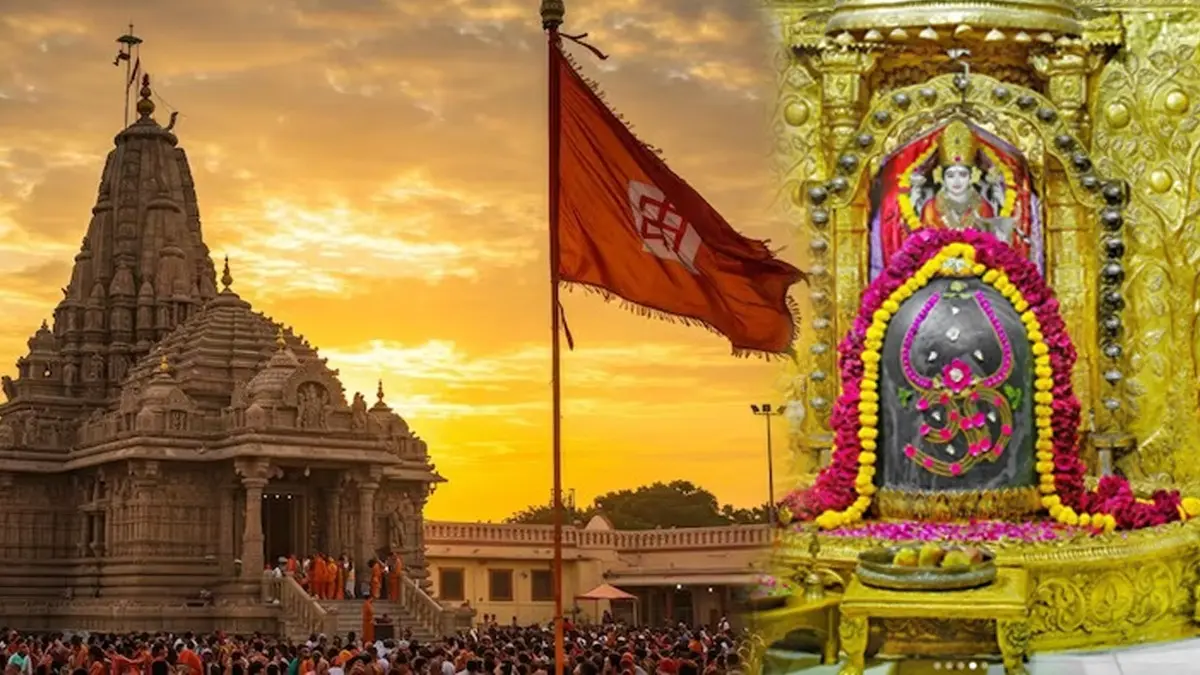
In India, all temples are known to have a significant history and hold special mythological importance. However, the Somnath Temple in Gujarat is one temple that everyone should visit once in their lifetime. Known as the first of the 12 Jyotirlingas of Lord Shiva, the temple is not just a testament of spirituality, but also of survival and resilience.
Where is the Somnath Temple located?
The Somnath temple is one of India's most revered pilgrimage destinations, located along the coastline in Prabhas Patan, Veraval, the Saurashtra region of Gujarat. The holy site is situated at the confluence of the Arabian Sea, making it not only one of the most significant but also one of the most beautiful temples of the nation. Not just pleasing to the eye, the location of the Somnath Temple also holds a special geological importance.
As per reports, there is no land between the seashore of the Somnath Temple and Antarctica. The vast ocean keeps sending its waves to the walls of the sacred site, which has sustained attacks much more than what can be normally sustained. The sound of the waves fills the air with peace, tranquilty reminding devotees to slow down and embrace each divine moment. The temple is also the site of the holy confluence (sangam) of three rivers, Kapila, Hiran and Saraswati. Beyond its spiritual significance, Somnath has come to be a scenic travel destination. The temple’s seaside location offers breathtaking views, especially at sunrise and sunset, drawing devotees and tourists alike.
What is the spiritual importance of the Somnath Temple?
Several reports and studies claim that the mention of the sacred site was made in early texts such as the Mahabharata and the Bhagavata Purana. The temple is believed to have been originally built by the Moon God, Soma, in gold to seek redemption from a curse. It is later said to be rebuilt in silver by Ravana, in wood by Lord Krishna, and finally in stone by King Bhimdev of the Solanki dynasty, as per ancient texts. These legends have earned Somnath the name “Shrine Eternal.”
Advertisement
The multiple attacks on the Somnath temple by Muslim invaders
Historically, the Somnath Temple has witnessed repeated invasions and destruction. The most notable attack took place in 1026 CE when Mahmud of Ghazni raided the temple, plundering its immense wealth and damaging the structure, even breaking the jyotirlinga. As per reports, he looted the temple of 20 million dinars at the time. In the centuries that followed, the temple faced destruction several times during subsequent invasions and political upheavals. Each time, however, it was rebuilt by devoted rulers and followers, reinforcing its status as a symbol of unyielding faith.
Advertisement
The restoration of the Somnath Temple by India's Iron man Sardar Vallabhbhai Patel
On Kartak Sud 1, Diwali day, November 12, 1947, Sardar Vallabhbhai Patel visited the ruins of Somnath and expressed his resolve to rebuild the temple, calling its restoration vital for restoring India's cultural confidence. The reconstruction, carried out with public support, was completed with the consecration of the present temple on May 11, 1951, in the presence of then President Rajendra Prasad. The temple was built in the Chalukya style of architecture, featuring intricately carved pillars, a majestic shikhara (flag) rising over 150 feet, and a sacred kalash weighing several tonnes atop the spire.
About the Somnath Swabhiman Parv
Prime Minister Narendra Modi participated in the grand Shaurya Yatra in the context of the Somnath Swabhiman Parv on Sunday. PM Modi offered prayers at the Somnath temple. He also paid floral tributes to the statues of Veer Hamirji Gohil and Sardar Vallabhbhai Patel. Veer Hamirji Gohil sacrificed his life while defending the Somnath Temple in 1299 AD during the invasion led by Zafar Khan.
Somnath Swabhiman Parv, held from January 8 to January 11, 2026, marks 1,000 years since Mahmud of Ghazni's first attack on the Somnath Temple in 1026. The attack marked the start of a long period during which the temple was repeatedly destroyed and rebuilt. Despite this, Somnath remained deeply rooted in the collective memory of the people. The repeated destruction and restoration of the temple is unique in world history, reflecting its enduring spiritual and cultural significance.
Also Read: PM Modi Performs Puja At Shree Somnath Mandir, Offers 'Abhishek'