
1984: The Fires Went Out, The Waiting Did Not
"I have covered the 1984 cases for nearly 2 decades. Sajjan Kumar is dead, but 42 years later, the questions surrounding the killings and the Congress’s reckoning with its past remain."
- Opinion News
- 5 min read

;'%3e%3cpath%20d='m8,15.99c4.41,0,7.99-3.58,7.99-7.99S12.41,0,8,0,0,3.59,0,8s3.58,7.99,7.99,7.99Z'%20style='stroke:%23fff;%20stroke-miterlimit:10;%20stroke-width:.02px;'/%3e%3cpath%20d='m3.08,3.37l3.82,5.11-3.84,4.15h.87l3.37-3.64,2.72,3.64h2.94l-4.04-5.39,3.58-3.87h-.86l-3.1,3.35-2.5-3.35h-2.94Zm1.27.64h1.35l5.97,7.99h-1.35l-5.97-7.99Z'%20style='fill:%23fff;'/%3e%3c/g%3e%3c/svg%3e)


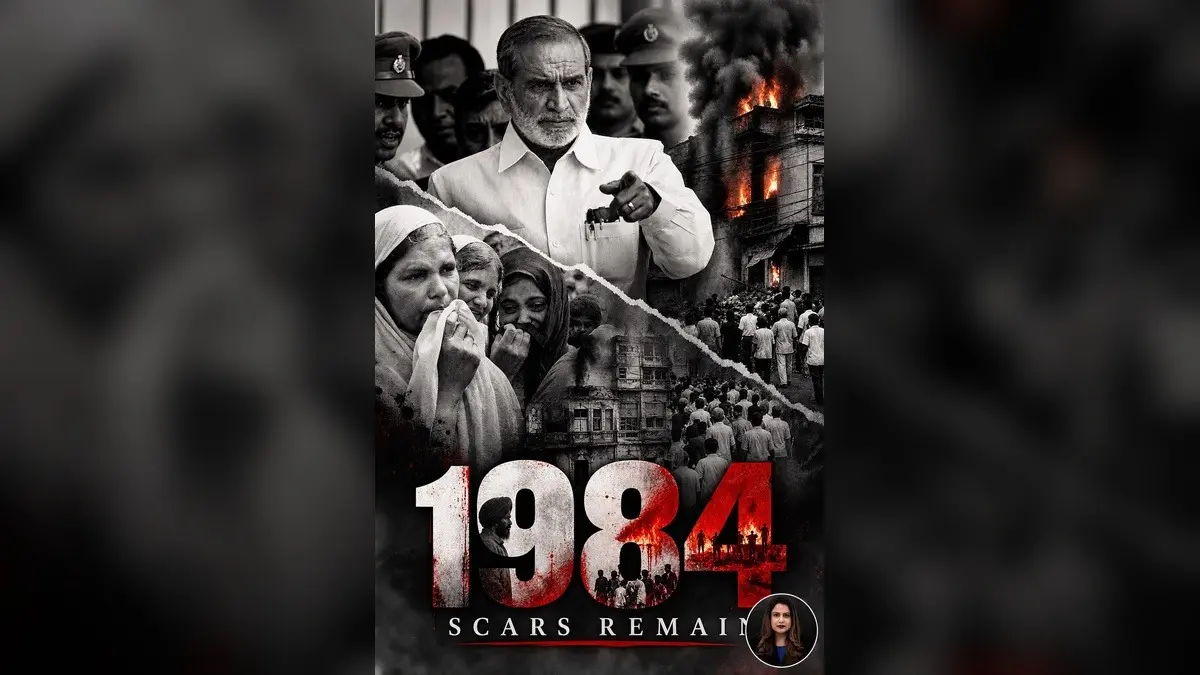
I have been reporting on the 1984 anti-Sikh violence and the cases that followed for nearly 2 decades. I was 26 when I first began closely following Sajjan Kumar’s case in court. Over the years, I watched the proceedings move slowly.
For me, 1984 was never an abstract chapter in India’s history. I was two years old when it happened. I am a Sikh. My family had to leave our home. My parents, uncles, aunts, and my baby brother, who was barely a month old, had to flee. My grandfather stayed behind.
There were Sikh men who cut their hair because they were terrified that being identified as Sikh could make them a target.
Some images remain-2 Sikh men with their hair open, tyres around them, being set on fire. That was 1984. But it was only much later, as a reporter, that I began to understand the scale of what those families had lived through.
Advertisement
I met many of them in court. Some had lost fathers, husbands, sons and brothers. They spoke about threats and intimidation.
I remember one day outside the Karkardooma courtroom very clearly.
Advertisement
Sajjan Kumar saw me. He knew I was reporting on the case and that I had done stories critical of him.
He looked straight at me. His face changed. There was anger in his eyes - a hard, cold rage that I have never forgotten. He raised his right arm, his fist clenched, in a gesture that was less like that of a politician and more like a warning from someone accustomed to having people around him do as he said.
It was an intimidating, almost mafia-like show of power. And then I saw a few of his men moving towards me. There were 5-6 of them. They always accompanied him.
I ran. I reached my OB van, which was parked far away, got inside and stayed there quietly until they moved away. I was told later that they had been looking for me around the court premises. Eventually, they left.
I called my Editor, Arnab. He made it the headline that night and debated the story on air.
I eventually went back into the courtroom. Because the bigger story was still there: the families who had been coming back, hearing after hearing, despite everything.
That day gave me a glimpse of what it must have been like for victims who had lost everything and still had to stand up to people with political power.
I met H.S. Phoolka many times during those years. I saw Manjinder Singh Sirsa join protests and stand with victims. I watched lawyers persist through hearings that seemed to stretch endlessly. And I watched families age.
Sajjan Kumar eventually became the most prominent Congress politician to be convicted in connection with the violence. In 2018, the Delhi High Court sentenced him to life imprisonment in the Raj Nagar case, involving the killing of five members of a family and the burning of a gurdwara. In February 2025, he was sentenced to another life term in the Saraswati Vihar case for the killings of Jaswant Singh and his son Tarundeep Singh. He died on August 20, 2026, while serving his sentence in Tihar.
His death brings to an end one chapter of a very long legal saga. But it does not bring an end to the questions surrounding 1984.
Because 1984 was 42 years ago.
Forty-two years is an entire lifetime. That is why the tributes following Sajjan Kumar’s death have been so difficult to understand.
Congress MP Deepender Singh Hooda paid a glowing tribute to Kumar, describing him in terms that included an exemplary political figure and national role model. Punjab Congress has since distanced itself from those remarks, calling them his personal views and reiterating solidarity with the victims.
Congress Leaders like Rahul Gandhi need to answer a larger question:
What does the party believe should be the political memory of 1984?
Can a man who was convicted in two separate 1984 cases be remembered by a Congress leader in the language normally reserved for a political hero without causing pain to the families who spent decades fighting those cases?
This is where the story goes beyond Sajjan Kumar.
In 2014, Rahul Gandhi was asked directly by Arnab whether Congressmen had been involved in the 1984 violence. He acknowledged that “some Congressmen were probably involved” and said some had been punished. When Arnab pressed him on whether he would apologise for the riots, Gandhi did not offer an apology on behalf of the Congress.
That interview is worth revisiting today because the fundamental question has not disappeared.
Sajjan Kumar’s convictions are now part of that judicial record. The Nanavati Commission also recorded evidence concerning the involvement of Congress leaders
I have spent nearly two decades reporting this story. But for the people who lived through 1984, it was not a political talking point. It was their home.
Their family.
Their father.
Their husband.
Their son.
Sajjan Kumar has died in prison. A court convicted him. Those are facts of the legal record. But the larger story of 1984 remains unfinished.
After 42 years, the Congress owes the country an answer.
Forty-two years have passed. The official record says 3,325 people were killed across India, 2,733 of them in Delhi alone.
3325 is not just a statistic.
Of 650 cases registered by the Delhi Police, chargesheets were filed in 362. Only 39 cases resulted in convictions. 323 ended in acquittal. Another 267 were classified as untraced
For the families who survived, 1984 did not end in November. The fires went out. The waiting has not.