
Iran's Oil Dash to China, and What Beijing Might Be Getting Back
Iran sells to China because there is almost nobody else. China takes close to 90 per cent of Iran's crude exports. European buyers left after 2018, and India has largely stayed away to protect its access to American banking.
- Opinion News
- 5 min read

;'%3e%3cpath%20d='m8,15.99c4.41,0,7.99-3.58,7.99-7.99S12.41,0,8,0,0,3.59,0,8s3.58,7.99,7.99,7.99Z'%20style='stroke:%23fff;%20stroke-miterlimit:10;%20stroke-width:.02px;'/%3e%3cpath%20d='m3.08,3.37l3.82,5.11-3.84,4.15h.87l3.37-3.64,2.72,3.64h2.94l-4.04-5.39,3.58-3.87h-.86l-3.1,3.35-2.5-3.35h-2.94Zm1.27.64h1.35l5.97,7.99h-1.35l-5.97-7.99Z'%20style='fill:%23fff;'/%3e%3c/g%3e%3c/svg%3e)


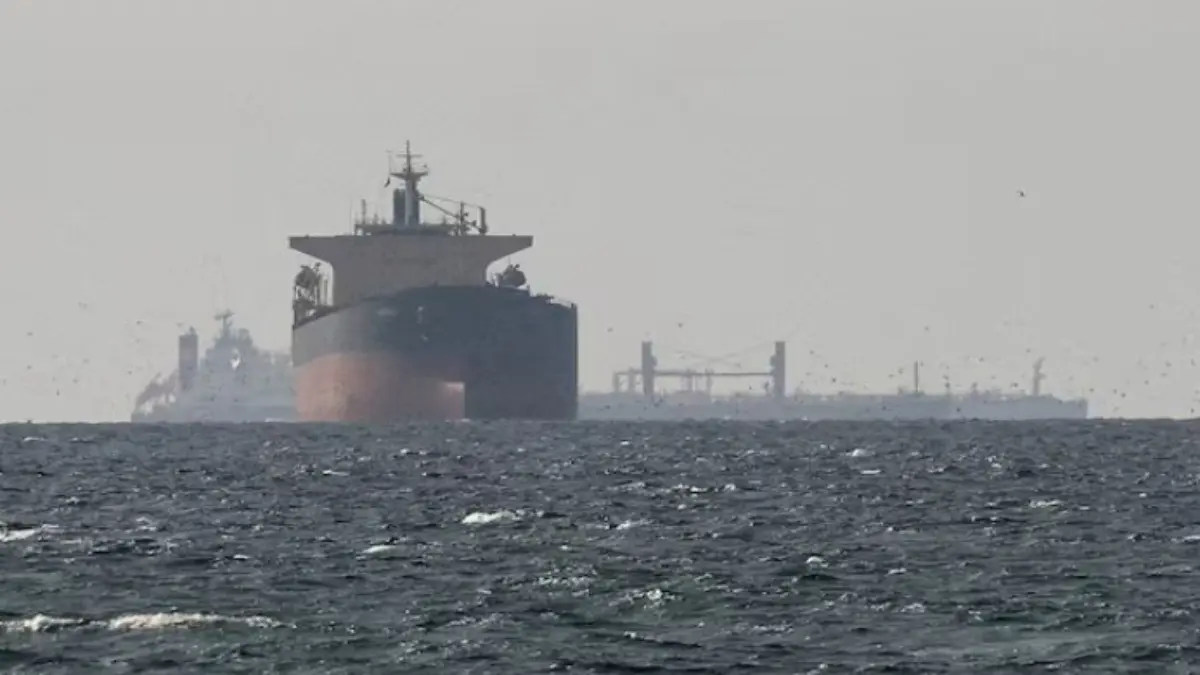
When Washington suspended its naval blockade of Iranian ports in mid-June, Tehran moved fast. According to a Wall Street Journal report published on 18 July, Iran shipped roughly 70 million barrels of crude during the pause, worth somewhere between $5 billion and $6 billion. From late June, about 20 Iranian tankers sailed east and gathered off the east coast of Malaysia. Named vessels include the Diona, the Hero II, the Sonia 1 and the Stream, which arrived on 13 July.
The timeline matters. The United States imposed the blockade on 13 April 2026, after the Islamabad talks failed. It lifted the blockade a day after the interim deal of 17 June, and reimposed it on 14 July once the truce collapsed and strikes resumed. That gap of roughly four weeks is the whole story.
The oil did not sail directly to China. Off Malaysia, tankers pump crude into other tankers at sea using large hoses. The cargo is then relabelled and carried on to Shandong province, where small private refineries known as "teapots" buy it cheap. These transfers break the paper trail, making it hard for American investigators to tie a specific barrel to a sanctioned seller.
The practical result is that Iran will keep collecting payments for months even though the blockade is back on. A Singapore-based analyst quoted by the Journal put it simply: if the blockade had stayed in place, Iran would be feeling the pain right about now. Instead, Tehran has bought itself a financial cushion.
Advertisement
Why China is the Only Buyer That Counts
Iran sells to China because there is almost nobody else. China takes close to 90 per cent of Iran's crude exports. European buyers left after 2018, and India has largely stayed away to protect its access to American banking.
Advertisement
That leaves the teapots: small private refiners with little exposure to the US financial system, which means US sanctions have limited bite. They pay in yuan, not dollars, through layers of middlemen, so the transaction never touches an American bank. Iran, in turn, gets paid in a currency it can spend on Chinese goods.
The cost is steep. Iranian crude has been selling at discounts of roughly $10 to $15 a barrel below Brent, and Iranian officials have publicly acknowledged the haircut. Add premiums for old tankers, insurance workarounds and middlemen, and Tehran keeps well below the headline figure. But a discounted barrel sold is better than a barrel stuck in storage, and oil remains the government's main source of hard currency. For China, the logic is equally plain. As the world's largest crude importer, it benefits from cheap sanctioned oil, and Beijing does not accept the legality of unilateral US sanctions anyway.
The Harder Question: What Flows Back
This is where the picture gets murky, and where care is needed. There is no public evidence of a formal barter arrangement; oil for weapons, signed and sealed. What exists instead is a pattern of parallel transactions that look mutually convenient.
The best-documented strand is chemical. Western intelligence services and shipping analysts have tracked repeated shipments of sodium perchlorate from Chinese ports to Iran. This chemical is converted into ammonium perchlorate, the oxidiser in solid rocket fuel. Roughly 1,000 tonnes arrived in early 2025, about 2,000 more from September 2025, and a further set of shipments on Iranian-owned vessels in early 2026, loading at Zhuhai. Non-proliferation experts estimate these volumes could fuel hundreds of ballistic missiles. Sodium perchlorate itself is not a controlled item; ammonium perchlorate is. That gap is what makes the trade possible.
Reuters reported in early 2026 that Iran was close to a deal for Chinese CM-302 supersonic anti-ship missiles, a weapon that would strengthen Iran's ability to threaten shipping in the Strait of Hormuz. Talks over HQ-9B air-defence batteries have also been reported. Neither transfer has been publicly confirmed as delivered.
The most consequential strand may be satellite support. A US Defense Department report noted that Chinese commercial satellite firms were doing business with the Revolutionary Guard as of August 2024. Reuters reported that Iran obtained a Chinese-made TEE-01B imaging satellite. Additionally, a Chinese geospatial company published detailed imagery of Prince Sultan Air Base in Saudi Arabia shortly before it was struck. On 8 May 2026, the State Department sanctioned three Chinese satellite companies, saying they had supplied imagery and data on American military activity. Iran also uses BeiDou, China's navigation system, which improves missile accuracy. Read together, the available evidence says that China supplies the "eyes" while Iran supplies the "fist." Chinese commercial imagery helps find targets; Iranian missiles and drones hit them.
Why it is Probably not a Simple Swap
Two cautions are worth keeping in mind.
First, nearly all of this runs through commercial companies rather than the Chinese state. That is deliberate. It gives Beijing deniability, and it makes the relationship hard to prove and harder to punish.
Second, China's interests are not identical to Iran's. Beijing imports far more oil from Saudi Arabia and the UAE than from Iran, and it has no interest in an Iranian collapse or a wider Gulf war that closes Hormuz permanently. What suits China is the current condition: a weakened Iran, dependent and cheap, that keeps American ships, aircraft and attention tied up in the Middle East rather than the Western Pacific. The conflict also serves as a live laboratory for watching how US air and naval defences perform.
So the quid pro quo is real but loose. Iran gets money, components and targeting help. China gets discounted energy, a strategic distraction for its main rival, and battlefield data, without ever signing anything.
That, more than the $6 billion, is the part worth watching.