
Nepal's New Tax on Indian Goods: A Blow to Bilateral Trade and the 'Roti-Beti' Rista
In protests across Bihar and Nepal's Terai, it is the women who have spoken most plainly. Many have said that the rule has turned the 'Roti-Beti ka rista' — the bond of bread and daughters, an expression that captures the deep, familial quality of India–Nepal ties — into something fragile and fraught.
- Opinion News
- 6 min read

;'%3e%3cpath%20d='m8,15.99c4.41,0,7.99-3.58,7.99-7.99S12.41,0,8,0,0,3.59,0,8s3.58,7.99,7.99,7.99Z'%20style='stroke:%23fff;%20stroke-miterlimit:10;%20stroke-width:.02px;'/%3e%3cpath%20d='m3.08,3.37l3.82,5.11-3.84,4.15h.87l3.37-3.64,2.72,3.64h2.94l-4.04-5.39,3.58-3.87h-.86l-3.1,3.35-2.5-3.35h-2.94Zm1.27.64h1.35l5.97,7.99h-1.35l-5.97-7.99Z'%20style='fill:%23fff;'/%3e%3c/g%3e%3c/svg%3e)


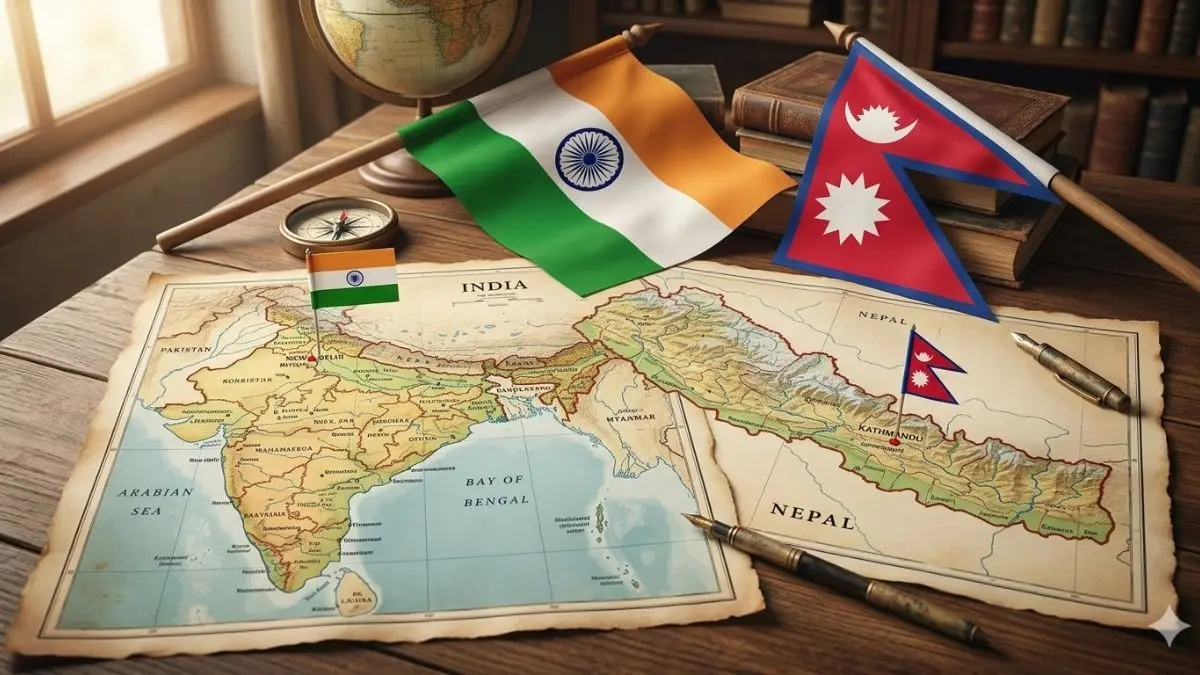
In April 2026, the Nepal government under Prime Minister Balendra "Balen" Shah began strictly enforcing a customs duty rule that has quietly upended the daily routines of millions living along the India–Nepal border.
Picture a Nepali homemaker who has crossed into Bihar every week for years, not for leisure, but to stretch her household budget a little further. A kilogram of lentils here, a packet of medicine there, perhaps a small bag of sugar. These are not luxuries. They are the small, unglamorous purchases that keep a family fed and healthy. Today, that same woman returns home lighter — not because she bought less, but because half her budget was consumed at the customs checkpoint. Any goods valued above NPR 100 (roughly ₹100) are now subject to mandatory customs duty, locally called *Bhansar*, with rates ranging from 5% to 80% depending on the category.
This is not a new law. It is a hard-line enforcement of an existing provision in Nepal's Customs Act, one that had long been overlooked for small-scale, everyday cross-border purchases. Staples such as pulses, sugar, salt, flour, vegetables, medicines, and packaged food — goods that border families have quietly depended on for generations — are now caught firmly in its net.
How it's enforced
At major border crossings like Raxaul–Birganj and Jogbani–Biratnagar, customs officers and Armed Police Force personnel now physically inspect bags and small consignments. Loudspeaker announcements and handwritten notices warn that goods worth more than NPR 100 will be taxed, with violators facing fines or seizure. The atmosphere at these once-bustling crossings has shifted, queues are longer, checks are more intrusive, and many Nepali shoppers have simply stopped coming.
Advertisement
Nearly 50 rural markets in Bihar have recorded a noticeable drop in sales since mid-April 2026. The timing could not be worse. April marks the wedding season, when demand for cereals, spices and dry goods normally surges and when border traders count on their busiest weeks of the year.
A long history of open-border trade
To understand why this policy stings so deeply, it helps to understand just how intertwined these two economies have become. Under the 1950 Treaty of Peace and Friendship, India and Nepal agreed to allow the free movement of goods and people, a provision that, over decades, evolved into something far more personal than a diplomatic clause. It became a way of life.
Advertisement
Nepali families, particularly in the Madhes belt along the southern plains, grew up shopping in Indian markets. Indian traders grew up counting on Nepali customers. This was not merely commerce, it was neighbourliness, conducted daily across an open border. Estimates suggest that 30–40% of Nepal's consumption of essential goods historically flowed through these informal, person-to-person channels.
Why the NPR 100 threshold hits hardest
The cruelty of the NPR 100 threshold lies in how ordinary the items it captures are. A 5 kg bag of sugar, a kilo of lentils, a bar of soap — each of these now attracts a duty of anywhere between 5% and 80%. For border households that once managed a reasonable shopping run on ₹200–₹500, the new regime makes the trip financially pointless. The money saved on cheaper Indian goods is now handed back at the checkpoint.
In protests across Bihar and Nepal's Terai, it is the women who have spoken most plainly. They are the ones who cross the border for groceries. They are the ones standing in longer queues, submitting to more intrusive checks, and returning home with less. Many have said that the rule has turned the "Roti-Beti ka rista" — the bond of bread and daughters, an expression that captures the deep, familial quality of India–Nepal ties — into something fragile and fraught.
Economic impact on both sides
India already supplies over 30% of Nepal's total imports. But formal trade figures do not capture the quiet economy that sustains life in the border belt. Thousands of rickshaw pullers, porters, kirana shopkeepers, tea stall owners and small vendors depend on Nepali footfall. In a typical 10 km stretch along the frontier, each Nepali buyer spending ₹300–₹1,000 supports two to three local livelihoods. When those buyers stop coming, those livelihoods begin to unravel.
The numbers are sobering. Daily footfall of Nepali shoppers has dropped 30–40% since mid-April. Shop turnover has fallen from ₹10,000–₹15,000 a day to ₹4,000–₹7,000, with some traders reporting entire days without a single sale. On the Nepali side, prices of Indian sugar and lentils in border districts like Siraha, Dhanusha and Morang have risen 10–15% in a single month. Transporter fees have climbed nearly 20% as inspection delays add hours to every consignment.
Political context and historical parallels
None of this is entirely new. In the 1990s and 2000s, Nepal periodically imposed non-tariff barriers on Indian goods during episodes of anti-India political sentiment — only to quietly reverse them when prices rose and communities protested. The pattern was predictable: economic pain eventually overcame political posturing.
What is different this time is the framing. The Balen Shah government has wrapped the customs crackdown in the language of "economic sovereignty," presenting it less as a revenue measure and more as a statement of national identity. Political commentators note that it conveniently consolidates nationalist support at home. It also coincides with Nepal's growing diplomatic engagement with non-Indian partners, suggesting that what looks like a customs dispute may carry deeper geopolitical undertones.
A call for a calibrated approach
There is a reasonable case for Nepal to review its customs framework. Protecting domestic industry and generating revenue are legitimate policy goals. But applying the same 5–80% duty to a bag of rice and a bottle of medicine as to imported electronics or luxury goods is not calibrated policy — it is a blunt instrument that lands hardest on those with the least.
Analysts and community leaders on both sides are calling for a tiered approach: exempt or minimally tax essential food and medicines, reserve higher duties for non-essentials and luxuries. Such a framework could achieve Nepal's stated economic objectives without tearing at the social fabric that generations of ordinary people have quietly woven together.
As protests simmer on both sides of the border, the real test for the Balen Shah government is not economic, it is human. Can it distinguish between asserting sovereignty and punishing the very people who have lived the Roti-Beti bond not as a political metaphor, but as daily life? The answer will determine whether India and Nepal's shared border continues to feel like a bridge or begins, for the first time in living memory, to feel like a wall.