
The Gen-Z Myth And The Cockroach Farce
S Gurumurthy dismisses the idea that political upheavals in Bangladesh and Nepal can be replicated in India. Tears down on the ‘Cockroach Janata Party’ as an opportunistic political toolkit attempting to hijack genuine student grievances to spark anarchy.
- Opinion News
- 12 min read

;'%3e%3cpath%20d='m8,15.99c4.41,0,7.99-3.58,7.99-7.99S12.41,0,8,0,0,3.59,0,8s3.58,7.99,7.99,7.99Z'%20style='stroke:%23fff;%20stroke-miterlimit:10;%20stroke-width:.02px;'/%3e%3cpath%20d='m3.08,3.37l3.82,5.11-3.84,4.15h.87l3.37-3.64,2.72,3.64h2.94l-4.04-5.39,3.58-3.87h-.86l-3.1,3.35-2.5-3.35h-2.94Zm1.27.64h1.35l5.97,7.99h-1.35l-5.97-7.99Z'%20style='fill:%23fff;'/%3e%3c/g%3e%3c/svg%3e)


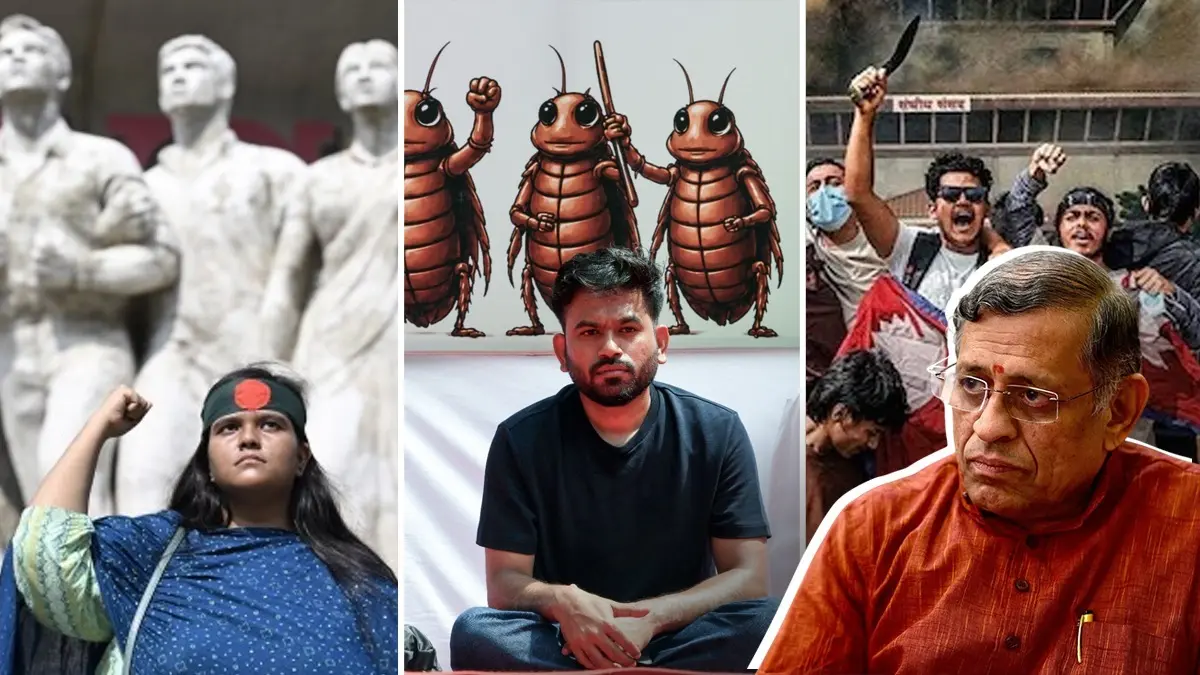
The Western-born term "Gen-Z" has gained immense popularity across various nations over the last few years. In our country, those who desperately long for anarchy and a regime change, similar to the youth-led political upheavals witnessed recently in Nepal and Bangladesh, have been aggressively popularizing this term, hoping to trigger a similar unrest here.
Last month, an outfit born abruptly on the internet called the Cockroach Janata Party (CJP) branded itself as the revolutionary voice of "Gen-Z." On June 6, they launched a protest at Delhi’s Jantar Mantar, the very site where Tamil Nadu farmers once protested wearing loincloths for a year.

In a previous caution published in Thuglak [26.6.2026], we explicitly noted that these "cockroaches" are merely acting as puppets of internal and external forces. We also promised our readers a detailed analysis of why the genuine Gen-Z of our nation cannot be instigated into unleashing anarchy.
Against this backdrop, Murasoli [25.6.2026] recently reported a warning from Udhayanidhi Stalin, stating that the DMK would not remain a silent spectator after a DMK Gen-Z meeting was allegedly attacked by TVK cadre. It is evident that the Western phrase "Gen-Z" has deeply penetrated Tamil Nadu’s political lexicon, even within the DMK. Therefore, we believe it is high time we demystify this fashionable buzzword, separating the Western Gen-Z, the Cockroach Gen-Z, and the DMK Gen-Z for our readers.
Advertisement
The Gen-Z ‘Anemoia’ Mindset
Let us first define what Gen-Z actually means. Western sociology categorizes modern society into three distinct generations based on technological evolution:
- Gen-X (Born 1965–1980): The generation that witnessed the rise of individual freedom.
- Gen-Y / Millennials (Born 1981–1996): The generation that saw the dawn of the internet era.
- Gen-Z (Born 1997 onwards): The modern "digital natives" who have never known a world without smartphones and social media.
Western research indicates that Gen-Z differs fundamentally from its predecessors. Surprisingly, numerous studies reveal that this smartphone-saturated generation is developing a deep fascination for the customs, cinema, music, and nostalgia of an era they never personally witnessed.
Advertisement
- A 2022 study by the music streaming platform Spotify revealed that today’s Gen-Z experiences a profound nostalgia for the 1980s.
- Data from Netflix shows that Gen-Z is heavily drawn to the youthful aesthetics of their parents' era, which belongs to the Gen-X generation, making tracks from that period immensely popular among modern teens
- Wikipedia lists extensive documentation proving that modern Gen-Z yearns for the past.
- Similarly, studies from Japan reveal that its youth are increasingly turning toward music, literature, and cinema from a century ago.
The consensus among sociologists is that the sheer stress of modern digital life drives them toward the comfort of antiquity, a longing that was severely intensified by pandemic-era isolations. Western sociologists call this psychological phenomenon "Anemoia", which means nostalgia for a time you’ve never known. Crucially, we must understand that this Western counter-culture represents a desire to embrace the old because they are fatigued by the new; it is not a radical movement to destroy tradition.
Islamist Revolution and American Design in the Name of Gen-Z
The 2024 Bangladesh uprising was globally hailed as a benchmark "Gen-Z Revolution." However, the current geopolitical consensus tells a completely different story.
Why? First, it was an engineered regime change orchestrated by the American CIA to depose the non-compliant Sheikh Hasina government. Second, the subsequent political landscape in Bangladesh completely shattered the myth of it being a progressive student movement.
While secular student unions may have lit the initial spark, well-organized Islamist student bodies swiftly hijacked the movement. Radical Islamic factions, such as the banned Jamaat-e-Islami, had long been operating covertly through these student fronts. Once they secured victories in student body elections, they systematically sidelined the genuine student idealists. Banned extremist outfits like Hizb-ut-Tahrir and Ansar-al-Islam took control, transforming a constitutional reform movement into an overtly fundamentalist Islamic uprising.
The hand of Washington, specifically the CIA, in this regime change is fully exposed. Even if one argues that the CIA did not birth the student movement, the moment Sheikh Hasina's stability wavered, the US seized the opportunity to eliminate a leader who refused to bow to its strategic interests. Artificial Intelligence data analyses indicate that the US aggressively deployed its diplomatic leverage, social media engineering, and financial muscle to install an interim government led by its Washington-vetted proxy, Dr. Muhammad Yunus. The fact that Dr. Yunus flew directly from the US to assume office clarifies exactly who engineered the transition.
This regime change was never organically designed by Gen-Z students. Instead, it was a long-planned geopolitical conspiracy that cleverly exploited Bangladesh’s internal crisis. Two major outcomes prove its Islamist mutation:
- During the transition, minority Hindus, including women and secular intellectuals, were systematically targeted, attacked, and murdered.
- In the subsequent elections held to replace the unpopular Yunus administration, it was not the student revolutionaries who triumphed, but the established right-wing Bangladesh Nationalist Party (BNP). Concurrently, the extremist Jamaat-e-Islami emerged as a major opposition force with 77 seats, marking its biggest electoral victory since the creation of Bangladesh in 1973. The ultimate yield of this "revolution" was the resurrection of radical forces that had been pushed into hiding for decades.
Nepal: A Mass Uprising, Not a Gen-Z Movement
In 2025, Nepal witnessed a massive civilian uprising where thousands of youth took to the streets, successfully unseating Prime Minister K.P. Sharma Oli. Though young people were at the forefront, the movement was heavily sustained and funded by millions of migrant Nepalese labourers working abroad.
AI-driven data analysis clarifies that this was an inclusive youth and civic uprising, rather than a strictly "Gen-Z" phenomenon. International media slapped the "Gen-Z" label onto it purely because the mobilization relied heavily on social media. In reality, the financial and emotional fuel came from overseas diaspora workers, and the vast majority of active participants were aged between 26 and 41. The online ecosystem that drove the agitation was a collective effort spanning multiple age groups, ranging from young entrepreneurs and professionals to retired elders. It was labeled a Gen-Z revolution merely because of its digital tactics, but the credit for toppling the government belongs to deep-seated public anger, foreign funding, and massive civilian mobilization.
The Great Gen-Z Fraud: The Cockroach Janata Party
Relying on the narrative that "Gen-Z revolutions" successfully altered regimes in Bangladesh and Nepal, left-liberal intellectuals and media houses in India began fantasizing about an identical youth uprising here. Since 2024, Rahul Gandhi has been openly instigating the youth to take to the streets. It is within this orchestrated ecosystem that the bizarre "Cockroach Movement" was manufactured.
On May 16, 2026, during a Supreme Court hearing regarding the appointment of senior advocates, the Chief Justice of India casually remarked that certain lawyers who abuse the RTI Act to target national institutions were acting like "cockroaches" and "social parasites." Following minor objections, the CJI clarified that his comments were strictly confined to unethical legal practitioners.
However, looking for an opportunity, digital media strategist Abhijit Dipke deliberately twisted the comment, claiming the CJI was insulting the entire unemployed youth population of India. Within 24 hours, Dipke launched an online entity named the Cockroach Janata Party (CJP).
Satirizing the ruling BJP, the CJP advertised itself as a platform for the "unemployed, the lazy, and internet lurkers." Dipke utilized advanced generative AI tools like Claude and ChatGPT to instantly churn out party manifestos and digital content.
The irony here is blatant: Abhijit Dipke himself, who was born before 1999 and is well over 30 years old, does not even belong to Gen-Z. He is a Western-educated political operative closely aligned with the Aam Aadmi Party (AAP). Employing standard digital "toolkit" tactics, he stitched together an assortment of fringe elements, notably bringing in hardline sympathizers of Umar Khalid, the activist jailed for instigating the 2020 Delhi riots.
Though advertised as an "apolitical" movement, established political forces rapidly co-opted the CJP. The CPI(M)’s youth wing, the Democratic Youth Federation of India (DYFI), began organizing "Cockroach Rallies." Soon, the Indian Youth Congress (IYC), representing a parent party that has lost nearly 100 elections in the last 12 years, extended its support under the moniker "IYC: Indian Youth Cockroaches." Mamata Banerjee’s recently defeated Trinamool Congress also jumped onto the bandwagon. What began with an apolitical veneer was exposed as a fraudulent front hijacking the "Gen-Z" brand to serve an alliance of opportunistic political parties and radical sympathizers.
The Cockroach Farce at Jantar Mantar
The CJP claimed an astronomical membership of 22 million on its portal. Left-leaning media houses and opposition parties began fueling panic, predicting that a Dhaka-style regime change was imminent in New Delhi. Seizing upon the controversial leak and subsequent cancellation of the NEET exam as a political opportunity, Dipke, operating from the safety of the United States, announced a massive "Gen-Z showdown" at Delhi’s Jantar Mantar on June 6, demanding the resignation of Union Education Minister Dharmendra Pradhan.
Dipke landed at Delhi airport on the morning of June 6, expecting an immediate arrest that would instantly grant him political martyrdom and spark nationwide chaos. Instead, he was met with a mundane reality check. When Delhi Police simply asked him to submit a formal letter seeking permission for the protest, he was visibly rattled. The police escorted him directly to Jantar Mantar to commence his highly publicized agitation.
Despite boasting millions of digital followers, Dipke had absolutely no ground-level preparation. Panicking at the empty venue, he desperately appealed to NEET students to join him, but they ignored him. He pleaded with Gen-Z youth, the general public, and even various farmer unions, yet no one turned up. It was a massive embarrassment for the political parties and domestic and international media outlets that had gathered expecting a historic revolution.
Out of the touted 22 million online members, barely a few hundred people gathered on the streets. Soon, the anti-NEET protest completely lost its stated narrative and devolved into a standard, generic anti-Modi, anti-Amit Shah, and anti-RSS rally.
Who were the actual participants? The gathering turned into a parade of niche lifestyle activists, non-binary individuals, and LGBTQ+ groups waving placards about gender identity. Dipke’s grand Gen-Z revolution was reduced to a farcical fashion show where the primary slogans shifted from academic grievances to personal statements on clothing and gender presentation.
As the days passed, public attendance plummeted to zero. Left with nothing but empty chairs, Dipke and his remaining cohorts resorted to playing casual cricket inside the Jantar Mantar complex to pass the time. Unable to bear the scorching Delhi summer heat, Dipke frequently retreated to his five-star hotel room, which reportedly led to internal friction and physical altercations among his own volunteers.
As I write this editorial, the protest has entered its 22nd day. The Delhi Police have shown absolutely no interest in arresting him or his associates, leaving Dipke stranded in a logistical nightmare, unable to sustain the gathering, yet unable to call it off without a complete loss of face. The grand "Gen-Z" uprising expected by opposition parties and hostile media stands thoroughly exposed as a digital hoax.
Understanding True Indian Gen-Z
Let us examine the reality of the young generation in India, erroneously viewed through a Western lens.
Unlike the West, Indian society is a continuum, a civilization where the ancient and the modern coexist seamlessly without sharp divisions. In this inherently spiritual land, the absorption of the new and the retention of the old is a natural, organic process. This explains why radical ideological experiments, from violent communist uprisings to the god-opposing Dravidian movements, have consistently failed to eradicate our foundational cultural ethos. India does not suffer from a black-and-white "Traditional vs. Modern" conflict. While our youth may adopt modern attire, language, and technology, their core spiritual identity remains deeply rooted.
The Western Gen-Z is a product of an atomized society. In developed nations, hyper-individualism and an absolute rejection of familial duties have shattered relationships, dissolved traditional families, and fragmented communities. This has resulted in isolated individuals and an unbridgeable generation gap devoid of cultural continuity.
In stark contrast, India is built on a relationship-centric, duty-conscious, and family-oriented social fabric where no such generational chasm exists. Our youth effortlessly integrate modernity while preserving antiquity, sustained entirely by the underlying spiritual consciousness of this nation. Recent data-driven AI studies explicitly validate this phenomenon.
The Spiritual Continuity of India’s Youth
Contrary to the Western thesis that economic growth, higher education, and rapid urbanization inevitably alienate the younger generation from tradition, India is witnessing the exact opposite. Youth participation in spiritual congregations and pilgrimages has reached unprecedented heights:
- The 2025 Maha Kumbh Mela: Out of the staggering 670 million pilgrims who participated, nearly 50% belonged to Gen-Z, meaning individuals under the age of 30.
- Kashi Vishwanath Dham: Approximately 80% of the 72 million annual devotees visiting the shrine are young Indians.
- Domestic Spiritual Tourism: Last year alone, domestic pilgrimage numbers touched a historic 1.43 billion, driven overwhelmingly by millions of young youths participating in the Kanwar Yatra in the North, the Palani Kavadi Yatra in the South, and the Pandharpur Wari in the West.
- Urban Cultural Trends: Recent consumer surveys indicate that the newly fashionable "Five-Star Bhajan/Kirtan" events see an active attendance of 39% urban Gen-Z and 24% rural youth.
For the modern Indian youth, a pilgrimage is not a passive retirement activity; it is a profound synthesis of adventure, cultural expression, social bonding, and mental well-being.
This is precisely why we can confidently assert that the genuine youth of our country cannot be manipulated into instigating lawlessness or anarchy. Abhijit Dipke’s spectacular failure on the streets of Delhi has definitively proven this truth. The vast majority of our Gen-Z generation is serious, aspirational, and deeply connected to the nation's roots. The few hundred individuals playing cricket and shouting vulgar political slogans at Jantar Mantar are nothing more than a microscopic, inconsequential aberration.