
Astronauts' Eyes And Brains Change In Space? NASA Study Reveals Why It Happens And How Long Effects May Last
Space travel may physically alter astronauts' eyes and brain, as NASA prepares for long missions to the Moon and Mars. Research on the International Space Station (ISS) focuses on microgravity's effects on vision, brain function, and cognition.
- Science News
- 3 min read

;'%3e%3cpath%20d='m8,15.99c4.41,0,7.99-3.58,7.99-7.99S12.41,0,8,0,0,3.59,0,8s3.58,7.99,7.99,7.99Z'%20style='stroke:%23fff;%20stroke-miterlimit:10;%20stroke-width:.02px;'/%3e%3cpath%20d='m3.08,3.37l3.82,5.11-3.84,4.15h.87l3.37-3.64,2.72,3.64h2.94l-4.04-5.39,3.58-3.87h-.86l-3.1,3.35-2.5-3.35h-2.94Zm1.27.64h1.35l5.97,7.99h-1.35l-5.97-7.99Z'%20style='fill:%23fff;'/%3e%3c/g%3e%3c/svg%3e)


New Delhi: Space travel doesn't just challenge the human body-it may physically alter the eyes and even shift the brain inside the skull.
As NASA prepares for long-duration missions to the Moon and Mars, scientists are intensifying efforts to understand how microgravity affects astronauts' vision, brain function and cognition.
The latest research aboard the International Space Station (ISS) is shedding light on why these changes occur and whether they persist after astronauts return to Earth.
During Expedition 73 aboard the ISS, crew members participated in a series of medical investigations under NASA's CIPHER (Complement of Integrated Protocols for Human Exploration Research) programme, a suite of 14 studies designed to understand how the human body adapts to spaceflight.
Advertisement
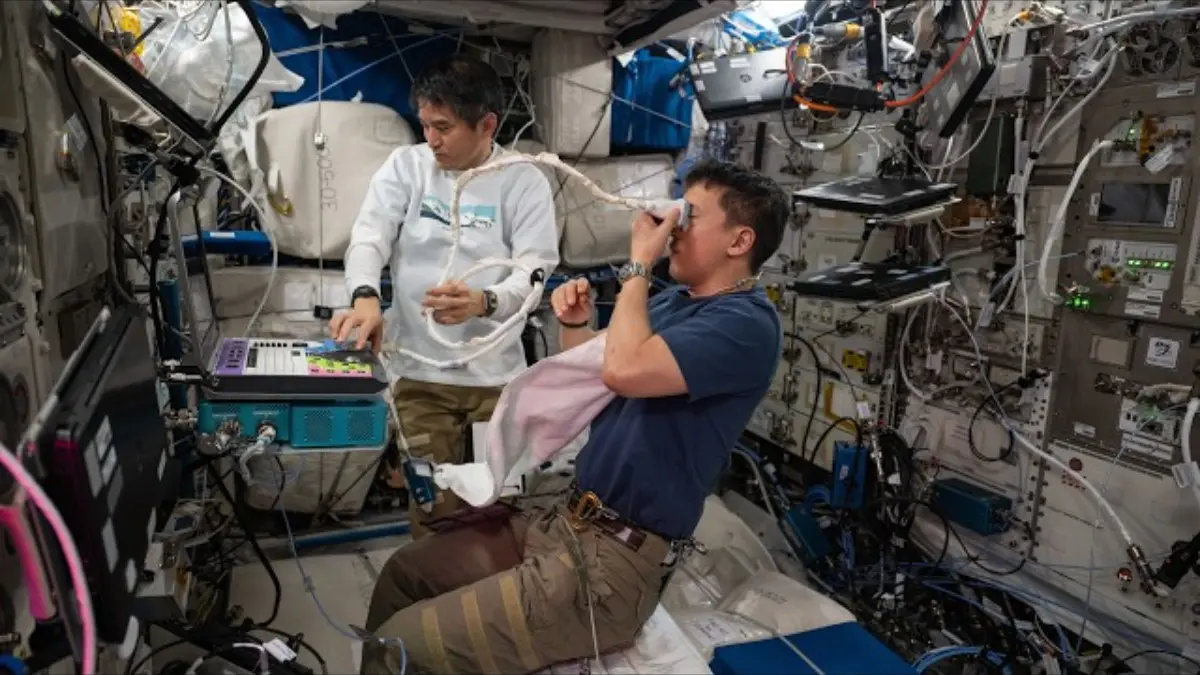
NASA astronauts Mike Fincke and Zena Cardman underwent specialised eye examinations to identify changes in eye anatomy and visual function caused by prolonged exposure to microgravity.
Using medical equipment connected to electrodes placed around the eyes and forehead, researchers measured how the retina responds to light, offering insights into how astronauts' vision adapts in space.
Advertisement
Another astronaut, Jonny Kim, took part in cognitive and balance assessments aimed at understanding how spaceflight influences memory, orientation and brain performance.
After providing blood and urine samples, Kim completed a series of computer-based spatial cognition tests that help scientists track changes in brain function during weightlessness. The findings could aid the development of advanced brain monitoring tools and cognitive tests for future deep-space crews.
The investigations build on growing evidence that spaceflight can trigger a condition known as Spaceflight Associated Neuro-ocular Syndrome, in which fluid shifts toward the head in microgravity affect both the eyes and brain.
According to NASA, chronic exposure to weightlessness can cause blood and cerebrospinal fluid to accumulate in the upper body, leading to swelling of the optic nerve, flattening of the back of the eye, folds in the retina and changes in brain structure. Scientists are still investigating how long these effects last after astronauts return home and whether they pose long-term health risks.
Recent studies have also found that astronauts' brains can physically shift upward and backward within the skull during extended missions, highlighting the profound effects of living without gravity.
NASA says understanding these changes is crucial as future explorers prepare for months-long journeys to the Moon under the Artemis program and eventually to Mars.
"By keeping an eye on the vision and brain health of spacefarers, NASA will be better equipped with the protocols needed to ensure humans are healthy on missions to the Moon, Mars and beyond," the agency said.
The research underscores a growing reality of human space exploration: reaching distant worlds will require not only advanced rockets and spacecraft, but also a deeper understanding of how space transforms the human body and mind.