
India Leads Green Energy Race, Commissions World's First Nuclear Heat-Based Hydrogen Production Plant
India has launched the world's first hydrogen production facility using nuclear reactor heat, located at the Indira Gandhi Centre for Atomic Research in Tamil Nadu. Inaugurated by Dr. Ajit Kumar Mohanty, the plant employs the Copper-Chlorine thermochemical cycle to produce hydrogen efficiently, bypassing electricity.
- Science News
- 3 min read

;'%3e%3cpath%20d='m8,15.99c4.41,0,7.99-3.58,7.99-7.99S12.41,0,8,0,0,3.59,0,8s3.58,7.99,7.99,7.99Z'%20style='stroke:%23fff;%20stroke-miterlimit:10;%20stroke-width:.02px;'/%3e%3cpath%20d='m3.08,3.37l3.82,5.11-3.84,4.15h.87l3.37-3.64,2.72,3.64h2.94l-4.04-5.39,3.58-3.87h-.86l-3.1,3.35-2.5-3.35h-2.94Zm1.27.64h1.35l5.97,7.99h-1.35l-5.97-7.99Z'%20style='fill:%23fff;'/%3e%3c/g%3e%3c/svg%3e)


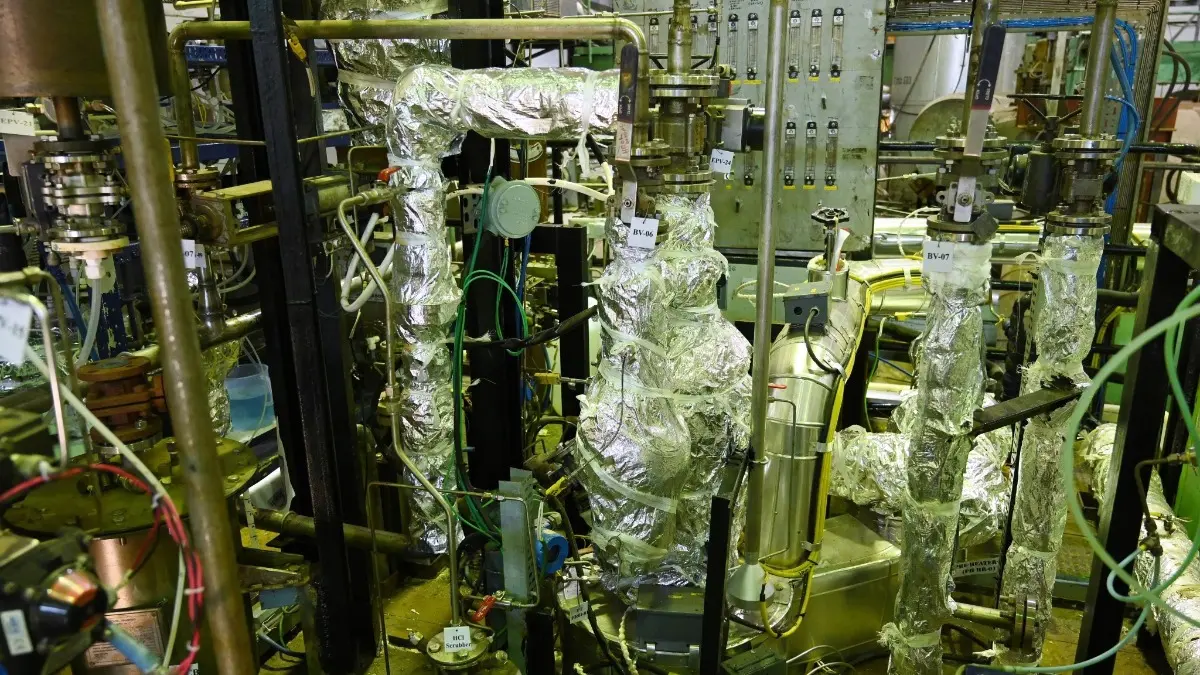
New Delhi: In a landmark breakthrough for clean energy and nuclear technology, India has commissioned the world's first hydrogen production facility that uses nuclear reactor heat instead of electricity to generate hydrogen.
The pioneering plant has been set up at the Indira Gandhi Centre for Atomic Research (IGCAR) in Kalpakkam, Tamil Nadu, marking a major milestone in the country's push towards carbon-free energy and green hydrogen production.
The facility was inaugurated by Department of Atomic Energy (DAE) Secretary and Atomic Energy Commission Chairman Dr. Ajit Kumar Mohanty on June 26.
Developed jointly by the Bhabha Atomic Research Centre (BARC), Mumbai, and IGCAR, the plant is designed as a technology demonstrator to validate hydrogen production using the indigenously developed Copper-Chlorine (Cu-Cl) thermochemical cycle.
Advertisement
Unlike conventional hydrogen production, which relies heavily on electricity for electrolysis, the new facility harnesses high-temperature process heat generated by the Fast Breeder Test Reactor (FBTR) to split water and produce hydrogen.
Scientists say bypassing electricity in favour of direct nuclear heat can improve efficiency and pave the way for large-scale, round-the-clock production of low-carbon hydrogen.
Advertisement
Addressing the inauguration ceremony, Dr. Mohanty said integrating nuclear energy with emerging clean-energy technologies such as hydrogen production offers a strategic pathway towards a sustainable future.
He noted that nuclear power's ability to provide reliable, carbon-free energy makes it ideally suited for large-scale hydrogen production while strengthening India's energy security, decarbonisation goals and long-term sustainable development.
The Department of Atomic Energy said the commissioning of the facility is the culmination of years of research, engineering design, fabrication, installation and testing carried out jointly by BARC and IGCAR. It also showcases India's growing expertise in advanced nuclear technologies and demonstrates the potential of using nuclear energy beyond electricity generation.
Officials said the project strengthens India's three-stage nuclear programme by expanding the role of nuclear reactors into clean hydrogen production.
Hydrogen produced through this technology could play a crucial role in decarbonising sectors such as fertilisers, refining, steel manufacturing and heavy transport while reducing dependence on fossil fuels.
The achievement places India at the forefront of next-generation hydrogen technologies and reinforces its ambition to become a global leader in clean energy innovation. The successful demonstration at Kalpakkam could eventually enable advanced nuclear reactors to produce both electricity and carbon-free hydrogen, accelerating India's transition towards a low-emission economy.