
Into the Blue: How Agnikul Cosmos Aims to Conquer India's First-Ever Ocean Booster Recovery
Indian space startup Agnikul Cosmos targets a historic milestone with Mission-02, aiming to achieve the nation's first-ever ocean recovery of an orbital-class rocket booster for sustainable spaceflight.
- Science News
- 5 min read

;'%3e%3cpath%20d='m8,15.99c4.41,0,7.99-3.58,7.99-7.99S12.41,0,8,0,0,3.59,0,8s3.58,7.99,7.99,7.99Z'%20style='stroke:%23fff;%20stroke-miterlimit:10;%20stroke-width:.02px;'/%3e%3cpath%20d='m3.08,3.37l3.82,5.11-3.84,4.15h.87l3.37-3.64,2.72,3.64h2.94l-4.04-5.39,3.58-3.87h-.86l-3.1,3.35-2.5-3.35h-2.94Zm1.27.64h1.35l5.97,7.99h-1.35l-5.97-7.99Z'%20style='fill:%23fff;'/%3e%3c/g%3e%3c/svg%3e)


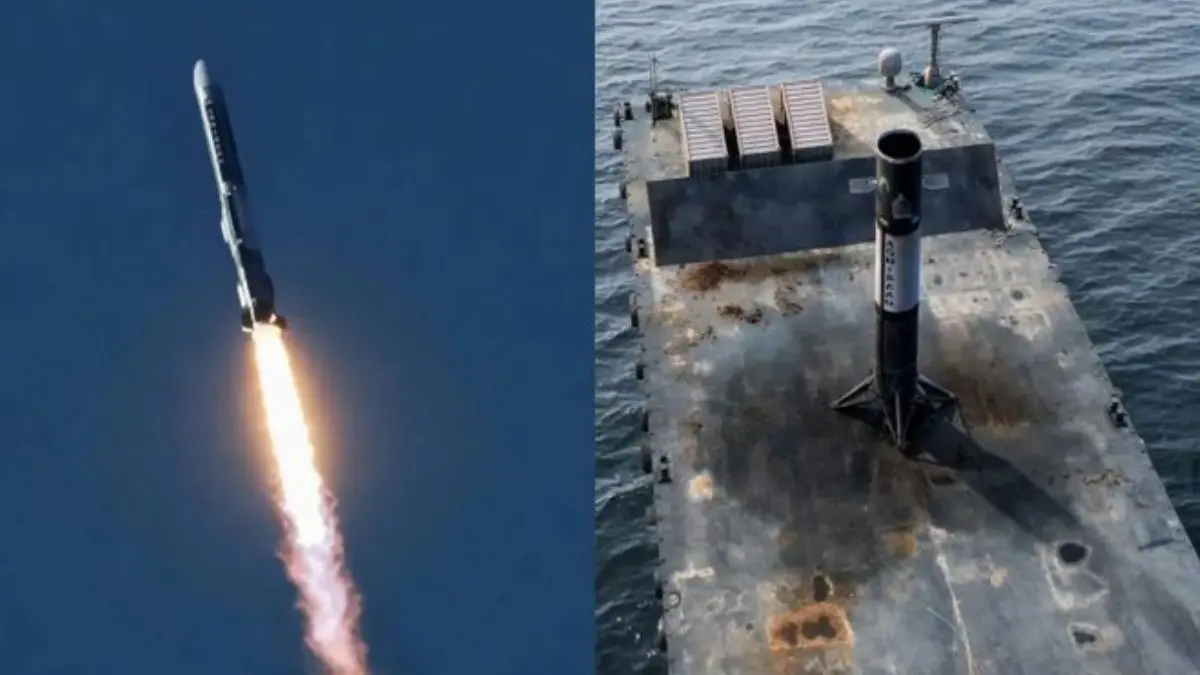
easy, Chennai-based space startup Agnikul Cosmos has announced its most ambitious project to date: Mission-02. The mission aims to achieve India's first-ever recovery of an orbital-class rocket booster, marking a giant leap toward reusable launch vehicles and low-cost access to space.
This milestone announcement follows closely on the heels of China’s successful recovery of a reusable rocket booster, underscoring an accelerating global race. Industry giants like SpaceX, Blue Origin, and Rocket Lab are pouring massive investments into reusability. SpaceX has led this revolution with its Falcon 9, flying recovered boosters over 650 times, with individual boosters completing up to 35 missions. This capability has rewritten the rules of the market, turning reusability from a mere differentiator into an absolute prerequisite. Agnikul now intends to bring this game-changing capability to India.
Mission-02: Changing the Launch Equation
The upcoming flight will feature a two-stage Agnibaan rocket configuration. Upon stage separation, the first-stage booster will attempt a controlled descent and an ocean recovery. However, Agnikul's ambitions extend well after the booster dies.
Instead of allowing the upper stage to burn up as space debris, Mission-02 will attempt to transform it into a functional, in-orbit platform. Supported by patents held in India, the US, and Europe, this convertible architecture allows spent hardware to host experiments, test technologies, and support future space infrastructure.
Advertisement
"One-time-use rockets were originally developed when reaching space was about accomplishing one-off goals," said Srinath Ravichandran, Co-founder and CEO of Agnikul Cosmos. "For economically viable, frequently flyable missions, the philosophy is about rapid reuse, complete flexibility and modularity. This is what our Mission-02 will demonstrate."
ISRO Veteran S. Somanath Joins Agnikul
To navigate these deep-tech complexities, Agnikul has appointed former Indian Space Research Organisation (ISRO) Chairman Dr. S. Somanath as an Observer on its Board of Directors. Dr. Somanath’s legendary tenure at ISRO included overseeing landmark programmes such as the LVM3, Chandrayaan-3, Aditya-L1, SSLV, and critical Gaganyaan test missions.
Advertisement
"To have Dr. Somanath guide us on strategy and execution at the Board level is a true blessing," Ravichandran noted. "Somanath's career is, in many ways, the story of Indian rocketry. Having him as an observer on our board as we attempt Mission 02 means we have, at the table, someone who has personally navigated the complexity of booster design, stage recovery and on-orbit operations at the highest level. For us, this is not a ceremonial appointment -- it is a serious working relationship at a serious moment."
Co-founder and COO Moin SPM emphasized the engineering rigor required for the flight:
"What Mission 02 demands from us is a step change in engineering discipline. Booster recovery requires precision at every layer -- propulsion, guidance, structures and avionics -- and the upper-stage extension pushes us into territory that few teams globally have operated in," Moin SPM said. "We have spent the last year hardening every one of these subsystems. Our Agnite booster engine, validated earlier this year, produces thrust at a scale that makes recovery trajectories tractable. Somanath's experience in exactly these kinds of multi-system integration challenges will be invaluable."
Dr. S Somanath shared his perspective on joining the strategic startup:
"I have watched Agnikul from close quarters for some time, and what strikes me most is not just the ambition of what they are attempting, but the quality of the engineering thinking behind it," S Somanath stated. "Mission 02 is a genuine technical frontier, for India and, in several respects, for the world. The convertible upper-stage concept, combined with indigenous semi-cryogenic propulsion and a 3D-printed engine that can be produced in days, is a coherent and defensible technical strategy. I am proud to support this team as they take this next step."
From Sriharikota to Nice: Global Credibility
Agnikul's domestic engineering strides are matching its international commercial expansion. The startup was recently featured among 120 deep-tech firms at Bharat Innovates 2026 in Nice, France, organized as part of the India-France Year of Innovation.
During the showcase, Ravichandran presented the Agnibaan rocket directly to French President Emmanuel Macron. The company also signed crucial memoranda of understanding (MoUs) facilitated via IITM Global with Finland’s ICEYE (a leader in SAR satellite imaging) and France’s Safran (an aerospace propulsion giant). Together, these partnerships hold a projected commercial and technological value of nearly $100 million, solidifying India’s status as a serious global space superpower.
Skyroot’s Vikram-1 Makes History with 'Aaraman'
Agnikul’s reusability push arrives amidst a massive wave of momentum for India’s private space sector. On a clear Saturday afternoon at the Sriharikota launch pad, initial anxiety and nervousness quickly gave way to excitement and euphoria.
Despite a brief, tension-filled "planned hold" called by mission control just minutes before the scheduled 11:30 AM liftoff, the clock struck 12:05:30 PM and Skyroot Aerospace’s Vikram-1 rocket soared into the sky. It became the first privately developed Indian rocket to attempt an orbital mission.
At 12:21 PM, history was officially made. The payload safely injected into its designated 450 km orbit at a 60-degree inclination. The mission control commentators proudly announced: "Hello, space. We have arrived."
Dubbed 'Aagaman', the successful flight marks the definitive arrival of India’s private sector in the global commercial launch market, placing Hyderabad-based Skyroot within an elite group of global entities.
The seven-story-tall Vikram-1 orbital vehicle features an all-carbon composite structure. It is powered by entirely proprietary propulsion systems, utilizing high-thrust solid-fuel boosters and cutting-edge 3D-printed engines designed to transport small satellites up to 350 kg to Low Earth Orbit (LEO). For its maiden flight, Vikram-1 carried technology demonstrators from Grahaa Space, Cosmoserve, DCubed, and Skyroot’s own SCOPE. The cargo also featured unique cultural items: Cosmos Diamonds' artwork "Cosmic Bloom" and a micro-art installation showcasing micro-sculptures of Sir CV Raman, Dr. Vikram Sarabhai, and Dr. APJ Abdul Kalam.
Through Skyroot's flawless orbital deployment and Agnikul’s impending reusability milestones, private enterprises are stepping up to lead the breakthroughs defining the future of global space transportation.