
Science Behind Caracas’s 'Candilazo': Why The Sky Turned Eerie Red After Deadly Earthquakes?
Following the deadly earthquakes, residents of Caracas witnessed an unusual red glow in the sky, a phenomenon popularly referred to as Candilazo. Scientists believe such events may be linked to a combination of atmospheric conditions, suspended dust and particles, sunlight scattering, and, in some cases, earthquake-related luminous phenomena.
- Science News
- 3 min read

;'%3e%3cpath%20d='m8,15.99c4.41,0,7.99-3.58,7.99-7.99S12.41,0,8,0,0,3.59,0,8s3.58,7.99,7.99,7.99Z'%20style='stroke:%23fff;%20stroke-miterlimit:10;%20stroke-width:.02px;'/%3e%3cpath%20d='m3.08,3.37l3.82,5.11-3.84,4.15h.87l3.37-3.64,2.72,3.64h2.94l-4.04-5.39,3.58-3.87h-.86l-3.1,3.35-2.5-3.35h-2.94Zm1.27.64h1.35l5.97,7.99h-1.35l-5.97-7.99Z'%20style='fill:%23fff;'/%3e%3c/g%3e%3c/svg%3e)


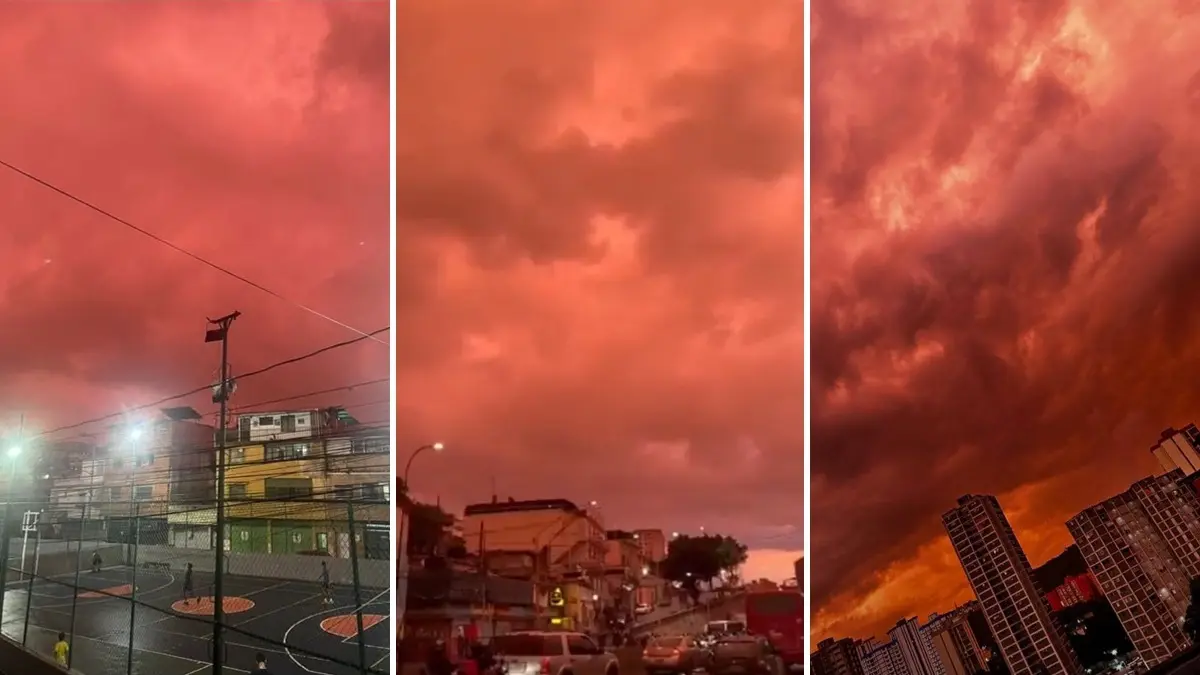
Venezuela: Dramatic footage of an intense, crimson-red sky over Caracas has gone viral across social media, mesmerising viewers but also sparking a wave of online misinformation.
Locally referred to as a "candilazo," the vivid atmospheric event has captured global attention just days after a devastating series of earthquakes struck Venezuela on June 24, leaving nearly 2,000 people dead.
As images of the blood-red horizon circulated, online conspiracy theorists quickly began exploiting the tragedy, claiming the unusual glow was the signature of secret directed-energy weapons or geophysical warfare.
However, scientists and meteorologists have swiftly debunked these rumours, pointing out that the phenomenon is driven entirely by sunlight, dust, and physics.
Advertisement
What is a “Candilazo”?
A candilazo is a well-documented optical phenomenon that occurs naturally during sunrise or sunset.
When the sun is low on the horizon, sunlight must pass through a much thicker layer of the Earth's atmosphere to reach our eyes.
Advertisement
This process triggers Rayleigh scattering, where shorter wavelengths of light are scattered by air molecules, allowing longer wavelengths (like red and orange) to dominate the sky.
The reason the skies over Caracas have looked exceptionally brilliant and eerie in recent days is directly tied to the disaster's aftermath.
The powerful earthquakes collapsed hundreds of buildings across the region, pulverising concrete and throwing massive plumes of fine dust into the air.
This dense layer of suspended particulate matter acts as a massive filter, dramatically intensifying the scattering process and shifting the dusk horizon into a deep, fiery red.
Posts on various digital platforms have falsely blamed the High Frequency Active Auroral Research Program (HAARP), a frequent scapegoat for natural disasters, for triggering earthquakes and illuminating the sky.
Experts remind the public that HAARP is a high-altitude ionospheric research facility based in Alaska. It lacks the physical capability to interact with tectonic plates or generate earthquakes.
Furthermore, while rare luminous phenomena known as earthquake lights can naturally occur near seismic rifts due to sudden friction and tectonic stress, they are a geological event, not the work of a weapon.
Ultimately, the phenomenon over Caracas is a stark visual reminder of the heavy dust and physical disruption left behind by a catastrophic natural disaster.
Spreading unfounded weaponisation theories only misleads the public and exploits a grieving population during a severe humanitarian crisis.